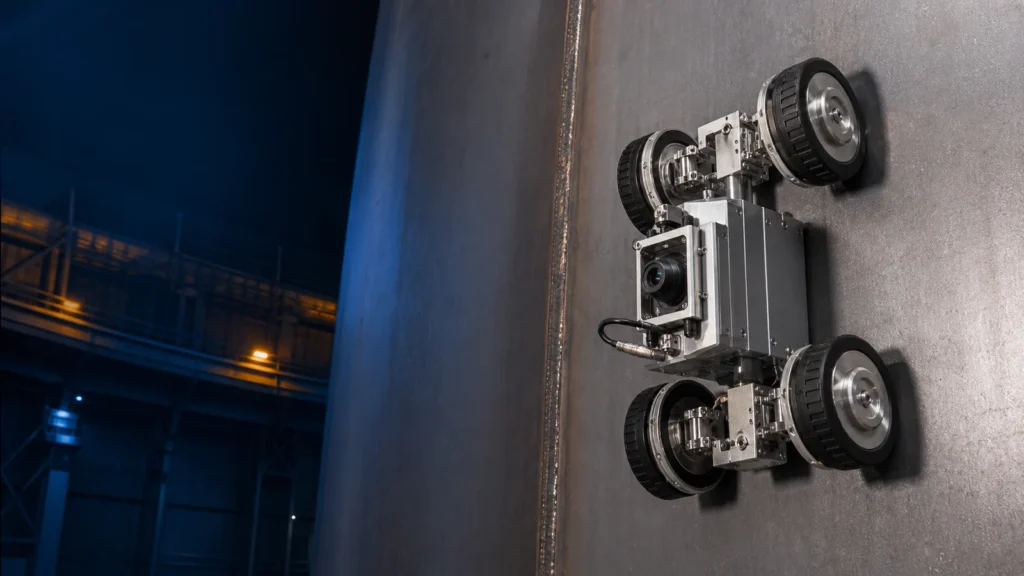
Steel tanks, ship hulls, bridges, wind towers, pressure vessels, and pipelines require regular inspection, yet many surfaces are vertical, curved, confined, or hazardous for people. A magnetic wheel allows a mobile robot to use the same component for adhesion and locomotion, creating a compact platform that can carry cameras, ultrasonic probes, eddy-current sensors, cleaning tools, or coating instruments.
The concept looks simple: put magnets in a wheel and drive it across steel. In practice, the wheel must balance adhesion, rolling resistance, traction, payload, detachment force, obstacle clearance, curvature, corrosion protection, and safe failure behavior. A wheel optimized only for maximum pull force may create a robot that cannot turn efficiently or cross a weld seam.
Design principle: The target is not maximum magnetic force. It is controlled, repeatable adhesion with enough traction and mobility for the complete robot and surface.
How Magnetic Wheels Create Adhesion
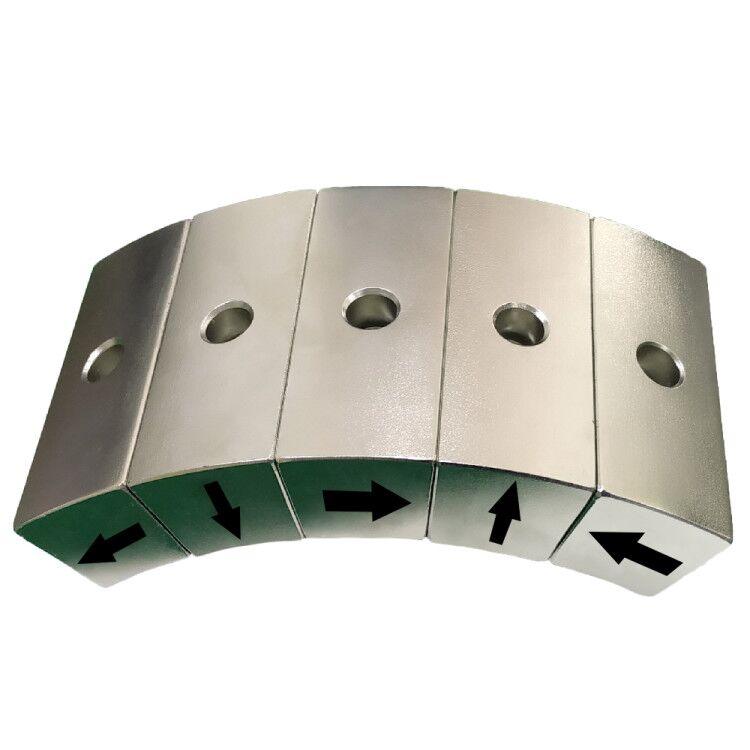
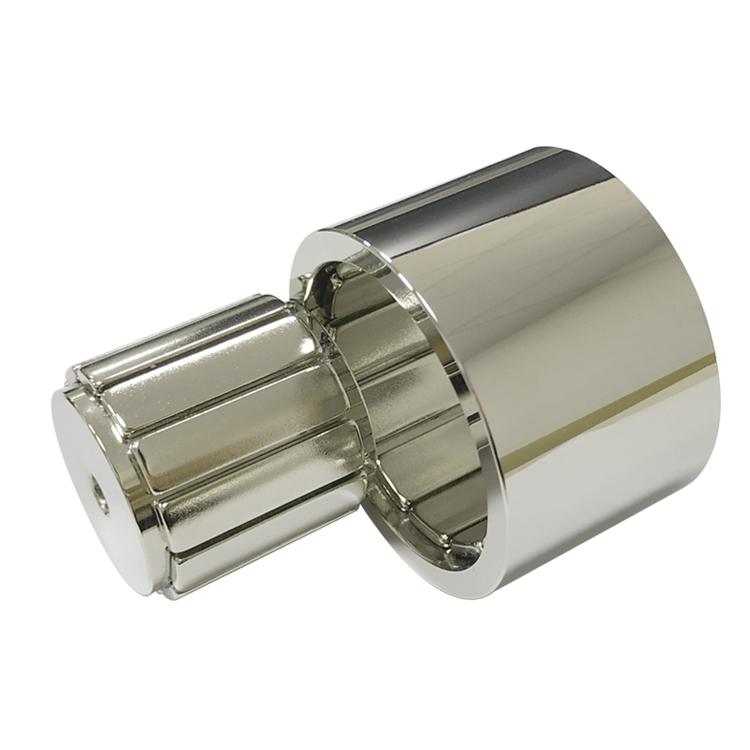
A typical magnetic wheel uses permanent magnets, soft-magnetic steel flux concentrators, a hub, bearings, and an outer traction layer. The magnetic circuit directs flux from the magnet through the wheel pole pieces, across the small working gap, into the steel surface, and back to the opposite pole.
Steel rings or pole shoes can increase useful flux at the contact area, while a rubber or polyurethane tread protects the assembly and provides friction. The tread also creates an air gap, so its thickness and compression behavior directly affect adhesion. The wheel is therefore a magnetic circuit and a mechanical tire at the same time.
Where Magnetic Wheel Robots Are Used
Storage Tanks and Pressure Vessels
Robots can carry visual, ultrasonic thickness, or coating sensors across vertical shells. A curved surface requires the wheel and chassis to maintain contact without transferring excessive load to one corner.
Bridges and Structural Steel
Magnetic-wheel platforms can inspect welds, joints, fatigue-prone details, and corrosion areas while reducing the need for scaffolding or rope access. Research on steel-bridge climbing robots shows that compact magnetic wheel units can combine relatively high adhesion with a simple mechanical architecture, but bolts, steps, concave corners, and convex corners still drive the chassis design.
Ship Hulls and Offshore Structures
Magnetic adhesion can support cleaning, coating inspection, and nondestructive testing on large ferromagnetic surfaces. Saltwater, coating thickness, surface contamination, and cable management must be included in the design.
Pipelines and Cylindrical Assets
External pipe inspection requires the wheel contact geometry to match a range of diameters. Small pipes increase curvature and can reduce the effective pole contact area. Internal inspection introduces additional constraints for size, debris, and recovery.
Wind Towers and Industrial Equipment
Robots can carry cameras or sensors over steel towers and large machinery where repeatable inspection routes improve data quality. Permanent-magnet adhesion consumes no electrical power simply to remain attached, which can preserve battery capacity for movement, sensing, and communications.
Eight Design Inputs That Determine Wheel Performance
1. Required Adhesion Force
Calculate the worst-case load at every robot orientation. Include robot mass, payload, cable or hose forces, acceleration, vibration, and the possibility that one wheel temporarily loses contact. Apply a safety factor that matches the consequence of detachment and the uncertainty of the surface.
2. Load Direction and Traction
On a vertical wall, magnetic attraction acts normal to the surface while gravity creates a shear load. The available climbing force is limited by tire friction as well as magnetic adhesion. Tread material, contamination, water, oil, and surface coating all affect the friction coefficient.
3. Working Air Gap
The effective gap includes tread thickness, paint, coating, rust scale, debris, curvature, and mechanical runout. Because magnetic attraction falls quickly as the gap increases, testing only on clean bare steel can overstate field performance.
4. Steel Thickness and Magnetic Properties
Thin steel can saturate and reduce the return flux available to the wheel. Different structures may also use steels with different magnetic behavior. The validation coupon should represent the minimum expected thickness and surface condition.
5. Wheel Diameter and Curvature
A larger wheel may cross obstacles more easily but increases torque and packaging requirements. A smaller wheel can fit compact robots but may struggle with weld beads and surface transitions. For curved structures, the pole layout and tread compliance must preserve an acceptable gap.
6. Turning and Detachment Torque
Strong adhesion increases bearing load, rolling resistance, steering effort, and the energy required to peel a wheel away at an edge. Differential-drive robots may scrub the tires during turning. The magnetic circuit should be optimized for the intended maneuver, not only for static pull.
7. Temperature and Corrosion Protection
NdFeB grade selection must consider the actual magnet temperature, not only ambient temperature. The housing, coating, seals, and tread should protect the magnets from moisture, salt, impact, and wear. Damaged coating can allow corrosion to propagate under the surface.
8. Assembly Tolerance and Serviceability
Magnet position, pole orientation, steel-ring dimensions, tread concentricity, and bearing alignment affect force distribution and vibration. A modular wheel can simplify replacement, but fasteners and access points must be designed so technicians can work safely around strong magnetic attraction.
Why Magnetic Simulation and Physical Testing Both Matter
Finite-element analysis can compare magnet geometry, pole pieces, steel saturation, and air-gap sensitivity before tooling. Mechanical analysis can estimate bearing load, shaft torque, contact pressure, and chassis stability. Neither model fully captures real coating roughness, tread deformation, debris, misalignment, or dynamic impacts.
A strong validation plan therefore uses staged testing:
- Magnetic circuit simulation at nominal and worst-case gaps
- Single-wheel pull, shear, rolling-resistance, and torque tests
- Wheel testing on representative steel thicknesses, coatings, curvature, and contamination
- Robot testing in vertical, inverted, and transition orientations
- Payload, obstacle, endurance, temperature, and controlled-failure testing
Published robot studies reinforce this system-level approach. Steel-bridge research has demonstrated magnetic-wheel robots crossing complex obstacles, while experimental comparisons show that hub and flux-path choices can materially change adhesion-to-weight performance. Sumitomo Heavy Industries has also demonstrated a spherical magnetic-wheel concept intended to adapt to curved steel walls, illustrating how surface geometry can drive a fundamentally different wheel architecture.
Custom Magnetic Wheels From Concept to Production
A production magnetic wheel often combines custom NdFeB segments, machined steel flux concentrators, hubs, shafts, bearings, elastomer tread, adhesives, fasteners, and inspection fixtures. The best time to optimize the magnetic circuit is before the final wheel diameter and motor torque are frozen.
Guande Magnet develops magnetic assemblies, custom magnetic tools, and engineered magnetic solutions. Our engineering process can translate target payload, steel geometry, air gap, temperature, and packaging constraints into magnet selection, flux-path design, prototype hardware, and production inspection. Explore additional magnet applications or send your robot and surface requirements for a design review.
Frequently Asked Questions
Do magnetic wheels work on stainless steel?
Only on ferromagnetic stainless grades and structures with a suitable magnetic return path. Austenitic stainless steels are generally not suitable. Always test the actual material and thickness.
Can a magnetic wheel climb a painted steel surface?
Yes, if the design allows for the coating thickness, roughness, and friction. Paint creates an air gap, so adhesion should be validated on the real coating system.
Are permanent magnetic wheels safer than electromagnets?
Permanent magnets maintain adhesion without electrical power, which can be valuable during a power loss. They also require a mechanical strategy for controlled detachment and safe handling. The overall safety depends on the complete system.
What information is needed to design a magnetic wheel?
Provide robot mass, payload, wheel count, surface orientation, steel grade and thickness, coating, curvature, maximum gap, obstacles, speed, drive torque, temperature, environment, allowable wheel dimensions, and safety factor.