Choosing a neodymium magnet by asking for the highest available N number is tempting, but it is rarely a complete engineering decision. An N52 magnet can provide more magnetic output per unit volume than an N35 magnet at room temperature, yet a lower-energy, higher-coercivity grade may be more reliable in a hot motor, a thin section, or a circuit exposed to an opposing field.
The right way to choose an NdFeB magnet grade is to start with the application: the field or force required at the working gap, the magnet’s actual temperature, its geometry, the surrounding steel, the demagnetizing load, and the acceptable cost. The grade label narrows the material options; the complete magnetic circuit determines whether the design works.
Quick answer: Select the lowest-cost grade that meets the required magnetic performance with adequate coercivity and temperature margin in the worst-case assembly. Then validate the finished part or assembly under representative conditions.
What an NdFeB Grade Name Actually Means
A common sintered neodymium grade contains a number and may include a suffix. In a label such as N42SH, the number identifies an approximate maximum-energy-product family, while the suffix identifies a higher intrinsic-coercivity family. These two parts answer different questions.
- The number: N35, N42, N48, N52 and similar grades indicate the approximate maximum energy product, commonly expressed in MGOe. A higher number usually allows more magnetic output from the same volume at room temperature.
- The suffix: M, H, SH, UH, EH and AH families generally provide increasing resistance to irreversible demagnetization and support higher application temperatures, often with some trade-off in remanence, cost, or material availability.
Published grade tables are useful for comparison, but suffix limits are not universal guarantees. Arnold Magnetic Technologies, for example, lists its standard grades with maximum-use temperatures that progress from roughly 80°C for many unsuffixed grades to 100°C for M, 120°C for H, 150°C for SH, 180°C for UH, 200°C for EH, and 220°C for AH families. The same table also shows that N52 in its standard range has a lower listed maximum temperature than N35. Always use the selected supplier’s data sheet and confirm the actual magnet operating point.
If you first need a general explanation of grade terminology, read Understanding Magnet Grades: From N35 to N52 and Beyond. The guide below focuses on applying that terminology to a real product.
Seven Factors That Determine the Right Grade
1. Define the Required Output at the Working Point
Do not begin with a material label. Begin with the function: holding force, air-gap flux density, sensor activation distance, torque, back-EMF, or magnetic coupling torque. State where the performance is required and how it will be measured.
Peak surface gauss is not a substitute for usable force or flux at distance. Air gaps, steel saturation, pole area, and leakage can make two magnets with similar surface readings perform very differently. Our guide to gauss versus pull force explains how to select the correct acceptance metric.
2. Use the Magnet’s Actual Temperature, Not Ambient Temperature
A magnet inside a motor, enclosure, brake, pump, or vehicle can run substantially hotter than the surrounding air. Include the continuous operating temperature, expected peak temperature, peak duration, and any manufacturing exposure such as adhesive curing, overmolding, coating bake, welding, or sterilization.
NdFeB output decreases reversibly as temperature rises. If the operating point crosses the knee of the demagnetization curve, part of the loss can become irreversible. A higher-coercivity suffix creates more resistance to this failure mode, but it does not remove the need to evaluate the geometry and magnetic circuit.
3. Check Demagnetizing Fields and the Load Line
Opposing fields can come from motor windings, adjacent magnets, a repelling magnet pair, or a magnetizing and calibration process. The risk depends on intrinsic coercivity, temperature, magnet dimensions, magnetization direction, and the permeance coefficient of the circuit.
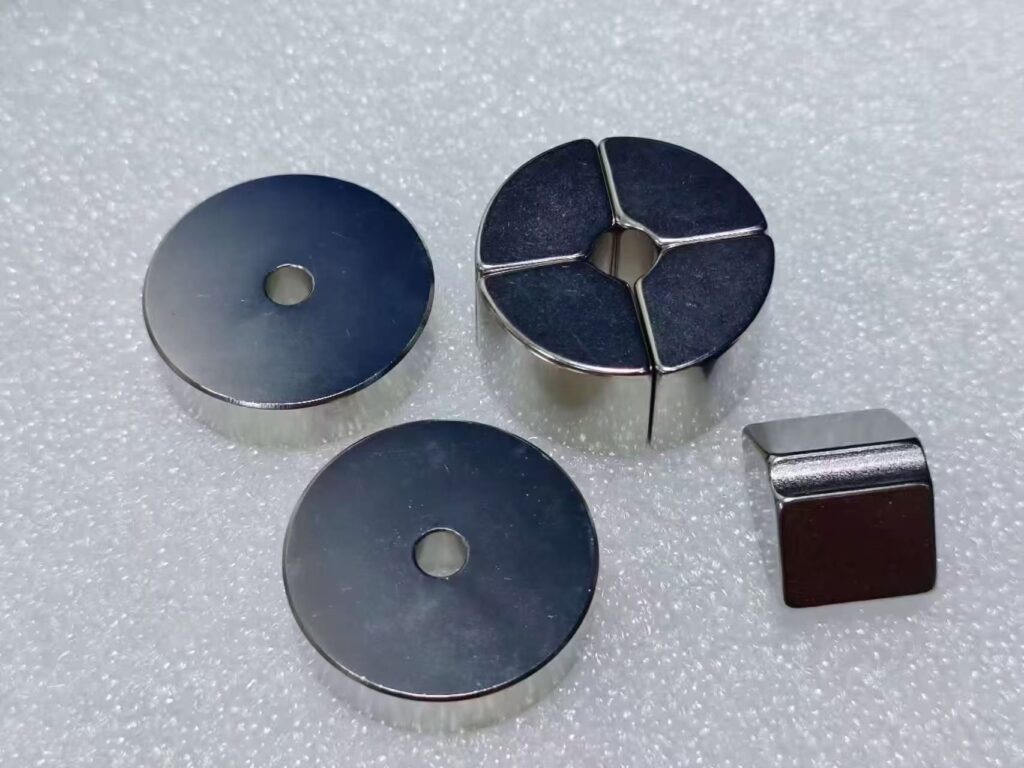
Thin magnets magnetized through their thickness and designs with large open air gaps often operate at a less favorable load line. They may need more coercivity than a thicker magnet in a closed steel circuit, even when both applications have the same maximum temperature. For motors, generators, and compact magnetic couplings, finite-element analysis and the supplier’s second-quadrant demagnetization curves are the appropriate tools.
4. Evaluate Geometry Before Increasing the N Number
Magnet length in the magnetization direction has a major effect on the operating point. Sometimes a small increase in thickness, a reduced gap, or a better steel return path improves performance more effectively than changing from N42 to N52. Geometry changes can also improve demagnetization margin and reduce material cost.
For an existing space envelope, compare several combinations of grade and dimensions. The best solution may be a slightly larger N42 magnet rather than a small N52, especially when temperature, coating thickness, tolerances, or availability are included.
5. Design the Complete Magnetic Circuit
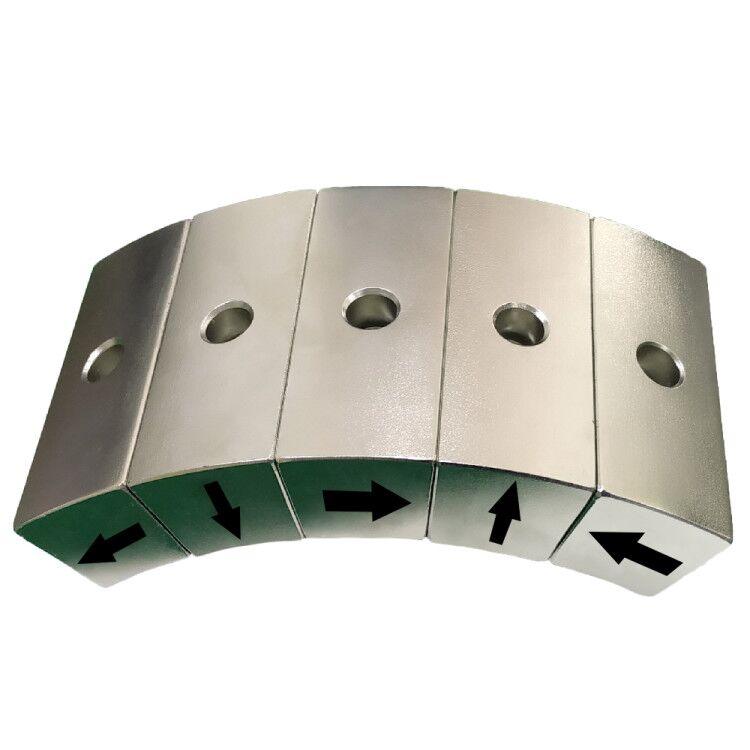
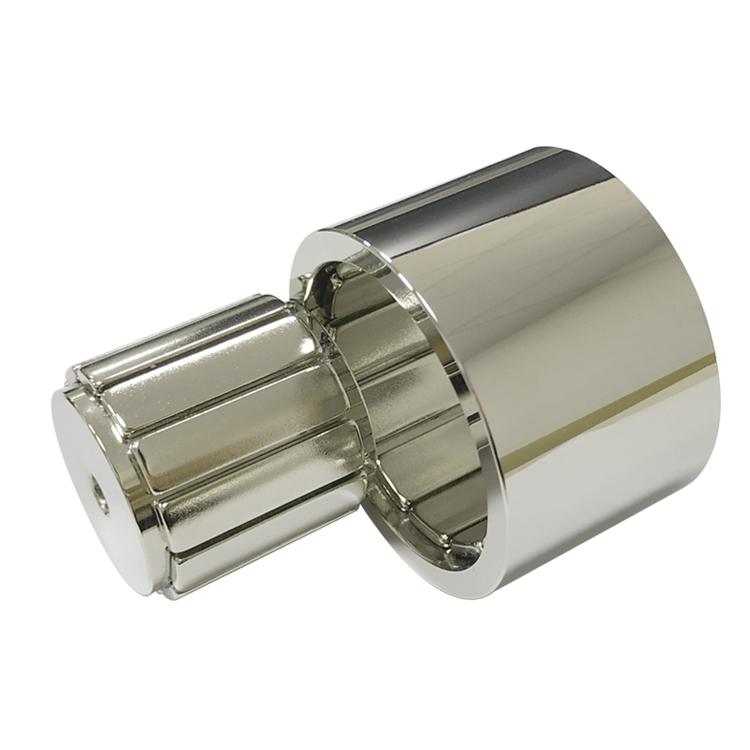
A magnet never works in isolation. Steel cups, pole pieces, back plates, shafts, housings, neighboring magnets, and the working air gap control how much flux reaches the useful area. Thin steel may saturate; excessive steel can add weight without improving output; an unintended nonmagnetic gap can sharply reduce attraction.
This is especially important for holding assemblies and magnetic wheels used on steel inspection robots. Their usable adhesion depends on the wheel’s flux path, tread gap, steel thickness, curvature, surface coating, and load direction—not just the grade printed on the magnet specification.
6. Match Coating and Mechanical Design to the Environment
Sintered NdFeB is hard, brittle, and vulnerable to corrosion when left unprotected. Nickel-based plating, epoxy, zinc, Parylene, and other systems serve different humidity, salt, chemical, wear, adhesive, and dimensional requirements. Coating choice does not change the base grade, but coating failure can end the service life of an otherwise correct magnet.
Also review edge breaks, impact protection, adhesive bondline, press-fit stress, thermal expansion, and retention. A higher grade cannot compensate for chipping, plating damage, or an assembly that allows the magnet to strike a steel surface.
7. Balance Performance, Supply Risk, and Total Cost
Higher energy product and higher coercivity can increase raw-material and processing cost or narrow the qualified supply base. Some high-coercivity grades historically relied on dysprosium or terbium. Modern grain-boundary diffusion and heavy-rare-earth-efficient processes can raise coercivity while limiting the penalty to remanence and resource exposure.
Proterial’s published development data illustrates why engineers should compare the actual Br and HcJ values rather than infer performance from a familiar grade name. Its heavy-rare-earth-free motor grades target different combinations of remanence and intrinsic coercivity for temperatures above 100°C. Ask the supplier which manufacturing route is used, which properties are guaranteed, and whether the proposed grade is routinely available for the required geometry and volume.
Application-Based Starting Points
The following are starting points for engineering review, not automatic grade approvals:
- Room-temperature holding and consumer products: N35 to N42 often provides a practical balance when space is not extremely limited. Validate pull force using the real gap and steel target.
- Compact sensors and switches: Choose the grade and dimensions from the required field at the sensor location. Tolerance, magnet position, and temperature drift may matter more than peak surface field.
- Space-constrained room-temperature designs: N48 to N52 may reduce magnet volume, provided temperature and demagnetization margin remain acceptable.
- Motors, generators, pumps, and actuators: H, SH, UH, or another specified high-coercivity family may be required depending on winding field, rotor temperature, segment geometry, and fault conditions.
- High-temperature or highly demagnetizing applications: Evaluate EH/AH-type NdFeB, grain-boundary-diffused grades, or an alternative material such as SmCo. Compare performance at operating temperature, not only at 20°C.
A Practical Grade-Selection Workflow
- Define the functional output and the test method.
- Document continuous, peak, and process temperatures.
- Model the complete magnetic circuit at nominal and worst-case gaps.
- Check demagnetization curves at the maximum magnet temperature.
- Compare grade-and-geometry combinations rather than grade alone.
- Select the coating and mechanical retention for the environment.
- Review tolerance, batch variation, availability, and cost.
- Prototype and test the finished assembly under worst-case conditions.
For an efficient supplier review, send the application, target performance, drawing, magnetization direction, maximum temperature, air gap, steel parts, coating environment, quantity, and acceptance method. The custom neodymium magnet RFQ checklist provides a complete copy-and-paste list.
How Guande Magnet Supports Grade Selection
Guande Magnet can evaluate the material and the magnetic circuit together. Our support covers sintered NdFeB grade selection, geometry and magnetization review, high-coercivity options, coating, tolerance, magnetic simulation, prototype samples, custom magnetizing fixtures, and production inspection. For assemblies, we can also review steel flux concentrators, housings, adhesives, shafts, hubs, and the final functional test.
The goal is not to recommend the strongest catalog grade. It is to find a stable, manufacturable solution with sufficient performance margin at the required volume and cost. Send your drawing and operating conditions for an engineering review and quotation.
Frequently Asked Questions
Is N52 always stronger than N35?
At room temperature and the same geometry, N52 usually provides higher remanence and energy product. It is not automatically better at elevated temperature or in a strongly demagnetizing circuit. Compare coercivity, temperature curves, geometry, and finished-system performance.
What do M, H, SH, UH, EH and AH mean?
They identify progressively higher intrinsic-coercivity families commonly associated with greater resistance to irreversible demagnetization and higher application temperatures. Exact guaranteed properties and temperature limits depend on the manufacturer’s data sheet and the magnet’s operating point.
Can I replace N42 with N52 without changing the design?
Not automatically. The replacement may change force, sensor thresholds, torque, assembly handling, cost, temperature margin, and magnetic interactions. Recalculate the circuit and validate the product before approving the substitution.
Which information is most important for selecting a grade?
Provide the required field or force, measurement location, magnet geometry, magnetization direction, maximum magnet temperature, air gap, surrounding steel, opposing fields, corrosion environment, tolerances, and quantity.