
Sintered NdFeB Magnets / Ring Magnets
Neodymium Ring Magnets: OD, ID, Wall Thickness and Pole Pattern
Ring magnets combine a central bore with a circular pole geometry. Their performance and manufacturability depend on outside diameter, inside diameter, wall thickness, concentricity and the selected magnetization pattern.
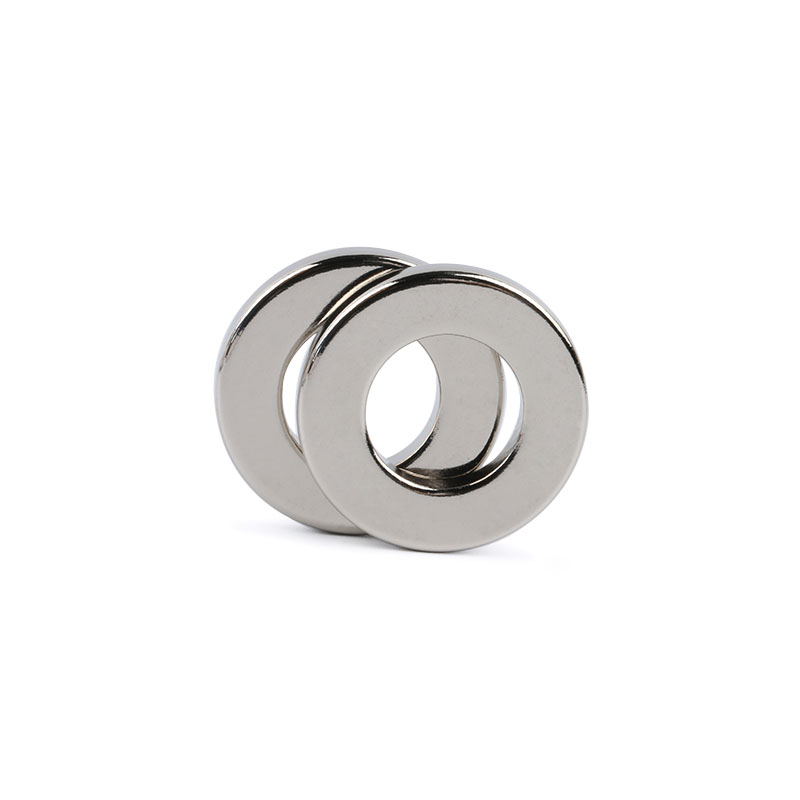
Geometry and Dimension Definition
Use functional datums and define the magnetization reference on the drawing. The table below provides the minimum geometry information for a practical manufacturing review.
| Parameter | How to define it | Why it matters |
|---|---|---|
| OD — Outside diameter | Maximum cylindrical envelope | Controls available pole area and radial installation space |
| ID — Inside diameter | Finished bore diameter | Defines shaft, sleeve or bearing clearance |
| T — Axial thickness | Distance between ring faces | Controls axial working length and assembly stack |
| Wall thickness | (OD − ID) ÷ 2 | Key indicator of machining strength and cracking risk |
Design Considerations
Axial or diametrical poles
Axial rings place poles on the flat faces. Diametrical rings create side-facing poles for rotary sensors and couplings.
Multipole pattern
Pole count, pole pitch, phase reference and field uniformity must be specified together with the sensing or motor geometry.
One-piece or segmented ring
Large diameter, thin wall or radial pole requirements may be more practical as a matched segmented assembly.
Manufacturing and Assembly Notes
- Thin walls are vulnerable to cracking during ID grinding, coating and press-style assembly.
- Concentricity and radial runout should be tied to functional datums, not specified independently without an inspection method.
- Small bores require suitable grinding access and may limit achievable aspect ratio.
- True radial magnetization is process-dependent and should be reviewed before tooling is committed.
Typical Applications
BLDC motors and generators
One-piece or segmented rings with controlled pole count and angular reference.
Rotary encoders
Diametrical or multipole rings for compact angle and speed sensing.
Magnetic couplings
Coaxial torque transfer with controlled air gap and pole alignment.
Speakers and actuators
Annular magnetic circuits around a central moving element.
Engineering Questions
Why is minimum wall thickness important?
A thin wall reduces mechanical strength and leaves less material to absorb grinding or assembly stress. It can also constrain magnetization and coating yield.
What is the difference between radial and diametrical magnetization?
Diametrical magnetization creates one north and one south region across the ring. Radial or multipole patterns create poles around the circumference and require a dedicated process.
When is a segmented ring preferable?
Segmented rings are often preferred for larger diameters, high pole counts, radial orientation or when one-piece handling risk becomes excessive.
How should concentricity be specified?
Define the functional datum—typically OD, ID or a mating shaft—and state the measurement method and acceptable runout.
For a focused design review, share your drawing, operating temperature, air gap, target magnetic performance and annual volume through our enquiry page. You can also return to Sintered NdFeB Magnets for material-level guidance.