
Sintered NdFeB Magnets / Countersunk Magnets
Countersunk Neodymium Magnets: Hole Geometry and Safe Assembly
Countersunk magnets add a mechanical fastening feature to a brittle magnetic material. Hole diameter, countersink diameter and angle, remaining wall thickness, screw torque and seating condition must be coordinated to prevent cracking.
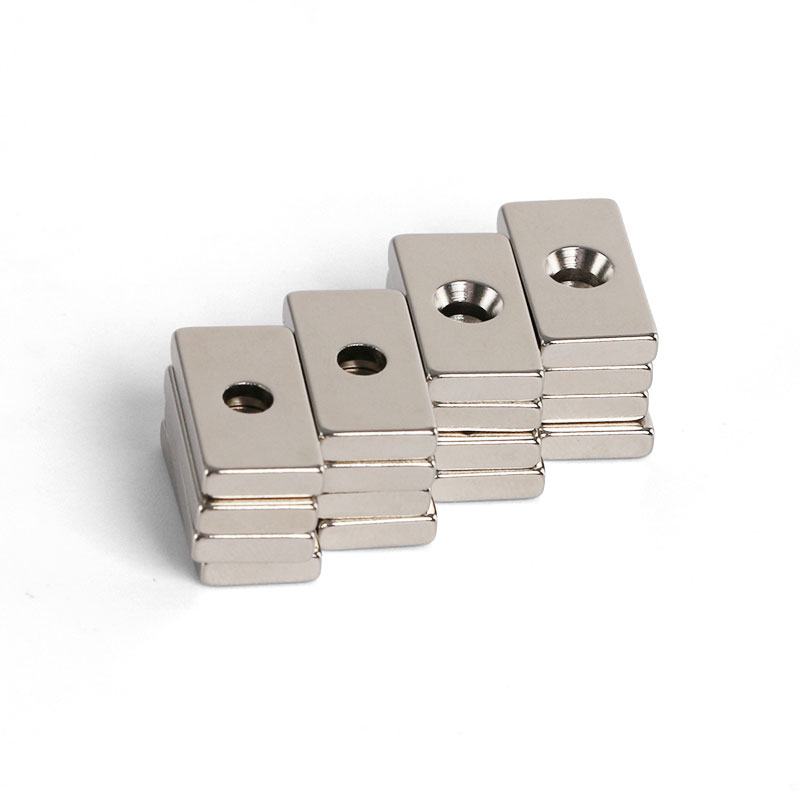
Geometry and Dimension Definition
Use functional datums and define the magnetization reference on the drawing. The table below provides the minimum geometry information for a practical manufacturing review.
| Parameter | How to define it | Why it matters |
|---|---|---|
| Body size | Disc D×T or block L×W×T | Defines magnet volume and mounting envelope |
| d — Through-hole | Minimum bore diameter | Provides screw clearance and controls remaining wall |
| Dcs — Countersink diameter | Major diameter at the seating face | Must match the screw head and available pole area |
| Angle and orientation | Countersink included angle and face | Essential for correct seating and polarity |
Design Considerations
Remaining material around the hole
The countersink removes magnetic and structural material. A larger screw head may reduce force and sharply increase fracture risk.
Screw and seating surface
A flat, controlled seat and suitable washer or cup reduce point loading. Countersunk magnets should not be used as structural washers.
Direct pull versus shear
Fastening prevents movement, but magnetic holding force still depends on contact, air gap and loading direction. Shear loads need mechanical support.
Manufacturing and Assembly Notes
- Over-tightening can split the magnet even when the screw appears properly seated.
- Misaligned screw heads create point stress at the countersink edge.
- Machining damages protective coating around the hole unless coating is applied after grinding.
- Very small edge distances or double countersinks require an early manufacturability review.
Typical Applications
Fixtures and jigs
Replaceable locating or holding points with positive mechanical retention.
Access panels and signage
Flush-mounted magnetic closures with defined polarity.
Retail and display systems
Reusable mounts where the fastener remains hidden.
Cabinet and equipment latches
Compact attachment when adhesive-only retention is unsuitable.
Engineering Questions
Can a countersunk magnet be tightened like a steel washer?
No. NdFeB is brittle and should be seated gently with controlled torque. The surrounding structure should carry mechanical clamp loads.
Which countersink angle should be used?
Match the selected screw standard and state the included angle on the drawing. Do not assume that all flat-head screws use the same geometry.
Does the hole reduce pull force?
Yes. It removes pole-face area and magnetic volume. A steel cup may recover some circuit efficiency, but the complete assembly should be tested.
Can both sides be countersunk?
It is possible in selected sizes, but remaining wall and central section become critical. A through-hole with separate retaining hardware may be more robust.
For a focused design review, share your drawing, operating temperature, air gap, target magnetic performance and annual volume through our enquiry page. You can also return to Sintered NdFeB Magnets for material-level guidance.