
Sintered NdFeB Magnets / Segment Magnets
Neodymium Segment Magnets: Polarity, Matching and Assembly Control
Segment magnets form larger rings, rotors, couplings and directed-field arrays. Their value comes from controlled geometry, magnetic moment, polarity sequence and assembly position across the complete set.
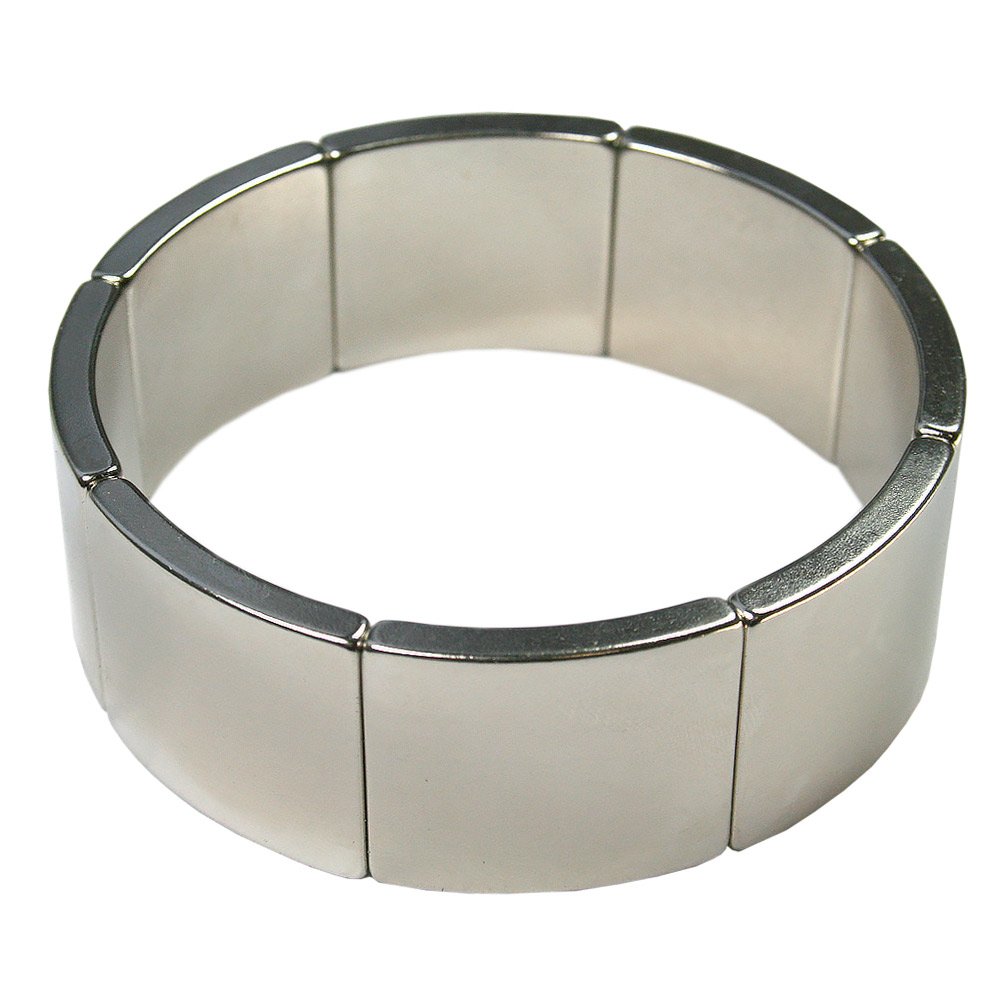
Geometry and Dimension Definition
Use functional datums and define the magnetization reference on the drawing. The table below provides the minimum geometry information for a practical manufacturing review.
| Parameter | How to define it | Why it matters |
|---|---|---|
| Ri / Ro | Inner and outer radius | Defines the assembled ring surfaces and radial thickness |
| L — Axial length | Length along the assembly axis | Controls active field length |
| α — Segment angle | Mechanical angle per piece | Defines piece count and assembly gap |
| Set definition | Quantity, position and polarity sequence | Required to inspect and pack a functional set |
Design Considerations
Segment count and gap
More segments can approximate a circular field more closely, but increase gaps, adhesive interfaces and assembly complexity.
Magnetic matching
Sorting by magnetic moment, surface field or flux can reduce variation across rotors and coupled assemblies.
Polarity sequence
Position references, markings and fixture poka-yoke are essential for alternating-pole and Halbach configurations.
Manufacturing and Assembly Notes
- Attractive and repulsive forces make freehand assembly unsafe and inconsistent.
- Accumulated angle and thickness tolerances can change final ring gap and concentricity.
- Incorrectly oriented one-piece segments may not be detectable after bonding without dedicated inspection.
- Adhesive bondline and fixture release strategy should be designed before magnet delivery.
Typical Applications
Large motor rotors
Matched arc or trapezoid segments assembled around a rotor core.
Magnetic couplings
Alternating poles for non-contact torque transmission.
Halbach arrays
Controlled magnetization directions for one-sided or concentrated fields.
Large-diameter rings
Segmented construction where one-piece manufacturing is impractical.
Engineering Questions
How many segments should a ring use?
The optimum number balances field quality, available magnetization directions, assembly gaps, tooling and cost. Electromagnetic and mechanical reviews should be combined.
Why purchase magnets as matched sets?
Set-level sorting and position control can reduce field imbalance and simplify assembly traceability.
How should polarity be marked?
Use a drawing-defined face, position number or color code that remains visible through the assembly process. Packaging should preserve the sequence.
Do small gaps matter?
Yes. Gaps affect field distribution and can accumulate around the ring. Bondline thickness and fixture tolerances should be included in the model.
For a focused design review, share your drawing, operating temperature, air gap, target magnetic performance and annual volume through our enquiry page. You can also return to Sintered NdFeB Magnets for material-level guidance.