
Magnetic Assemblies / Halbach Arrays
Halbach Arrays: Directed Flux Through Controlled Magnetization
A Halbach array rotates magnetization direction from segment to segment to strengthen the field on one side while reducing it on the other. Useful performance depends on segment geometry, orientation accuracy, gaps and assembly fixtures.
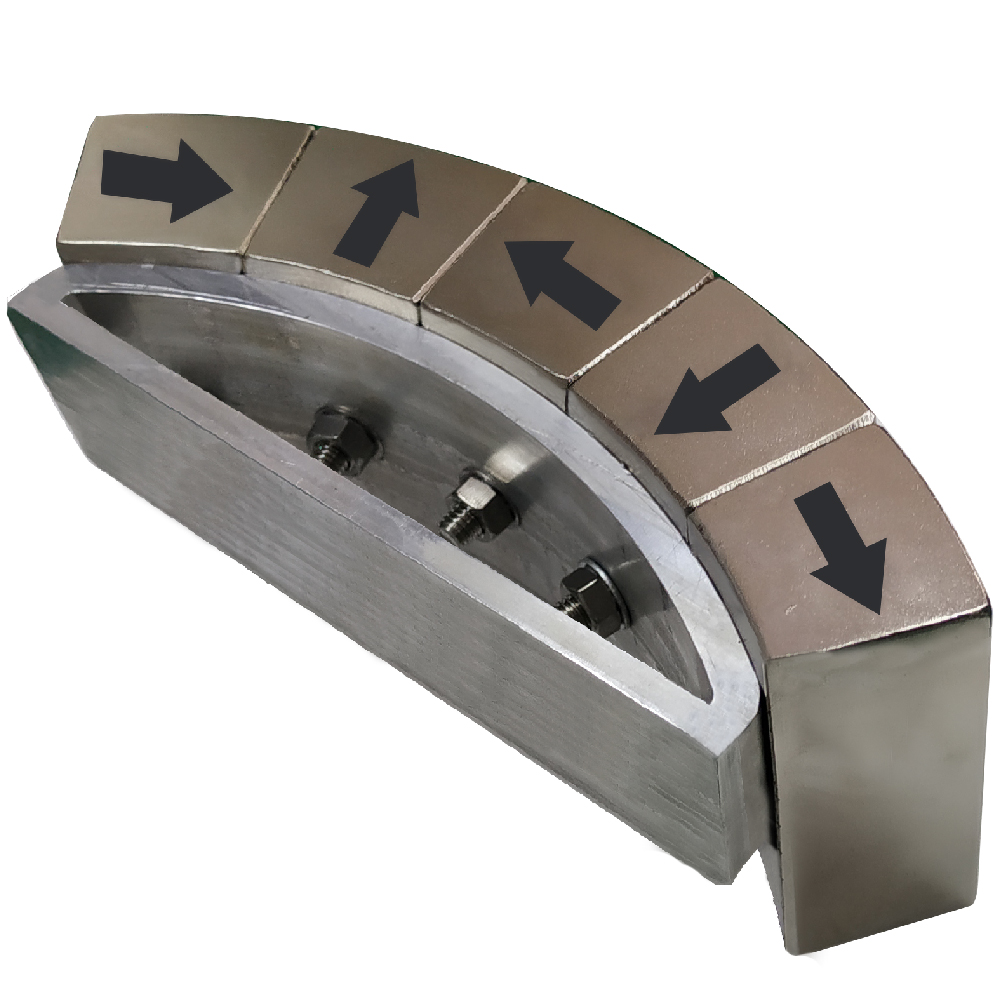
Geometry and Dimension Definition
Use functional datums and define the magnetization reference on the drawing. The table below provides the minimum geometry information for a practical manufacturing review.
| Parameter | How to define it | Why it matters |
|---|---|---|
| Array length / diameter | Finished linear or circular envelope | Defines the working field region |
| Segment geometry | Block, trapezoid or arc dimensions | Controls approximation of the ideal magnetization rotation |
| Magnetization angle | Direction for every numbered segment | Primary functional specification |
| Gap and support | Bondline, carrier and locating features | Controls field uniformity and mechanical stability |
Design Considerations
Segment count
More orientations can improve field concentration but increase parts, gaps and assembly complexity.
Orientation accuracy
Magnetization angle and physical placement errors directly reduce the intended one-sided effect.
Back iron and surroundings
Nearby steel changes the field distribution and must be included in modeling and tests.
Manufacturing and Assembly Notes
- Strong repulsive forces make uncontrolled assembly unsafe.
- One reversed segment can materially distort the field.
- Bondline accumulation changes pitch and circular closure.
- Custom magnetization fixtures may determine prototype lead time.
ASSEMBLY PROCESS
Watch: 12-Segment Halbach Ring Assembly
This 41-second demonstration shows how spacer fixtures with holes help control segment position, assembly gaps and orientation while the ring is closed. The fixture supports repeatability, but the magnetization direction of every numbered segment must still be verified before bonding.
Video hosted on the Guande Magnet YouTube channel. The YouTube player loads only after you click play.
Typical Applications
Linear motors
High working-side field with reduced back-side leakage.
Magnetic bearings
Directed fields for non-contact support.
NMR and sensing
Compact field-shaping arrays.
Robotics and transport
One-sided attraction and magnetic wheel systems.
Engineering Questions
How many segments are needed?
It depends on field quality, size, available orientations, assembly cost and tolerance budget.
Can standard axially magnetized blocks be used?
Some simplified arrays can, but the intended field may require multiple magnetization directions.
Why are assembly fixtures essential?
They control position and prevent magnets from rotating or ejecting under strong mutual forces.
How should the array be accepted?
Define a field map or measurements at functional locations, not only individual magnet surface readings.
For a focused design review, share your drawing, operating temperature, air gap, target magnetic performance and annual volume through our enquiry page. You can also return to Magnetic Assemblies for material-level guidance.