
Magnetic Assemblies / Fishing Magnets
Fishing Magnets: Recovery Force, Eye-Bolt Safety and Corrosion Control
Fishing magnets are heavy-duty pot-magnet assemblies designed for underwater recovery. Safe selection requires realistic force expectations, a verified lifting interface, corrosion protection and controlled use—not only the maximum laboratory pull rating.
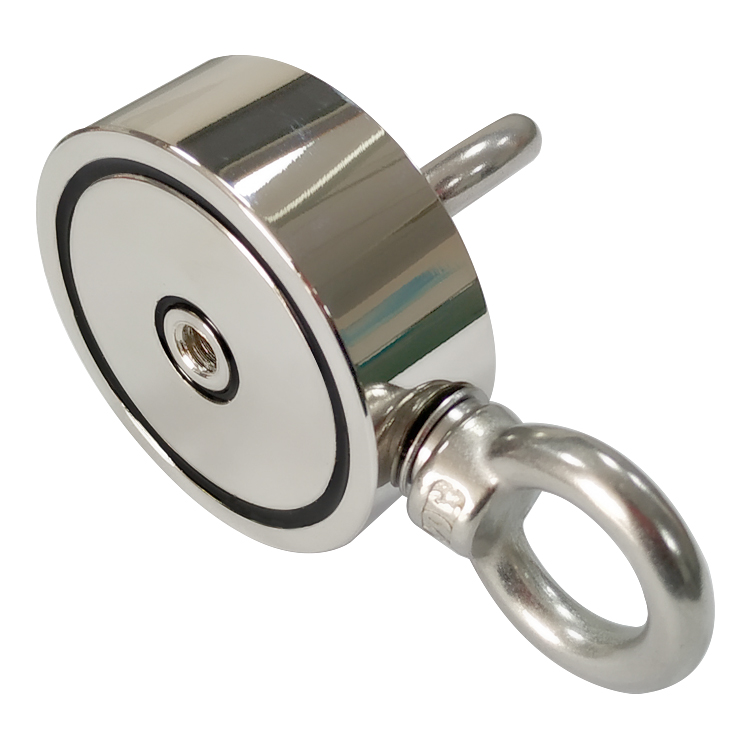
Geometry and Dimension Definition
Use functional datums and define the magnetization reference on the drawing. The table below provides the minimum geometry information for a practical manufacturing review.
| Parameter | How to define it | Why it matters |
|---|---|---|
| D — Working diameter | Outer steel-cup diameter | Controls contact area and recovery envelope |
| H — Body height | Finished cup and magnet stack | Affects weight and edge clearance |
| Eye-bolt interface | Thread size, engagement and locking method | Critical for load transfer and field service |
| Rated pull condition | Target thickness, contact face and test direction | Makes force data comparable and auditable |
Design Considerations
Direct pull versus recovery load
Rust, curvature, edge contact, mud and side loading can reduce usable force far below a flat-steel bench result.
Mechanical attachment
The eye bolt, thread and cup must be evaluated separately from magnetic force. A locking method prevents loosening during retrieval.
Water exposure
Nickel alone is not a complete marine barrier. Coating, seals, rinsing and drying practices should be defined.
Manufacturing and Assembly Notes
- Sudden attachment can pinch fingers or damage equipment.
- Recovered objects may release when the load changes from direct pull to peel or shear.
- Corrosion can begin at coating damage or threaded interfaces.
- A magnet recovery tool is not certified lifting equipment unless the complete system is designed and tested as such.
Typical Applications
Underwater recovery
Retrieval of ferrous objects in controlled environments.
Tank and pit inspection
Recovery of tools or debris where access is limited.
Workshop retrieval
Locating steel parts from channels or enclosed spaces.
Training and field kits
Purpose-built recovery assemblies with documented limitations.
Engineering Questions
Why can a “500 kg” magnet fail to lift a much lighter object?
The rating may be measured on thick, flat, clean steel in direct pull. Real objects rarely provide those conditions.
Should the eye bolt be thread-locked?
A verified locking method is recommended because rope twist and repeated use can loosen the interface.
How can corrosion be reduced?
Rinse, dry and inspect after use; protect damaged coating and avoid long-term wet storage.
Can two magnets be used together?
Yes, but interaction, rope geometry and load sharing must be controlled; forces do not simply add in every arrangement.
For a focused design review, share your drawing, operating temperature, air gap, target magnetic performance and annual volume through our enquiry page. You can also return to Magnetic Assemblies for material-level guidance.