
Magnetic Assemblies / Magnetic Couplings
Magnetic Couplings: Non-Contact Torque Across a Sealed Barrier
Magnetic couplings transmit torque without a mechanical shaft seal by synchronizing inner and outer magnet rotors across an air gap or containment can. Torque, slip behavior, eddy-current loss and mechanical containment must be designed together.
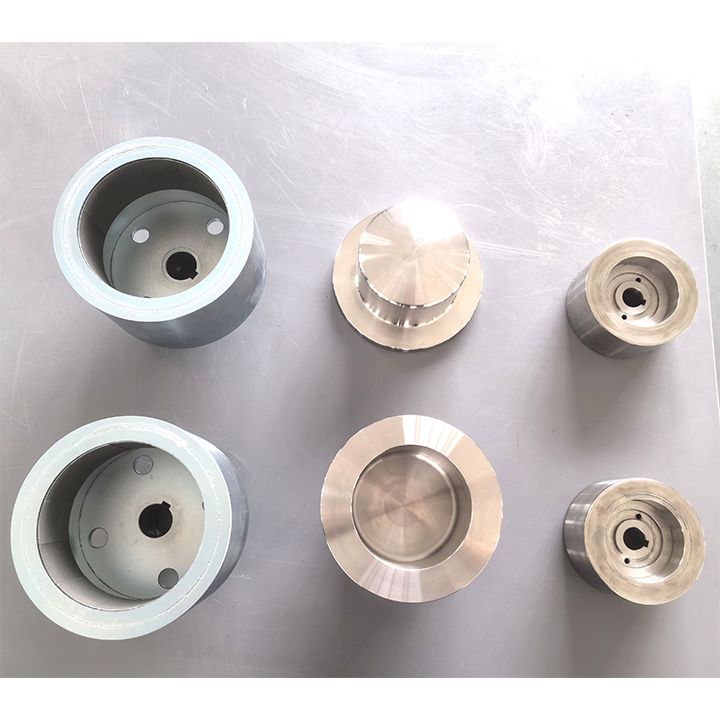
GDMCS Series: Magnetic Coupling Selection Guide
The GDMCS permanent magnet synchronous coupling series provides a starting point for selecting non-contact torque transmission across a sealed barrier. The models below cover listed torque values from 10 to 500 N·m, with reference dimensions for checking the available installation space.
Use this guide alongside the torque, containment and thermal considerations on this page. In synchronous operation, the driving and driven rotors turn at the same speed; actual losses and operating limits depend on the containment sleeve, working gap, speed and temperature.
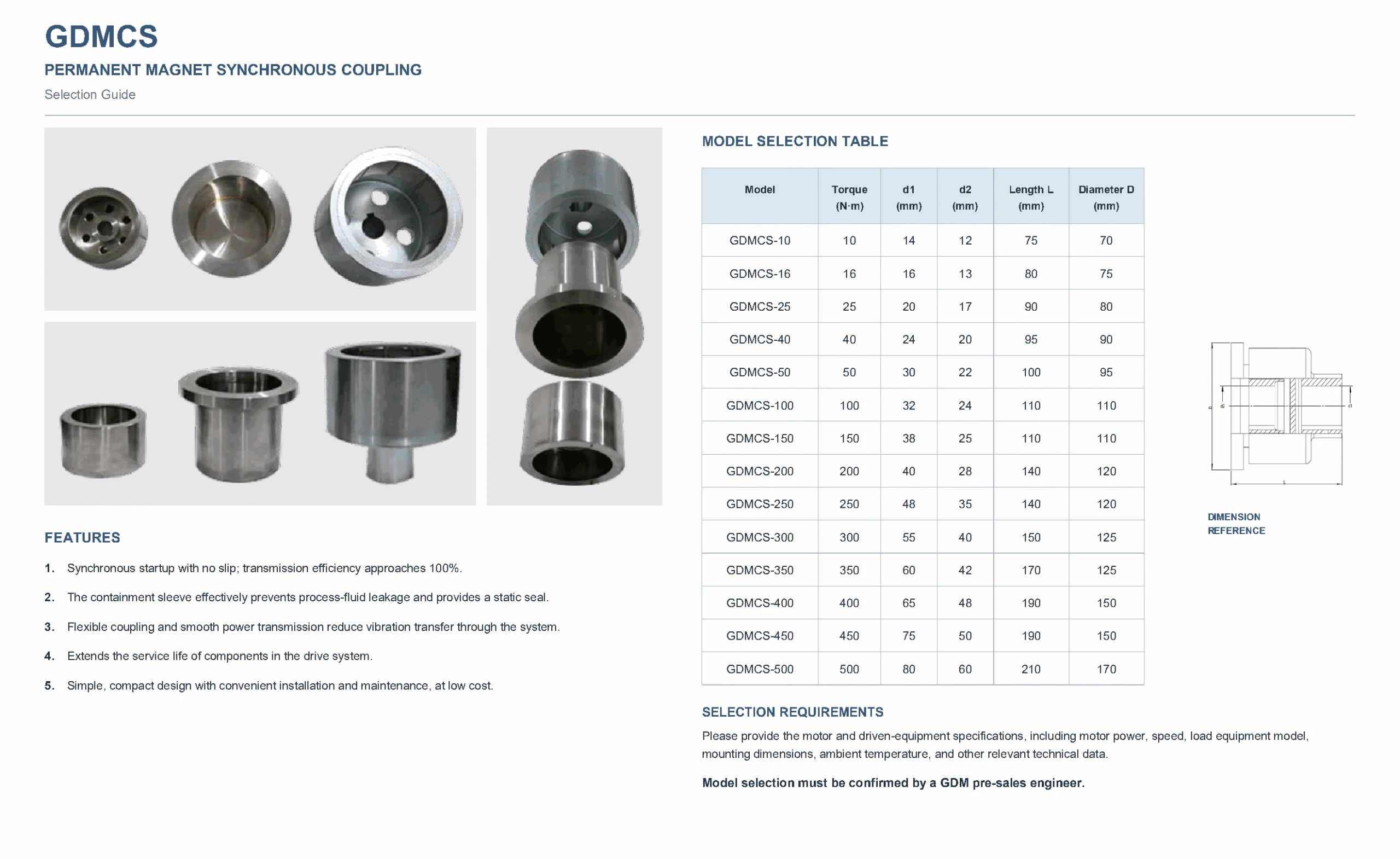
Model Selection Table
Torque is shown in N·m; all dimensions are in mm. On smaller screens, scroll the table horizontally to view every column.
| Model | Torque (N·m) | d1 (mm) | d2 (mm) | Length L (mm) | Diameter D (mm) |
|---|---|---|---|---|---|
| GDMCS-10 | 10 | 14 | 12 | 75 | 70 |
| GDMCS-16 | 16 | 16 | 13 | 80 | 75 |
| GDMCS-25 | 25 | 20 | 17 | 90 | 80 |
| GDMCS-40 | 40 | 24 | 20 | 95 | 90 |
| GDMCS-50 | 50 | 30 | 22 | 100 | 95 |
| GDMCS-100 | 100 | 32 | 24 | 110 | 110 |
| GDMCS-150 | 150 | 38 | 25 | 110 | 110 |
| GDMCS-200 | 200 | 40 | 28 | 140 | 120 |
| GDMCS-250 | 250 | 48 | 35 | 140 | 120 |
| GDMCS-300 | 300 | 55 | 40 | 150 | 125 |
| GDMCS-350 | 350 | 60 | 42 | 170 | 125 |
| GDMCS-400 | 400 | 65 | 48 | 190 | 150 |
| GDMCS-450 | 450 | 75 | 50 | 190 | 150 |
| GDMCS-500 | 500 | 80 | 60 | 210 | 170 |
Dimension reference: d1 and d2 correspond to the two bore dimensions identified in the guide drawing; L is the listed length and D is the listed diameter. Confirm the shaft interfaces, fits, tolerances and assembly envelope against an approved drawing before manufacture or installation.
How to Select a GDMCS Coupling
Start with the required operating torque and available space, then check start-up and peak loads, speed, working gap and temperature. For a sealed drive, the containment sleeve material and thickness must also be reviewed for pressure, chemical compatibility and eddy-current heating. The table does not specify speed, pressure or temperature ratings.
For model selection, please provide the motor power and speed, driven-equipment model, operating and peak torque, mounting dimensions or drawings, ambient and process temperatures, and relevant fluid or pressure conditions.
Model selection must be confirmed by a GDM pre-sales engineer. Send your application details for a coupling selection review. If the listed dimensions do not fit your assembly, include your required interfaces and space limits so we can review a custom configuration.
Geometry and Dimension Definition
Use functional datums and define the magnetization reference on the drawing. The table below provides the minimum geometry information for a practical manufacturing review.
| Parameter | How to define it | Why it matters |
|---|---|---|
| Coupling OD / ID | Rotor and containment envelope | Defines available magnet volume and radial gap |
| Active length | Axial overlap of magnetic rotors | Controls torque capacity |
| Pole count | Alternating pole pairs and angular reference | Influences torque density and slip behavior |
| Barrier thickness | Containment can material and wall | Adds magnetic gap and may create eddy-current loss |
Design Considerations
Torque curve
Specify working torque, peak torque and allowable slip instead of one nominal value.
Containment can
Electrical conductivity, strength, corrosion resistance and thickness affect both safety and heating.
Thermal conditions
Eddy loss, fluid temperature and poor heat rejection can raise magnet temperature.
Manufacturing and Assembly Notes
- Metallic barriers can overheat at speed due to eddy currents.
- Loss of synchronism may create impact torque or heat.
- Rotor concentricity and bearing deflection change the working gap.
- Chemical exposure must be assessed for the entire wetted system.
Typical Applications
Sealless pumps
Leak-free torque transfer across a containment shell.
Mixers and reactors
Drive through vessel walls.
Vacuum systems
Motion without a dynamic shaft seal.
Instrumentation
Compact isolated rotary transmission.
Engineering Questions
How is coupling torque specified?
Provide operating, start-up and upset torque across the speed and temperature range.
Why does can material matter?
Conductive metal can create eddy-current heating; non-metallic barriers reduce loss but have different strength and compatibility.
What happens during overload?
The rotors may slip out of synchronism. Recovery behavior and thermal consequences should be validated.
Can the design be scaled by adding magnets?
Not linearly. Pole pitch, saturation, gap and rotor dimensions interact.
For a focused design review, share your drawing, operating temperature, air gap, target magnetic performance and annual volume through our enquiry page. You can also return to Magnetic Assemblies for material-level guidance.