
Magnetic Assemblies / Rotor Magnets
Rotor Magnet Assemblies: Pole Accuracy, Balance and High-Speed Retention
Rotor magnet assemblies integrate permanent magnets with a shaft, hub, sleeve or rotor core. A production-ready design must align electromagnetic targets with polarity control, adhesive bonding, dimensional runout, balance and overspeed safety.
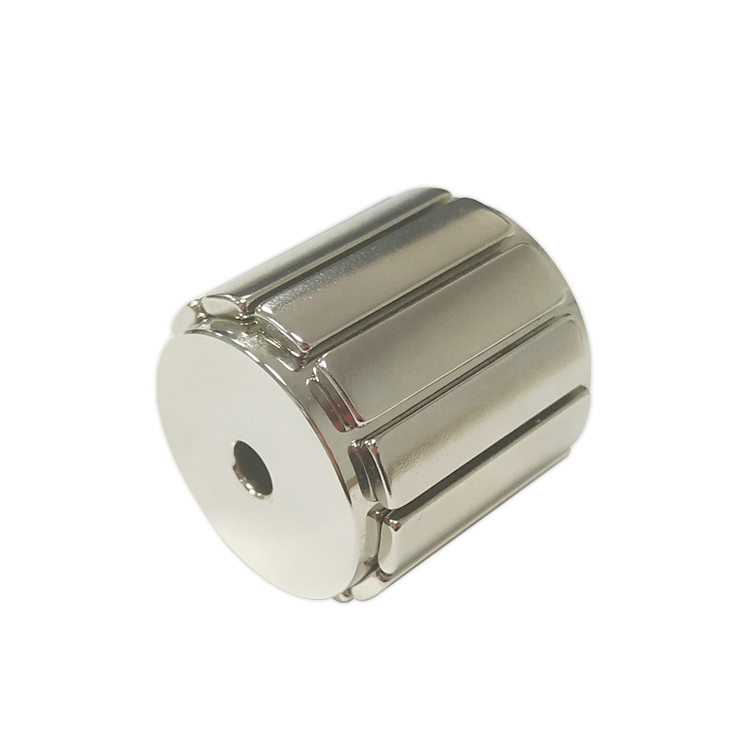
Geometry and Dimension Definition
Use functional datums and define the magnetization reference on the drawing. The table below provides the minimum geometry information for a practical manufacturing review.
| Parameter | How to define it | Why it matters |
|---|---|---|
| Rotor OD / ID | Finished magnetic and mechanical diameters | Controls air gap, shaft fit and sleeve clearance |
| Active length | Axial magnetic stack length | Defines torque-producing region |
| Pole count and phase reference | Pole sequence and angular datum | Links the rotor to stator and sensor timing |
| Runout and balance | Datum, speed grade and measurement method | Protects air gap and bearing life |
Design Considerations
Retention system
Adhesive, sleeve, banding and mechanical keys should be analyzed as one load path for speed and temperature.
Magnetic matching
Moment and pole-angle variation influence torque ripple, vibration and current control.
Thermal stack-up
Magnet, steel, sleeve and adhesive expand differently; peak rotor temperature and cycling matter.
Manufacturing and Assembly Notes
- Incorrect polarity or angular placement may be impossible to correct after bonding.
- Sleeve interference can crack magnets or overstress adhesive.
- Rotor balance can change after coating, bonding and magnetization.
- Demagnetizing current and peak temperature must be evaluated together.
Typical Applications
Servo motors
Precision pole placement and dynamic balance.
High-speed spindles
Retention and low-loss magnet design.
Pumps and compressors
Sealed or canned motor rotor systems.
Generators
Controlled flux and mechanical integrity over the duty cycle.
Engineering Questions
Should the rotor be magnetized before or after assembly?
The best route depends on magnetizer access, handling force, adhesive process and final field requirements.
Why is pole matching important?
Variation can create unbalanced magnetic pull, torque ripple and sensor timing error.
When is a retaining sleeve required?
When speed, temperature and magnet geometry make adhesive-only retention insufficient.
What data is needed for an initial review?
Rotor geometry, speed profile, temperature, pole layout, air gap, materials and validation requirements.
For a focused design review, share your drawing, operating temperature, air gap, target magnetic performance and annual volume through our enquiry page. You can also return to Magnetic Assemblies for material-level guidance.