
Sintered NdFeB Magnets / Custom Shaped Magnets
Custom Shaped Neodymium Magnets for Space-Constrained Designs
Custom shaped magnets integrate magnetic material into an existing product envelope. The goal is not simply to machine an unusual profile, but to define datums, functional surfaces, magnetization and inspection methods that can be repeated in production.
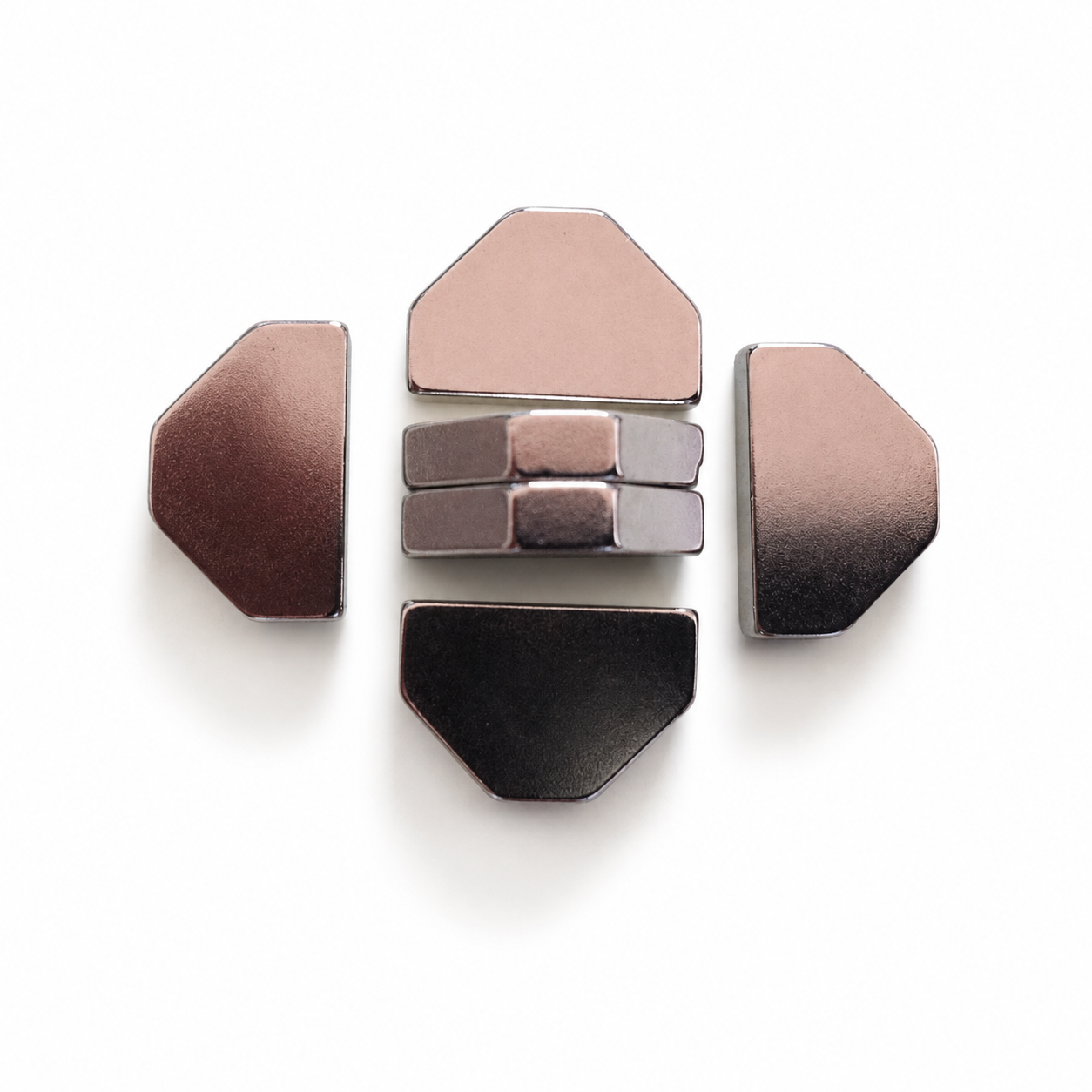
Geometry and Dimension Definition
Use functional datums and define the magnetization reference on the drawing. The table below provides the minimum geometry information for a practical manufacturing review.
| Parameter | How to define it | Why it matters |
|---|---|---|
| Overall envelope | Maximum L×W×T or diameter | Confirms raw-material and grinding feasibility |
| Functional datums | Primary, secondary and tertiary references | Creates a repeatable inspection and assembly coordinate system |
| Profiles and features | Slots, steps, notches, holes and radii | Must be dimensioned from functional datums |
| Magnetization reference | Direction, pole face and orientation mark | Links the magnetic function to the geometry |
Design Considerations
Function before profile
Identify which surfaces control air gap, location and assembly. Non-critical cosmetic geometry can often use wider tolerances.
Material utilization
Nested profiles, segmentation or a multi-piece assembly may reduce waste and machining risk compared with one complex magnet.
Inspection strategy
A dimension is only useful when a stable datum and measurement method are available. Custom gauges may be appropriate for volume production.
Manufacturing and Assembly Notes
- Thin bridges, inside corners and abrupt section changes concentrate grinding and assembly stress.
- Complex geometry may require wire cutting or dedicated fixtures, increasing prototype lead time.
- Coating thickness affects small slots and mating dimensions and must be included in tolerance analysis.
- Magnetization after machining is preferred in many cases, but geometry can limit fixture access or field uniformity.
Typical Applications
Medical and analytical devices
Compact profiles with controlled traceability and magnetic output.
Optical and sensor assemblies
Defined datums for accurate field placement in limited space.
Aerospace and robotics
Weight-optimized shapes integrated with retention features.
Consumer electronics
Thin, asymmetric magnets for speakers, haptics and attachment systems.
Engineering Questions
When is a custom shape justified?
Use it when a standard magnet plus a holder cannot meet air-gap, space, weight or assembly requirements. Compare total assembly cost, not magnet price alone.
What information is needed for a manufacturability review?
A drawing or 3D model, magnetization direction, critical datums, tolerances, coating, operating conditions, inspection needs and annual volume are the best starting inputs.
Can every profile be ground into NdFeB?
No. Tool access, corner radius, aspect ratio and brittle sections impose limits. We may suggest segmentation or a small geometry change.
Should prototypes use production tooling?
Not always. A low-volume route can validate function first, followed by production fixtures and gauges after the design is stable.
For a focused design review, share your drawing, operating temperature, air gap, target magnetic performance and annual volume through our enquiry page. You can also return to Sintered NdFeB Magnets for material-level guidance.