
Sintered NdFeB Magnets / Disc Magnets
Neodymium Disc Magnets: Geometry, Field and Design Guidance
Disc magnets package strong magnetic performance into a simple cylindrical geometry. This guide focuses on diameter-to-thickness ratio, practical tolerances, edge protection and the decisions that determine usable surface field and holding force.
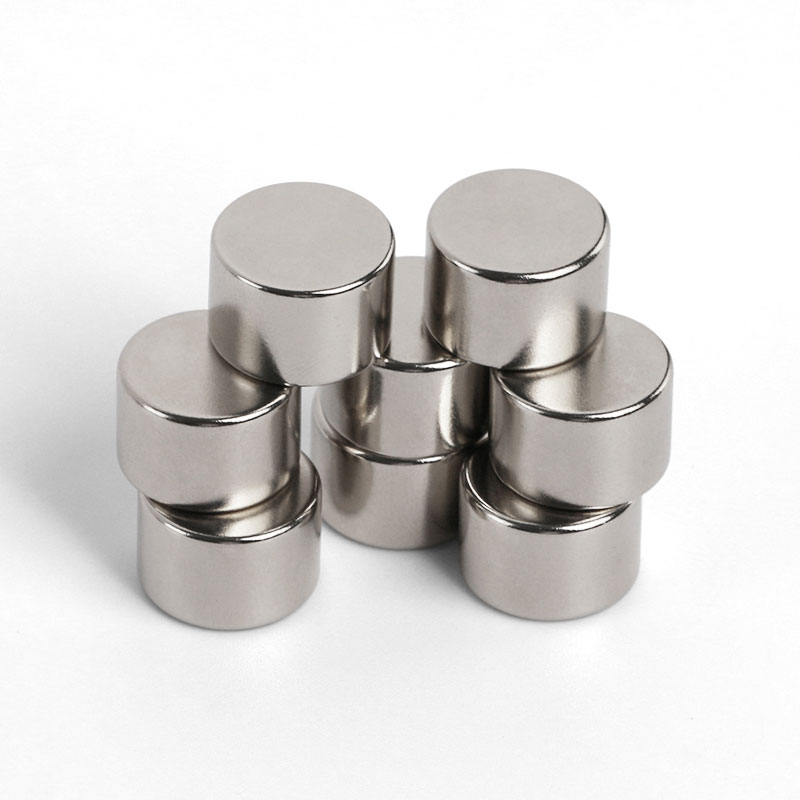
Geometry and Dimension Definition
Use functional datums and define the magnetization reference on the drawing. The table below provides the minimum geometry information for a practical manufacturing review.
| Parameter | How to define it | Why it matters |
|---|---|---|
| D — Diameter | Outside diameter of the circular face | Controls pole-face area and installation envelope |
| T — Thickness | Distance between the two flat faces | Controls the magnetic working length for axial magnetization |
| C / R — Edge detail | Chamfer or edge radius | Reduces chipping risk and protects coating at assembly |
| Magnetization | Axial or diametrical | Must be defined on the drawing together with pole orientation |
Design Considerations
Diameter-to-thickness ratio
Increasing diameter usually enlarges the useful pole area, while increasing thickness can raise the available flux until the magnetic circuit approaches saturation. The result must be evaluated with the real air gap and steel return path.
Air gap and mating steel
Published pull force is not an intrinsic magnet value. Surface finish, air gap, steel thickness, contact area and loading direction can change the measured force substantially.
Stacking versus one thick disc
Stacking identical discs can simplify sourcing, but the field does not increase in direct proportion to stack height. Adhesive gaps and pole alignment also affect repeatability.
Manufacturing and Assembly Notes
- Thin discs have low bending strength. They can crack when attracted to steel at an angle or when two magnets snap together.
- Sharp edges concentrate stress and are vulnerable to coating damage; a small chamfer is normally preferred.
- Very tight flatness, parallelism or thickness tolerances require additional grinding and inspection.
- Press fitting is generally avoided because NdFeB is brittle and has little tolerance for tensile stress.
Typical Applications
Sensors and encoders
Compact axial or diametrical field sources for position, speed and proximity sensing.
Speakers and haptics
Thin magnetic circuits where diameter, gap and magnetic consistency are tightly linked.
Latches and holding devices
Simple pole faces for closures, fixtures and removable assemblies, often combined with steel cups.
Compact motors
Rotor or actuator designs that need a repeatable circular magnetic element.
Engineering Questions
How does the D/T ratio affect surface field and pull force?
A larger diameter increases pole-face area; additional thickness increases the magnet working length. Neither change guarantees proportional pull force because air gap, steel saturation and contact conditions often become the limiting factors.
Why do very thin disc magnets break more easily?
Sintered NdFeB is a hard, brittle ceramic-like material. A thin section has low resistance to bending, edge impact and uneven attraction, so handling and assembly fixtures become important.
Should I specify axial or diametrical magnetization?
Axial magnetization places the poles on the flat faces and is common for holding. Diametrical magnetization places the poles across the curved side and is often used for rotary sensing.
Can several discs replace one thick disc?
Sometimes. Stacking can reduce tooling or inventory complexity, but adhesive layers, alignment and mechanical retention must be reviewed. We recommend comparing both options in the actual magnetic circuit.
For a focused design review, share your drawing, operating temperature, air gap, target magnetic performance and annual volume through our enquiry page. You can also return to Sintered NdFeB Magnets for material-level guidance.