
Sintered NdFeB Magnets / Laminated Magnets
Laminated Neodymium Magnets for High-Speed Motor Loss Reduction
Laminated magnets divide a conductive NdFeB magnet into electrically isolated layers or segments. The design aims to reduce eddy-current loss and magnet heating while preserving magnetic performance and mechanical integrity at speed.
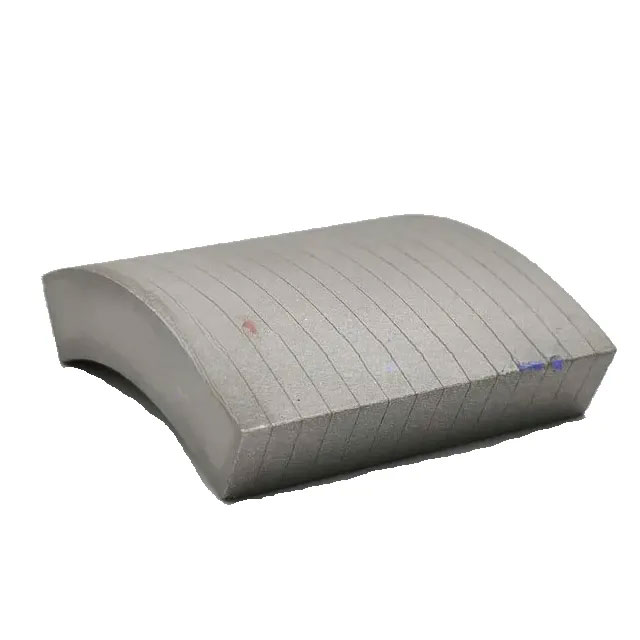
Geometry and Dimension Definition
Use functional datums and define the magnetization reference on the drawing. The table below provides the minimum geometry information for a practical manufacturing review.
| Parameter | How to define it | Why it matters |
|---|---|---|
| Overall geometry | Finished arc, block or segment envelope | Must fit the rotor and maintain the designed air gap |
| Layer thickness | Thickness of each insulated magnet slice | Primary variable for eddy-current path length and assembly count |
| Bondline | Adhesive and insulation thickness | Affects stack dimension, thermal transfer and mechanical strength |
| Stack orientation | Lamination plane relative to induced current | Must interrupt the dominant eddy-current path |
Design Considerations
Loss reduction versus complexity
Thinner laminations can reduce eddy-current loss, but increase pieces, interfaces, dimensional stack-up and assembly cost.
Adhesive thermal class
Bond strength, glass-transition temperature, thermal conductivity and cycling durability must match the motor duty.
Mechanical retention
At high speed, the laminated stack, rotor sleeve and adhesive system must be analyzed together for centrifugal loading.
Manufacturing and Assembly Notes
- Uneven bondline thickness can change final radius, air gap and rotor balance.
- Insulation damage or adhesive squeeze-out may create conductive bridges between layers.
- Thermal expansion mismatch and repeated cycling can degrade interfaces if the adhesive is poorly matched.
- Magnetization and polarity verification must be defined for the finished stack, not only individual slices.
Typical Applications
High-speed traction motors
Reduced magnet heating under slotting harmonics and inverter excitation.
Aerospace and turbo machinery
High electrical frequency with strict rotor thermal limits.
Servo and spindle motors
Improved efficiency and temperature control during dynamic operation.
Permanent-magnet generators
Loss management at high speed or high harmonic content.
Engineering Questions
When should laminated magnets be considered?
When electromagnetic analysis or testing shows significant magnet eddy-current loss, temperature rise or demagnetization margin risk that cannot be solved efficiently by topology alone.
How is lamination thickness selected?
Use electromagnetic loss modeling together with manufacturing yield, bondline control and mechanical stress. The thinnest layer is not automatically the best system solution.
Do laminations reduce magnetic performance?
The magnetic material remains active, but non-magnetic bondlines reduce the effective magnet fill slightly. The complete stack should be modeled and measured.
What should be specified for the adhesive?
Include operating and peak temperature, thermal cycling, shear strength, environmental exposure, cure process and traceability requirements.
For a focused design review, share your drawing, operating temperature, air gap, target magnetic performance and annual volume through our enquiry page. You can also return to Sintered NdFeB Magnets for material-level guidance.