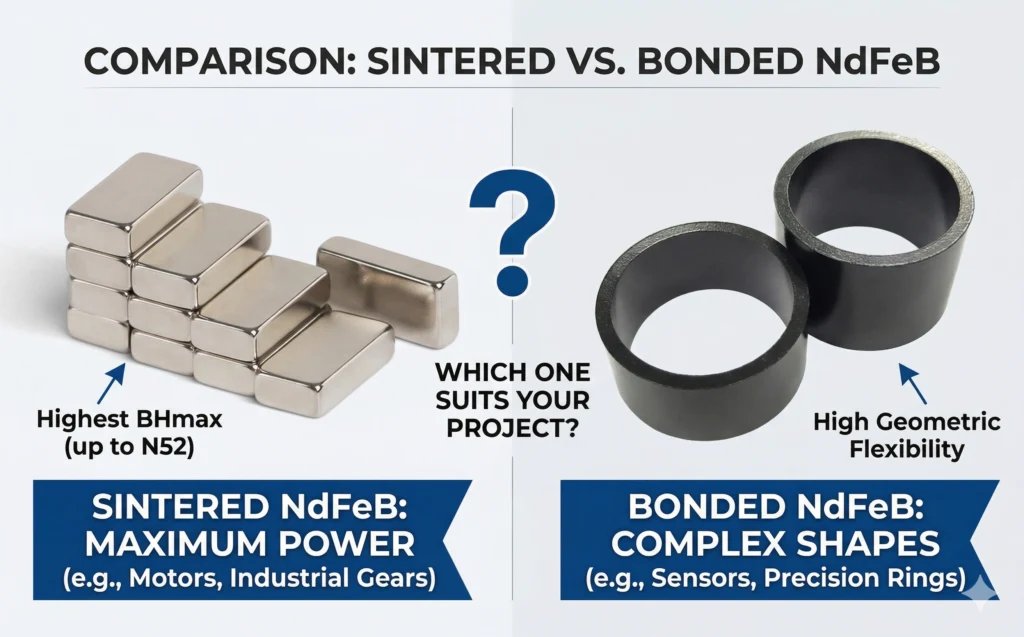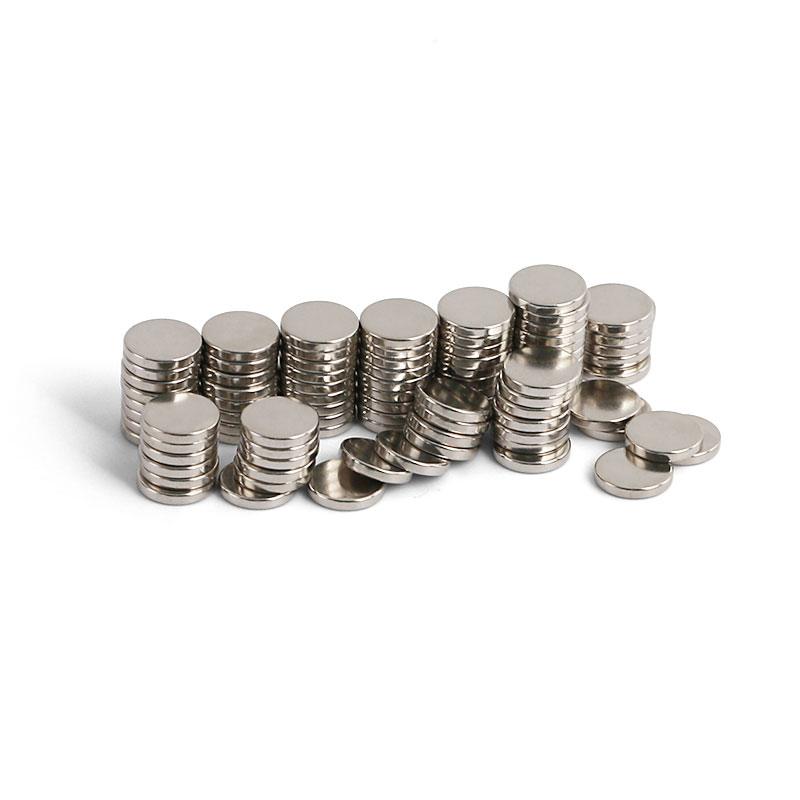
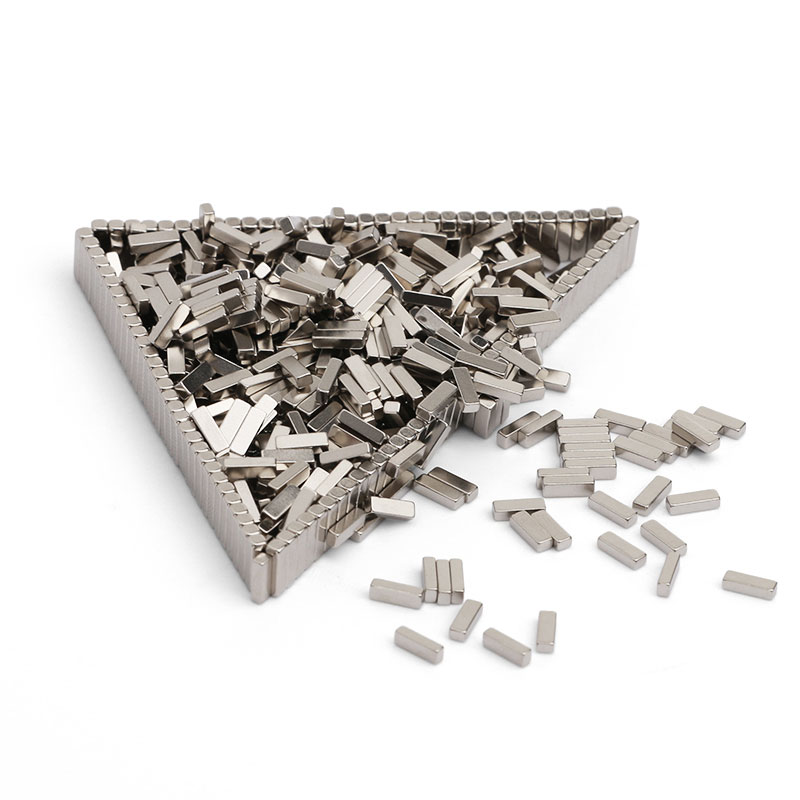
Sintered neodymium-iron-boron magnets are not cast directly into their final shape. They are produced by a tightly controlled powder-metallurgy route in which chemistry, particle size, crystal orientation, density, heat treatment, machining, coating, and magnetization all influence the final result. Understanding the NdFeB magnet production process helps engineers specify realistic tolerances, choose a suitable grade, and avoid problems that cannot be corrected after production.
Key takeaway: a reliable NdFeB magnet is the result of an integrated process. Maximum energy product is important, but coercivity, temperature stability, corrosion protection, geometry, magnetization, and inspection must be designed together.
1. Raw-Material Selection and Formula Design
The process begins with neodymium, praseodymium, iron, boron, and smaller additions selected for the target magnetic and thermal properties. Dysprosium or terbium may be used selectively when higher coercivity and temperature resistance are required, while other additions help control grain structure or processing behavior.
The formula is not chosen from grade name alone. The engineer must consider operating temperature, reverse magnetic field, geometry, permeance coefficient, corrosion exposure, and cost. A high-remanence material may be unsuitable if the magnet operates near a demagnetizing condition. For critical applications, magnetic-circuit analysis should precede material selection.
2. Vacuum Melting and Strip Casting
Raw materials are melted under vacuum or an inert atmosphere to limit oxidation. The molten alloy is rapidly cooled into thin flakes by strip casting. Cooling rate and alloy uniformity affect the distribution of the Nd-rich phase and the microstructure that will later support high coercivity.
Composition is checked before the alloy advances. Traceability at this stage matters because small chemistry changes can influence remanence, coercivity, sintering behavior, and long-term consistency.
3. Hydrogen Decrepitation
The alloy flakes are exposed to hydrogen, which enters the material and causes it to break into a coarse, friable powder. This hydrogen-decrepitation step reduces the energy required for fine milling and helps the material fracture along favorable microstructural boundaries.
Hydrogen is removed under controlled conditions. Oxygen pickup must be minimized throughout powder handling because fine NdFeB powder is chemically active and excess oxygen can reduce magnetic performance.
4. Jet Milling to Fine Powder
The coarse material is milled in an inert-gas jet mill until the particles are typically only a few micrometers in size. Particle-size distribution is a critical process variable. Powder that is too coarse may not align or sinter correctly; excessive fines increase oxidation risk and may create processing instability.
Production controls normally include particle-size measurement, oxygen monitoring, controlled atmosphere, and strict powder-handling procedures. This stage is one reason magnet manufacturing requires specialized safety and environmental controls.
5. Magnetic-Field Alignment and Pressing
Sintered NdFeB is normally anisotropic. During pressing, an external magnetic field rotates the powder particles so their easy magnetization axes point in a preferred direction. The aligned powder is then compacted in a die, often followed by cold isostatic pressing to improve density uniformity.
The orientation direction established here determines the practical final magnetization direction. An axially oriented blank cannot simply be converted later into a high-performance radial magnet. Drawings should therefore define magnetization direction, pole position, and any angular datum before tooling is approved.
6. Vacuum Sintering and Heat Treatment
The green compact is heated in a vacuum furnace to bond the particles and develop a dense microstructure. Controlled cooling and subsequent aging heat treatments optimize grain-boundary phases and coercivity. Furnace temperature uniformity, vacuum level, loading pattern, and thermal cycle all affect lot consistency.
The sintered block shrinks during this step, so near-net pressing does not eliminate finish machining. Density, magnetic properties, and microstructure are sampled after sintering before the material is released for cutting.
7. Cutting, Grinding, and Precision Machining
Sintered NdFeB is hard and brittle. Blocks are sliced by wire cutting, multi-wire cutting, or diamond tooling, then ground to final dimensions. Discs, rings, arcs, chamfers, grooves, and special profiles require process-specific fixtures and allowances.
Tolerance should reflect function. Extremely tight tolerances on every dimension increase scrap and cost without necessarily improving the assembly. Critical pole faces, adhesive gaps, concentricity, parallelism, and position features should be identified separately from noncritical dimensions.
8. Cleaning and Surface Protection
NdFeB contains a reactive Nd-rich phase and normally needs corrosion protection. Parts are cleaned and prepared before receiving a coating such as nickel-copper-nickel, zinc, epoxy, phosphating, passivation, or an application-specific multilayer system. The best coating depends on humidity, salt exposure, temperature, wear, adhesive chemistry, and whether the magnet will be overmolded or sealed inside an assembly.
Coating quality is verified through appearance, thickness, adhesion, and relevant corrosion testing. A coating cannot compensate for poor edge design, impact damage, or an assembly that traps moisture.
9. Magnetization
Finished magnets are placed in a magnetizing fixture and exposed to a short, very strong magnetic pulse. The fixture establishes axial, diametrical, radial, multipole, or another drawing-defined pole pattern. Large sections, high-coercivity grades, and fine multipole pitches require careful fixture design and sufficient magnetizing field.
Some parts are shipped unmagnetized and magnetized after assembly, but this is only practical when the entire magnetic circuit fits the fixture and surrounding components tolerate the pulse and assembly forces.
10. Final Inspection and Lot Release
Final inspection combines mechanical, visual, coating, and magnetic checks. Depending on the project, the control plan may include:
- Dimensions, flatness, parallelism, concentricity, and profile inspection.
- Visual checks for chips, cracks, plating defects, and contamination.
- Flux, magnetic moment, surface field, or Helmholtz-coil measurement.
- Polarity, pole position, and multipole-pattern verification.
- Coating thickness, adhesion, and corrosion-resistance testing.
- Pull-force, torque, sensor-output, or assembly-level functional tests.
A magnetic value is meaningful only when the test fixture, air gap, temperature, and measurement position are defined. For repeat production, golden samples and calibrated fixtures reduce ambiguity.
Typical Process Flow at a Glance
| Stage | Main purpose | Key control |
|---|---|---|
| Formula and melting | Create the required alloy | Chemistry and oxidation |
| Hydrogen treatment and milling | Produce fine powder | Particle size and oxygen |
| Alignment and pressing | Set crystal orientation | Field direction and density |
| Sintering and aging | Develop density and coercivity | Vacuum and thermal cycle |
| Machining | Create final geometry | Tolerance and edge integrity |
| Coating | Protect against corrosion | Preparation, thickness, adhesion |
| Magnetization and inspection | Create and verify final poles | Fixture, polarity, magnetic test |
Common Production Risks
Frequent risks include oxidation during powder handling, density variation, insufficient orientation, furnace nonuniformity, machining cracks, edge chipping, coating pinholes, incorrect pole direction, and magnetic test methods that do not match the application. Early design-for-manufacturing review is the most effective way to control them.
How Guande Supports Custom NdFeB Projects
Guande Magnet supports grade selection, manufacturability review, custom machining, coating selection, magnetizing-fixture planning, magnetic-circuit evaluation, assembly, and lot-specific inspection. We can review drawings before tooling, establish critical-to-quality dimensions, and develop a practical test method around the actual working gap and target component.
Frequently Asked Questions
Are NdFeB magnets machined before or after sintering?
Precision machining is performed after sintering because the compact shrinks during densification and the final material is hard and brittle.
When are NdFeB magnets magnetized?
Most are magnetized after machining and coating. Some assemblies are magnetized as a complete unit when safe assembly or the magnetic circuit requires it.
Why do two N42 magnets sometimes perform differently?
Grade is only one variable. Geometry, orientation, coating allowance, magnetizing saturation, temperature, working point, test distance, and the surrounding steel circuit can all change measured performance.
Send Guande your drawing, operating temperature, coating environment, magnetization direction, and inspection requirement for a production-route and manufacturability review.