NdFeB, SmCo, and AlNiCo are all permanent-magnet materials, but they solve very different engineering problems. Neodymium-iron-boron offers the highest magnetic energy in the smallest volume. Samarium cobalt combines strong magnetism with high coercivity, temperature stability, and corrosion resistance. AlNiCo tolerates very high temperatures and has excellent reversible temperature behavior, but its low coercivity makes magnetic-circuit design especially important.
Selection rule: do not choose a magnet from pull force or maximum operating temperature alone. Start with the magnetic working point, reverse field, temperature profile, available space, mechanical load, corrosion environment, and required lifetime.
What the Main Magnet Parameters Mean
Remanence (Br)
Remanence is the magnetic flux density retained after the external magnetizing field is removed. Higher Br generally supports higher air-gap flux, but the final field also depends on magnet shape, magnetization direction, pole area, air gap, leakage, and surrounding steel.
Coercivity (Hcb and Hcj)
Coercivity describes resistance to demagnetization. Intrinsic coercivity Hcj is particularly important when a magnet faces high temperature, a reverse field from a motor winding, a thin geometry, or an unfavorable permeance coefficient. A high-Br grade is not automatically a safe grade.
Maximum energy product ((BH)max)
(BH)max indicates the maximum useful magnetic-energy density available from the material. It is valuable for comparing how compact a magnetic circuit can be, but it does not directly predict force, torque, or sensor output in a finished assembly.
Temperature coefficients
The reversible temperature coefficient shows how Br or coercivity changes while temperature changes. Irreversible loss occurs when the operating point crosses a critical region and does not fully recover after cooling. Maximum service temperature therefore depends on grade, geometry, load line, and external field—not only the material family.
Typical Property Comparison
The ranges below are representative engineering values. Exact properties depend on grade, manufacturing route, orientation, shape, supplier specification, and test standard.
| Property | Sintered NdFeB | SmCo | AlNiCo |
|---|---|---|---|
| Typical (BH)max | About 26–55 MGOe | About 15–35 MGOe | About 1.3–13 MGOe |
| Typical Br | About 1.0–1.48 T | About 0.8–1.2 T | About 0.7–1.35 T |
| Coercivity | High to very high; grade dependent | High and thermally robust | Relatively low |
| Practical service temperature | Often 80–230°C by grade and circuit | Often 250–350°C by grade | Often 450–550°C by grade and circuit |
| Br temperature coefficient | Roughly −0.10 to −0.12%/°C | Roughly −0.03%/°C | Roughly −0.02%/°C |
| Corrosion resistance | Usually needs protection | Generally very good | Generally good |
| Mechanical behavior | Hard and brittle | Very hard and brittle | Hard; cast grades can be brittle |
| Relative material cost | High performance per volume; price varies | Usually highest | Application dependent |
NdFeB Magnets: Maximum Strength in Minimum Space
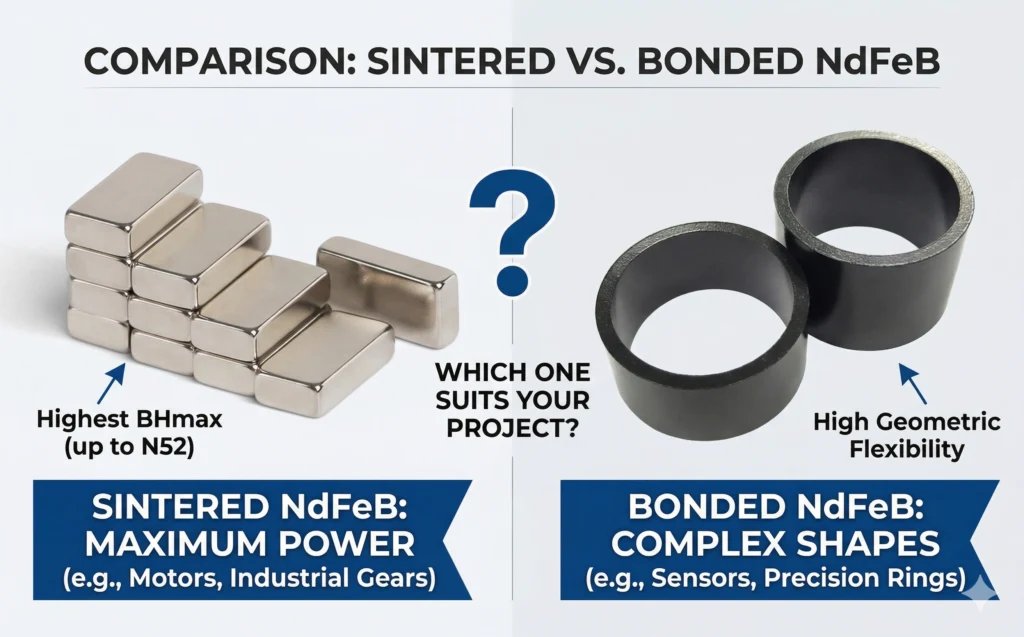
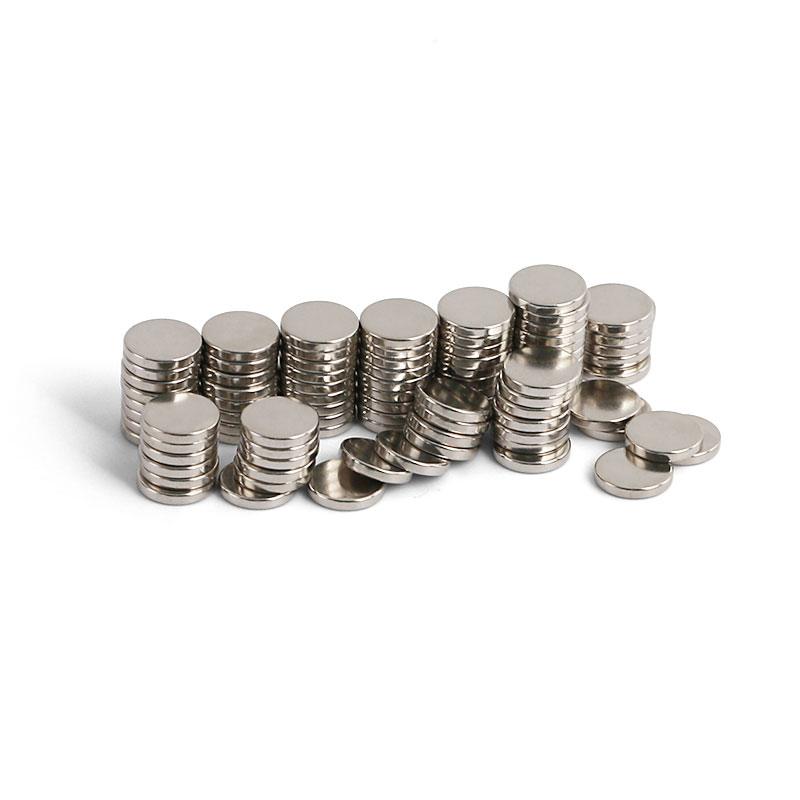
Sintered NdFeB provides the highest commercially available energy product among common permanent magnets. It is the first choice when the design needs high torque density, strong holding force, compact sensors, or a small magnetic assembly.
Its main limitations are temperature sensitivity, corrosion risk, and brittleness. Standard grades may be suitable only around 80°C, while H, SH, UH, EH, or AH grades are designed for progressively higher coercivity and temperature capability. The exact safe temperature still depends on magnet geometry and the reverse field.
Common protection systems include Ni-Cu-Ni, zinc, epoxy, passivation, phosphating, Parylene, and sealed or overmolded assemblies. Coating selection should reflect humidity, salt, adhesive chemistry, wear, and edge-impact risk.
Typical NdFeB applications
- Electric-vehicle traction motors and high-efficiency industrial motors.
- Servo motors, robotics, drones, and compact actuators.
- Wind generators, magnetic couplings, and magnetic bearings.
- Speakers, headphones, sensors, encoders, and consumer electronics.
- Pot magnets, magnetic filters, fixtures, and high-force assemblies.
SmCo Magnets: High Temperature and Magnetic Stability
SmCo magnets are available mainly as SmCo5 and Sm2Co17 families. They offer lower peak energy density than the strongest NdFeB grades, but their intrinsic coercivity, thermal stability, and corrosion resistance make them highly valuable in demanding environments.
SmCo can maintain useful performance at temperatures where many NdFeB grades would suffer unacceptable loss. It also has a much smaller reversible Br temperature coefficient. These benefits support stable sensor calibration, aerospace mechanisms, downhole tools, and high-temperature motors.
The material is very brittle and sensitive to tensile stress, impact, and sharp corners. Machining requires diamond tooling and careful fixturing. Although SmCo often works without a coating, protection or assembly encapsulation may still be specified for cleanliness, handling, or severe chemical exposure.
Typical SmCo applications
- Aerospace, defense, and satellite actuators.
- High-temperature motors, generators, and magnetic couplings.
- Oil-and-gas downhole instruments and turbine sensors.
- Precision encoders, traveling-wave tubes, and analytical equipment.
- Applications requiring long-term field stability and corrosion resistance.
AlNiCo Magnets: Very High Temperature, but Low Coercivity
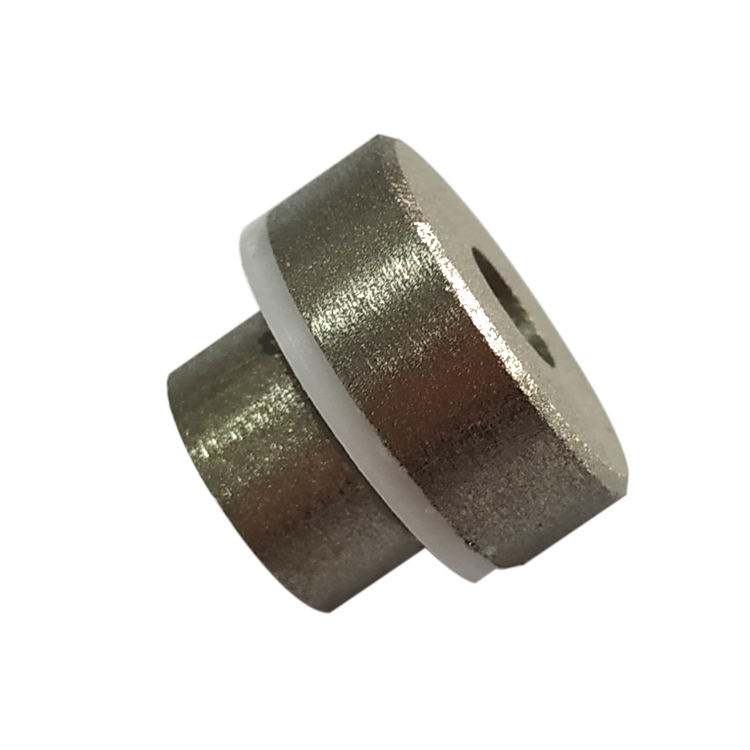
AlNiCo is based mainly on aluminum, nickel, cobalt, and iron. It provides high remanence, excellent temperature stability, and service capability at very high temperatures. Cast AlNiCo supports larger and more complex shapes, while sintered AlNiCo can provide closer tolerances and more uniform small parts.
The major design constraint is low coercivity. A short, thin AlNiCo magnet can be partially demagnetized by its own open-circuit field, an external reverse field, or incorrect assembly. Long magnetic length, a closed steel circuit, and magnetization after assembly are often used to preserve the operating point.
Typical AlNiCo applications
- High-temperature sensors, meters, relays, and ignition systems.
- Electric-guitar pickups, loudspeakers, and legacy motor designs.
- Holding and lifting assemblies with a well-designed steel circuit.
- Laboratory instruments where temperature stability is critical.
- Applications exposed to temperatures beyond practical rare-earth-magnet limits.
Which Material Should You Choose?
| Design priority | Likely starting point | Reason |
|---|---|---|
| Maximum force or torque in minimum volume | NdFeB | Highest energy density |
| High temperature plus strong demagnetization resistance | SmCo | High coercivity and thermal stability |
| Very high temperature in a favorable closed circuit | AlNiCo | Excellent high-temperature capability |
| Uncoated corrosion resistance | SmCo or AlNiCo | More chemically stable than NdFeB |
| Lowest assembly volume | NdFeB | Highest (BH)max |
| Stable field over temperature | SmCo or AlNiCo | Lower reversible temperature coefficient |
Why a Magnetic-Circuit Review Is Essential
A material comparison cannot replace a circuit calculation. Engineers should evaluate the magnet’s load line, operating point at maximum temperature, reverse field, irreversible-loss margin, steel saturation, leakage, air-gap tolerance, and required output. Finite-element analysis and thermal demagnetization testing are especially useful for motors and compact assemblies.
Guande Material and Design Support
Guande Magnet supports NdFeB and SmCo grade selection, AlNiCo application review, custom geometry, magnetization direction, coatings, magnetic-circuit analysis, assembly, and application-level inspection. We can compare candidate materials against the actual operating point instead of relying on a catalogue grade alone.
Frequently Asked Questions
Is SmCo always weaker than NdFeB?
At room temperature and equal volume, high-grade NdFeB normally provides more magnetic energy. At elevated temperature or under a strong reverse field, however, a correctly selected SmCo grade may retain more usable performance.
Can AlNiCo replace SmCo in a high-temperature motor?
Not automatically. AlNiCo tolerates high temperature but has much lower coercivity. The motor’s reverse field and magnet geometry may make it unsuitable without a substantially different magnetic circuit.
Does a higher maximum temperature guarantee longer life?
No. Temperature rating does not cover corrosion, fatigue, coating damage, adhesive aging, vibration, or an unfavorable demagnetizing field. The complete assembly must be validated.
Send Guande your temperature profile, magnetic circuit, available space, reverse field, and target output for a material and grade comparison.