Magnetic filter rods and magnetic grids are passive separators that remove ferromagnetic contamination from powders, granules, liquids, and slurries. They are commonly installed in hoppers, chutes, pipelines, and process vessels where product must pass close to a high-gradient magnetic surface.
Key takeaway: separation performance depends on more than a surface-gauss number. Magnetic gradient, product-to-tube distance, flow pattern, contamination size, temperature, tube spacing, cleaning frequency, and material buildup all matter.
What Is a Magnetic Filter Rod?
A magnetic filter rod—also called a magnetic bar or magnetic tube—normally contains a stack of permanent magnets and steel pole pieces sealed inside a stainless-steel tube. The internal pole pieces concentrate flux at repeated positions along the tube, creating strong local field gradients at the outer surface.
When a ferromagnetic particle enters this nonuniform field, it becomes magnetized and experiences a force toward the tube surface. The particle remains attached until the rod is cleaned or until product buildup creates enough distance and drag to reduce retention.
What Is a Magnetic Grid?
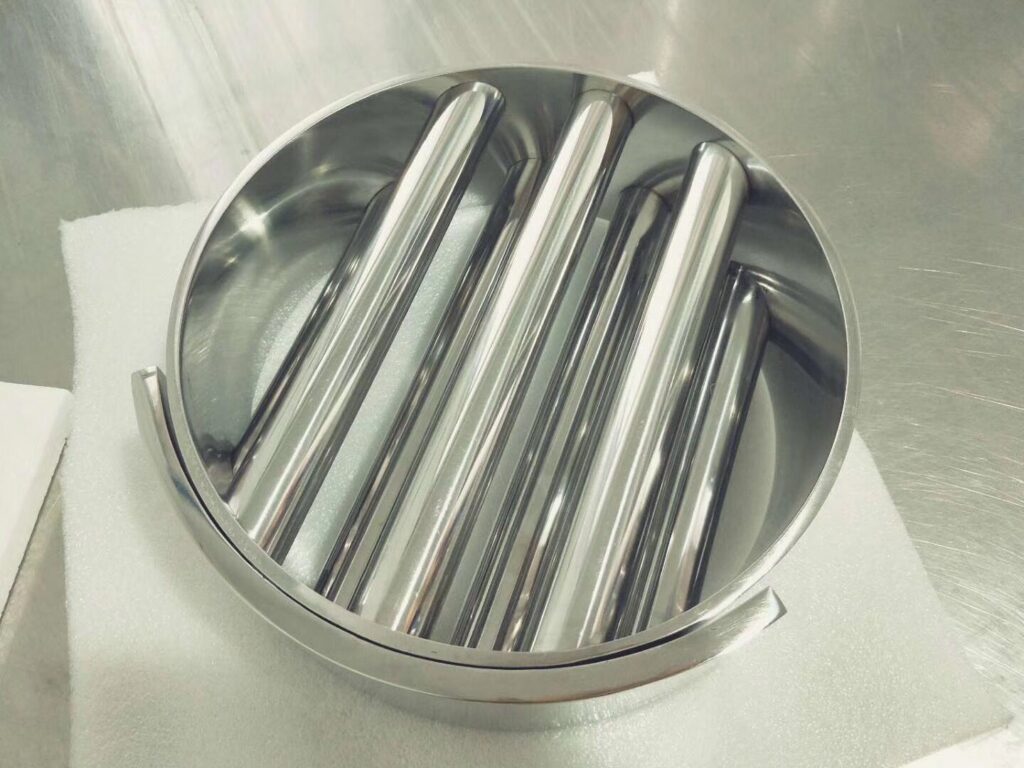
A magnetic grid arranges several rods across a frame so the product stream is divided and forced close to multiple magnetic surfaces. Grids may be rectangular, square, round, drawer-style, or custom shaped to fit a hopper, chute, pipe, or vessel.
Compared with one rod, a grid increases exposure area and reduces the maximum travel distance from the product to a magnetic pole. Staggered rows can improve contact probability because product diverted by the first row approaches different surfaces in the second row.
Core Working Principle
1. Permanent magnets create the source field
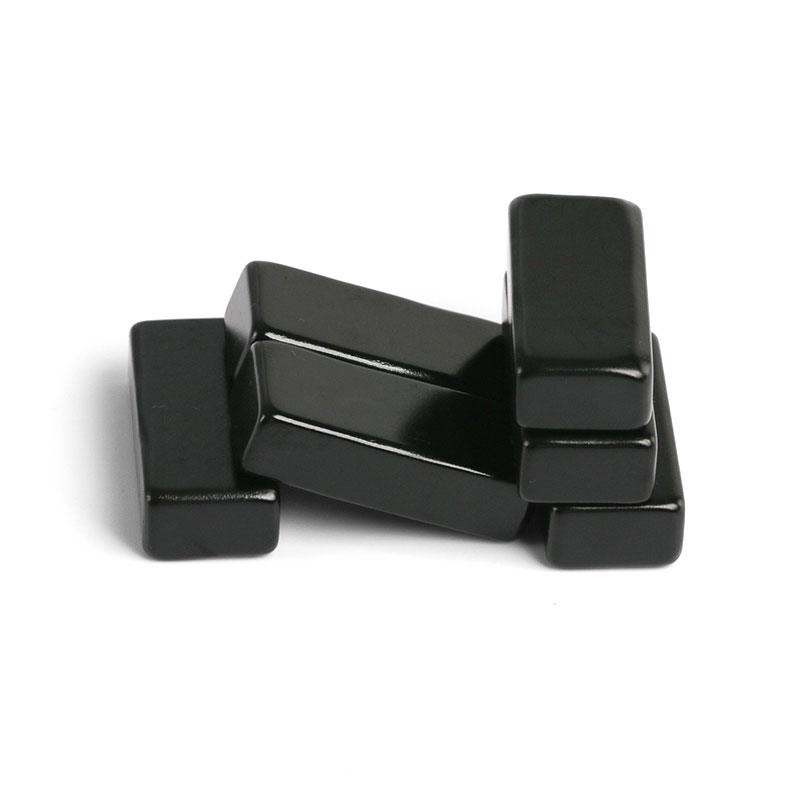
High-energy NdFeB is common where strong room-temperature performance and compact tubes are required. High-temperature NdFeB or SmCo may be used when the process temperature or cleaning cycle exceeds standard-grade limits. The magnet grade must be selected for the actual operating point and not just a claimed surface field.
2. Pole pieces create a high field gradient
A uniform magnetic field can magnetize a particle but produces limited translational force. Separation requires a gradient. Alternating magnets and ferromagnetic pole washers concentrate the field near the tube surface, where small iron and steel particles experience the strongest attraction.
3. The product passes close to the active surface
Magnetic force decreases rapidly with distance. Tube diameter, rod spacing, grid pitch, flow depth, viscosity, particle size, and product bridging determine whether contaminants approach closely enough to be captured.
4. Captured contamination must remain attached
A particle faces fluid drag, vibration, collision, and the weight of accumulated material. Retention depends on particle shape, magnetic permeability, flow velocity, surface condition, and the thickness of the captured layer. A filter that is not cleaned at the correct interval can lose effective performance even though the magnets remain fully functional.
What Contaminants Can Be Removed?
Magnetic filters are effective for iron, mild steel, rust, weld fragments, machining chips, and many work-hardened stainless-steel particles. They can also capture very fine ferromagnetic wear debris that is difficult to screen mechanically.
They do not reliably remove aluminum, copper, brass, most nonmagnetic stainless steels, glass, stone, plastic, or other nonferrous contamination. Weakly magnetic particles may require a very high-gradient design, slow flow, close contact, and application testing.
Typical Applications
| Industry | Typical product stream | Purpose |
|---|---|---|
| Food and beverage | Flour, sugar, spices, grains, oils, syrups | Protect product quality and downstream equipment |
| Plastics | Pellets, regrind, powders | Remove screw, grinder, and transport wear particles |
| Chemicals | Pigments, powders, resins, process liquids | Prevent contamination and equipment damage |
| Ceramics and minerals | Slurries, glazes, silica, powders | Reduce iron staining and quality defects |
| Pharmaceuticals | Powders and ingredients | Control process contamination under validated hygiene rules |
| Battery materials | Powders and slurries | Remove ferrous wear debris from processing equipment |
| Recycling | Granules and shredded material | Protect machines and improve material purity |
Dry-Product Applications
For free-flowing powders and granules, grids are commonly mounted below hopper outlets or in gravity chutes. The key challenge is achieving close exposure without excessive pressure drop or product bridging. Cohesive powders may need vibration, a larger pitch, a drawer housing, or a different separator architecture.
Abrasive product can wear the stainless tube and eventually expose the internal magnetic circuit. Tube wall thickness and material should therefore match the expected abrasion, while inspection intervals should be part of the maintenance plan.
Liquid and Slurry Applications
Liquid-line filters place rods in a housing that directs flow around the magnetic surfaces. Viscosity, pressure, flow rate, temperature, solids loading, chemical compatibility, and clean-in-place requirements influence the design. Sanitary systems may require 316L stainless steel, polished surfaces, hygienic welds, food-grade seals, drainability, and documented surface finish.
High flow can shorten residence time and increase drag on captured particles. Computational flow review or prototype testing helps avoid bypass paths and stagnant zones.
Standard, Easy-Clean, and Drawer Designs
- Fixed rods: simple and compact; contamination is wiped from the tube manually.
- Easy-clean rods: magnetic cartridges retract from an outer sleeve so particles fall away when the field is removed.
- Drawer grids: one or more rows slide out of a housing for inspection and cleaning.
- Rotary grids: move through cohesive material to improve exposure and reduce bridging.
- Pipeline filters: sealed housings manage liquids, pressure, sanitary connections, and controlled flow.
Critical Design Parameters
Field strength and gradient
Surface gauss is useful only when the measuring instrument, probe orientation, pole position, and temperature are defined. Gradient and capture force at the expected particle distance are more representative of separation performance.
Tube diameter and wall thickness
A thinner nonmagnetic tube wall brings the product closer to the poles but must withstand pressure, impact, abrasion, welding, and repeated cleaning. Mechanical safety and magnetic performance must be balanced.
Grid pitch and row arrangement
Closer spacing improves exposure but may restrict flow or cause bridging. Staggered rows create a tortuous path and are useful when the product can flow freely through the available open area.
Temperature
Product temperature, steam cleaning, hot-water wash, and ambient heat can reduce magnet performance or cause irreversible loss if the wrong grade is selected. The whole thermal cycle must be specified.
Hygiene and corrosion
Tube alloy, weld quality, polish, passivation, seals, dead spaces, and cleaning chemicals determine whether the assembly is suitable for food, pharmaceutical, chemical, or battery-material service.
How to Specify a Magnetic Filter
- Product type, particle size, density, moisture, viscosity, and abrasiveness.
- Flow rate, pressure, installation orientation, and available space.
- Normal and cleaning temperature, including duration and frequency.
- Contaminant material, size range, concentration, and required removal objective.
- Required stainless grade, surface finish, sanitary standard, and connection type.
- Manual, easy-clean, drawer, rotary, or automated cleaning preference.
- Inspection method and permitted pressure drop or bridging risk.
Guande Filter Design and Manufacturing Capability
Guande Magnet supports magnetic-circuit design, NdFeB or SmCo grade selection, pole-stack optimization, stainless-tube machining and welding, round and rectangular grids, sanitary housings, easy-clean structures, surface-field mapping, temperature validation, and customized dimensions.
Frequently Asked Questions
Is a higher surface-gauss value always better?
No. Probe method, gradient, product distance, pole spacing, flow, and cleaning condition may matter more. Compare filters using a defined test method and the actual process stream.
Can a magnetic filter remove stainless-steel contamination?
Some work-hardened stainless particles are magnetic enough to capture; fully austenitic or weakly magnetic particles may not be. A sample test is recommended.
How often should a grid be cleaned?
The interval depends on contamination load, flow, retention, and hygiene rules. It should be established through inspection and shortened before buildup shields the active surface.
Send Guande your product, flow, temperature, contaminant, dimensions, and cleaning requirements for a customized filter-rod or magnetic-grid proposal.