New energy vehicles—including battery-electric, plug-in hybrid, hybrid, and fuel-cell vehicles—use permanent magnets in many more places than the main traction motor. Magnets help convert electrical energy into motion, measure position and speed, operate valves and latches, generate sound, and improve the efficiency of pumps, compressors, fans, and steering systems.
Key takeaway: the traction motor is usually the largest single magnet application, but a vehicle may contain dozens of additional permanent-magnet motors, sensors, and actuators. Each location has a different temperature, corrosion, vibration, safety, and magnetic-performance requirement.
1. Traction Motor
The traction motor converts battery energy into propulsion and recovers kinetic energy during regenerative braking. Interior permanent-magnet synchronous motors are widely used because they offer high torque density, strong efficiency over a broad operating range, and compact packaging.
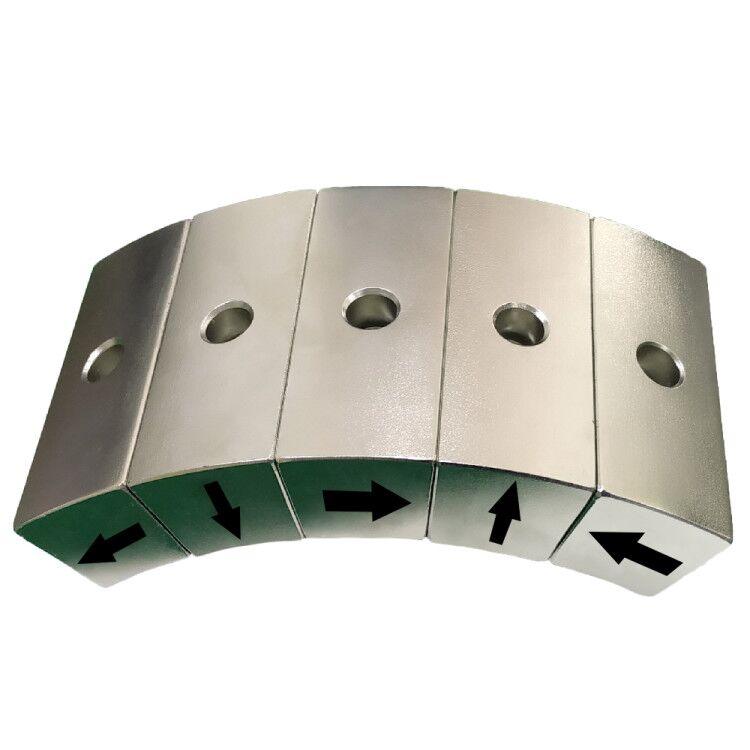
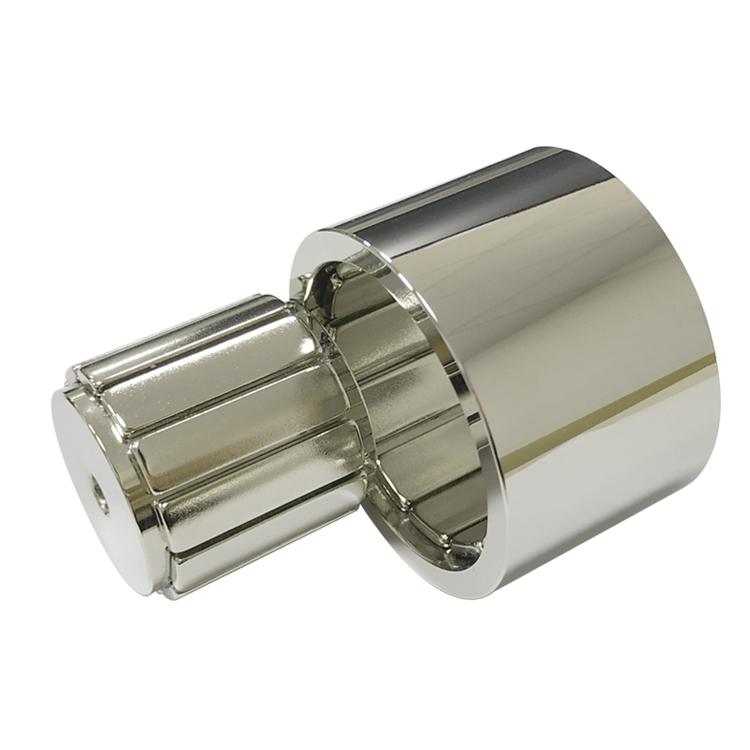
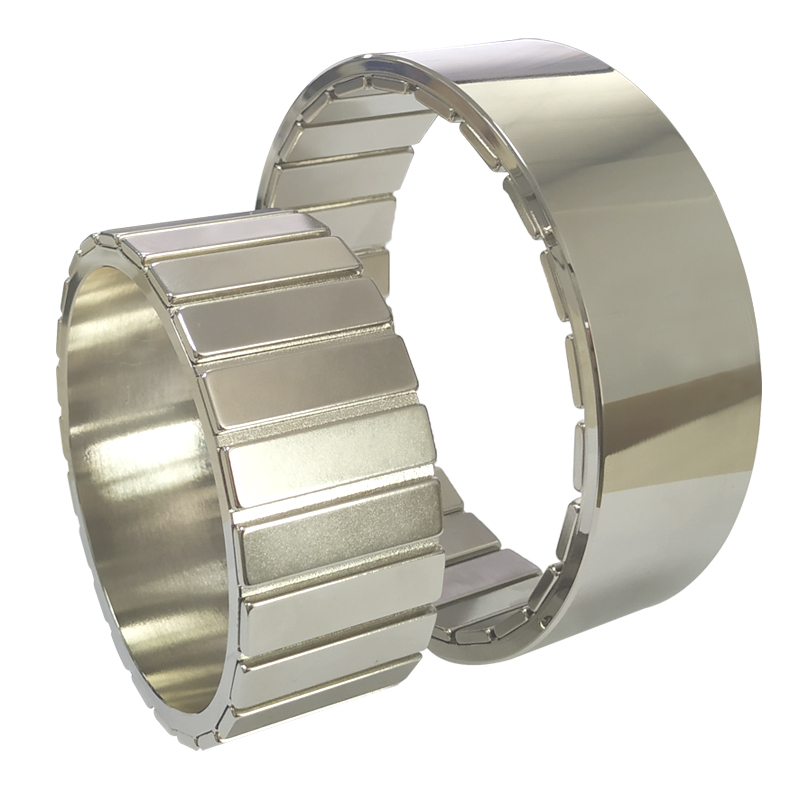
Sintered NdFeB arc or rectangular magnets are placed inside rotor laminations in V, U, spoke, or other flux-shaping arrangements. The magnets experience elevated temperature, centrifugal load, vibration, mechanical stress, and reverse fields from the stator. High-coercivity grades, grain-boundary diffusion, optimized rotor bridges, protective coatings, and secure retention are therefore important.
Not every EV uses a permanent-magnet traction motor. Induction, electrically excited synchronous, wound-field, switched-reluctance, and hybrid topologies are also used. The choice reflects efficiency, cost, supply strategy, control, speed range, and rare-earth exposure.
2. Electric Air-Conditioning Compressor
An electric compressor operates independently of engine speed and is essential for cabin cooling and battery thermal management. Compact permanent-magnet motors provide high efficiency and smooth variable-speed control inside the compressor.
The rotor magnet system must tolerate refrigerant-related environments, heat, high rotational speed, oil exposure, and repeated thermal cycling. Magnetic loss, rotor balance, adhesive compatibility, and containment require careful validation.
3. Coolant and Thermal-Management Pumps
Electric coolant pumps circulate fluid through the battery, inverter, motor, charger, fuel-cell stack, or cabin heating circuit. Brushless permanent-magnet motors are common because they provide efficient variable flow, long life, and precise electronic control.
Wet-rotor pumps may use a magnetic coupling or a sealed rotor to isolate electronics from liquid. Magnet grade, coating, overmolding, fluid compatibility, and temperature range are key design variables.
4. Oil Pumps, Vacuum Pumps, and Brake Boosters
Electrified vehicles cannot rely on a continuously running combustion engine for oil pressure or vacuum. Electric oil pumps lubricate gearboxes and e-axles, while electric vacuum pumps or electromechanical brake boosters support braking functions. Permanent-magnet motors offer fast response and efficient intermittent operation.
Safety-related pumps and boosters need controlled torque, low noise, diagnostic capability, and robust operation under voltage and temperature extremes.
5. Electric Power Steering
Electric power steering uses a motor to assist driver input. Permanent-magnet synchronous or brushless DC motors provide high torque in a compact space and respond accurately to control commands. Position and torque sensors within the steering system may also contain small permanent magnets.
Because steering is safety critical, the magnetic design must consider demagnetization margin, fault torque, vibration, acoustic behavior, sensor redundancy, and long-term thermal exposure.
6. Fans and Blowers
Permanent-magnet motors drive radiator fans, battery-cooling fans, HVAC blowers, seat-ventilation fans, electronics-cooling fans, and sometimes fuel-cell air systems. High efficiency reduces auxiliary energy consumption and can extend driving range.
These motors may use NdFeB, ferrite, bonded magnets, or hybrid magnetic circuits depending on size, temperature, noise, speed, and cost targets.
7. Active Grille Shutters, Valves, and Thermal Actuators
Small permanent-magnet motors operate grille shutters, coolant valves, refrigerant valves, air doors, charging-port covers, and battery disconnect mechanisms. Magnets are also used in solenoids, latching devices, and position sensors.
Although each device uses little magnetic material, the combined volume across a vehicle platform can be significant. Reliability often depends on moisture sealing, gear durability, stall behavior, and corrosion control.
8. Sensors and Encoders
Permanent magnets provide reference fields for Hall-effect, magnetoresistive, reed, and inductive-magnetic sensing systems. Typical functions include:
- Motor rotor position and speed sensing.
- Wheel speed, pedal position, steering angle, and gear position.
- Door, hood, trunk, seat-belt, and charging-port detection.
- Fluid level, valve position, and pump commutation.
- Battery current sensing, often through a magnetic core and field sensor.
Sensor magnets require controlled field direction, magnetic moment, pole position, air gap, and temperature drift. The strongest grade is rarely the best specification; repeatability at the sensor location is more important.
9. Speakers, Buzzers, and Haptic Systems
Cabin speakers, pedestrian warning systems, alert buzzers, microphones, and haptic actuators use permanent magnets to convert electrical signals into sound or motion. NdFeB enables compact high-output transducers, while ferrite remains attractive for larger, cost-sensitive speakers.
10. Seats, Windows, Doors, and Comfort Motors
Seat adjustment, window lift, sunroof, power door, mirror, tailgate, wiper, washer, and ventilation systems use small motors. Many employ ferrite magnets, although NdFeB or bonded magnets can reduce size, weight, or power consumption in demanding designs.
Permanent-Magnet Application Map
| Vehicle system | Typical magnet function | Common priorities |
|---|---|---|
| Traction motor | Torque generation | Coercivity, torque density, high-speed retention |
| Electric compressor | High-speed motor | Heat, balance, refrigerant/oil compatibility |
| Coolant and oil pumps | Efficient variable-speed drive | Fluid sealing, temperature, life |
| Steering and braking | Assist torque and actuation | Functional safety and demagnetization margin |
| Fans and blowers | Airflow generation | Efficiency, noise, cost |
| Sensors and encoders | Position, speed, current, and status | Field tolerance and temperature drift |
| Cabin systems | Sound, haptics, comfort motion | Compactness, acoustics, price |
Which Magnet Materials Are Used?
Sintered NdFeB
Used where high power density, compact size, and strong air-gap flux are important. High-coercivity grades are common in hot, reverse-field environments.
Bonded NdFeB
Supports complex shapes, multipole patterns, and dimensional consistency. It provides lower energy density than sintered NdFeB but can simplify integrated rotor or sensor designs.
Ferrite
Offers low cost, good corrosion resistance, and supply diversity. It is widely used in auxiliary motors and is also being reconsidered for some traction architectures with larger or more complex magnetic circuits.
SmCo
Used selectively where high temperature, corrosion resistance, and magnetic stability justify the higher material cost.
Automotive Design and Validation Requirements
- Magnetic performance over the full operating-temperature range.
- Irreversible demagnetization under worst-case current and fault conditions.
- Dimensional tolerance, rotor balance, magnet position, and pole-angle control.
- Coating, adhesive, overmolding, corrosion, humidity, and fluid compatibility.
- Thermal shock, vibration, centrifugal load, impact, and endurance cycling.
- Flux, back-EMF, torque, cogging, sensor output, or assembly-level testing.
- Lot traceability, change control, process capability, and failure analysis.
Guande Automotive Magnet Capability
Guande Magnet supports high-coercivity NdFeB grade selection, arc and block magnets, bonded magnets, coatings, grain-boundary-diffusion options, motor-rotor assemblies, magnetization fixtures, magnetic mapping, pull and torque tests, and design-for-manufacturing review. We can evaluate the magnet together with the steel circuit, adhesive gap, operating temperature, and reverse field.
Frequently Asked Questions
How much NdFeB is in an EV?
The amount varies widely by motor topology, power, number of motors, and auxiliary systems. A vehicle with a permanent-magnet traction motor uses far more NdFeB than one with an induction or wound-field traction motor.
Are all magnetic components in an EV permanent magnets?
No. Transformers, inductors, charging components, and many current sensors use soft-magnetic cores rather than permanent magnets. The functions and materials are different.
Why are high-temperature grades used in traction motors?
Rotor magnets experience heat and reverse fields. Higher intrinsic coercivity provides additional resistance to irreversible demagnetization, but the final grade must be verified in the actual rotor circuit.
Send Guande your motor or automotive component drawing, temperature map, reverse field, coating environment, and validation plan for an application-specific review.