Sintered NdFeB provides high magnetic output in a compact volume, but its microstructure is not naturally corrosion resistant. The alloy contains an Nd2Fe14B main phase plus neodymium-rich grain-boundary phases. Those neodymium-rich regions are chemically active. Moisture, salts, acids, machining residues, or a damaged surface can start localized corrosion that spreads along the grain boundaries.
Practical answer: an NdFeB magnet coating is part of the functional design, not just a cosmetic finish. It protects the magnet during storage, assembly, and service. The correct coating depends on humidity, chemicals, temperature, dimensional allowance, adhesion method, wear, and expected life.
What Happens If Sintered NdFeB Is Left Unprotected?
When the grain-boundary phase oxidizes, the surface can discolor, blister, pit, or form loose powder. Corrosion reduces physical dimensions and weakens the material around the grains. A magnet may then lose flux, crack during assembly, or release particles into the product. The risk is highest at sharp edges, pores, grinding damage, and locations where water is trapped.
Plating cannot repair a poor substrate. Before neodymium magnet plating, the part must be ground to size, properly chamfered, cleaned, activated, and handled without contamination. Coating thickness also belongs in the dimensional tolerance stack.
Common NdFeB Magnet Coatings
| Coating system | Typical total thickness* | Main strengths | Important limits |
|---|---|---|---|
| Ni-Cu-Ni | 10–30 µm | Hard, attractive, good adhesion and wear resistance; widely available | Metallic layers can corrode after deep scratches or edge damage |
| Zinc | 5–15 µm | Economical, relatively thin, offers sacrificial protection | Softer finish; appearance and long-term humidity resistance are below premium systems |
| Epoxy | 15–30 µm | Good barrier against humidity, salt mist and many mild chemicals | Edges may chip; coating process and adhesion control are critical |
| Ni-Cu-Ni + epoxy | 20–40 µm | Metal base layers plus an organic barrier for demanding corrosion exposure | Greater thickness; dimensional and bonding interfaces must be checked |
| Electroless Ni-P | 8–25 µm | Uniform coverage on complex geometry; good hardness and corrosion resistance | Process cost and chemistry control are higher |
| Parylene C | 5–25 µm | Conformal, electrically insulating, low-friction and highly uniform | Higher cost; edge preparation and adhesion promotion may be needed |
| Phosphate / passivation | Very thin | Minimal dimensional change; useful as temporary or mild-environment protection | Not a substitute for a robust barrier in wet or salty service |
*Representative industry ranges, not universal specifications. Actual thickness depends on the drawing, process, geometry, and supplier capability.
How to Choose Between Nickel, Zinc and Epoxy
Ni-Cu-Ni for general mechanical durability
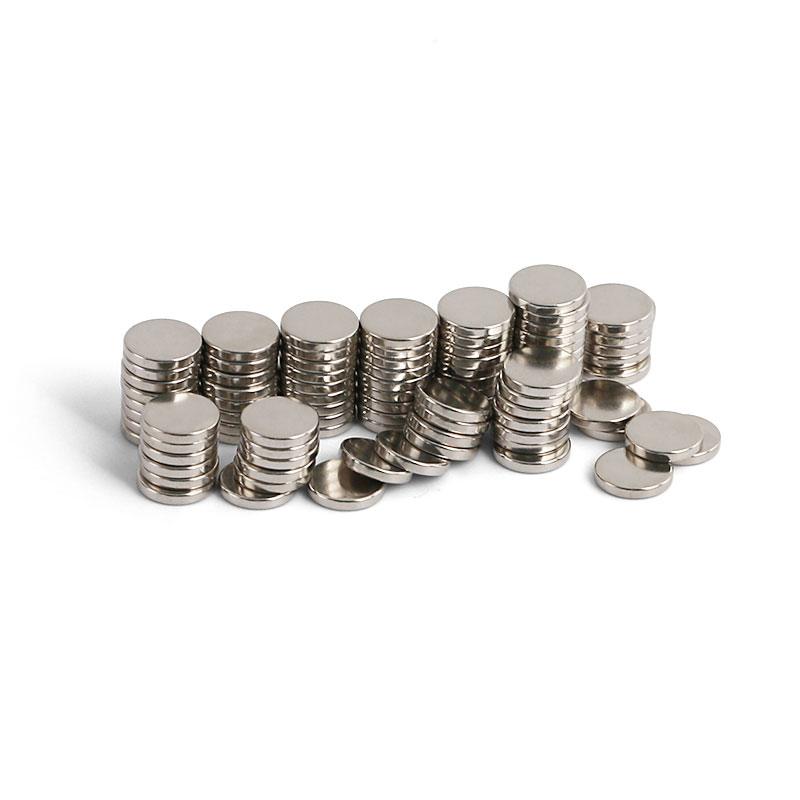
Nickel coated neodymium magnets are common in sensors, motors, fixtures, consumer products, and dry industrial equipment. Copper between the nickel layers improves leveling and helps form a stable multilayer barrier. The finish also provides a consistent surface for handling and some adhesive systems. It is not automatically suitable for permanent outdoor exposure or immersion.
Zinc for cost-controlled, moderate exposure
Zinc plating is useful when the environment is relatively dry, abrasion is limited, and a thin, economical finish is required. Because zinc is anodic to the underlying material, it can provide sacrificial protection at small defects. White, blue, or colored passivation systems may be available, but environmental compliance must be defined on the drawing.
Epoxy for moisture and chemical barriers
Epoxy coated neodymium magnets are frequently selected for humid, salt-mist, or mildly chemical environments. Black epoxy is common, but color alone does not define performance. Resin formulation, pretreatment, film thickness, cure, porosity, and edge coverage matter. For rotors and bonded assemblies, the adhesive must also be compatible with the epoxy surface.
Coating Selection by Application Environment
| Environment or process | Useful starting option | Engineering checks |
|---|---|---|
| Dry indoor equipment | Ni-Cu-Ni or zinc | Wear, appearance, adhesive compatibility |
| High humidity / condensation | Epoxy or Ni-Cu-Ni + epoxy | Edge coverage, thermal cycling, trapped water |
| Outdoor or salt exposure | Multilayer epoxy system plus sealed assembly design | Salt-mist target, UV, fasteners, galvanic couples |
| Medical or clean assembly | Parylene or qualified specialty coating | Biocompatibility, sterilization, cleanliness documentation |
| High-temperature motor | Qualified metallic or high-temperature organic system | Cure temperature, adhesive, expansion mismatch, Hcj margin |
| Food or fluid-contact equipment | Application-specific encapsulation | Regulatory status; coating alone may not be an acceptable barrier |
Why “Salt-Spray Hours” Are Not Enough
Salt-spray results are useful for comparing controlled samples, but they do not predict every service condition. A finished magnet may experience impact, cyclic heat, adhesive cure, grinding dust, flexing, cleaning chemicals, or galvanic contact with aluminum and steel. Test coupons also have fewer vulnerable edges than small production magnets.
A practical qualification plan combines coating thickness, visual inspection, adhesion, porosity or continuity, humidity or salt-mist exposure, thermal cycling, and a final magnetic or pull-force check. Critical assemblies should be tested after the real bonding and encapsulation process.
Design Details That Improve Coating Reliability
- Add a controlled chamfer instead of a sharp edge that is difficult to cover.
- State coating type and thickness on the drawing; do not specify color alone.
- Include coating thickness when setting air gaps, press fits, and final dimensions.
- Avoid metal-to-metal impact during assembly and transport.
- Seal water traps and exposed interfaces at the assembly level.
- Confirm that adhesive, primer, overmolding temperature, and cleaning agents are compatible.
How Guande Supports Coated NdFeB Parts
As a sintered NdFeB magnet supplier, Guande reviews the substrate, coating system, tolerances, working temperature, and assembly method together. Buyers evaluating a neodymium magnet supplier should ask how coating thickness, adhesion and corrosion tests are controlled. For custom magnetic assemblies, we can align coating selection with bonding, overmolding, steel parts, inspection, and lot traceability instead of treating each process independently.
For custom neodymium magnets, send the drawing, environment, expected life, temperature range, and any salt-mist or chemical requirement. A responsible neodymium magnet manufacturer should confirm what will be tested, not simply recommend the thickest coating. Share your application conditions for a coating and manufacturability review.
Frequently Asked Questions
Are nickel-plated NdFeB magnets waterproof?
No. Ni-Cu-Ni improves corrosion resistance, but scratches, pores, edges, and interfaces remain possible failure paths. Continuous immersion normally needs a sealed assembly or qualified encapsulation.
Does a thicker coating always last longer?
No. Pretreatment, adhesion, porosity, edge coverage, and mechanical damage can matter more than thickness alone. Excess thickness can also affect fit and air gap.
Can coated magnets be machined afterward?
Machining breaks the protective layer and exposes brittle NdFeB. Final grinding and chamfering should normally be completed before coating.