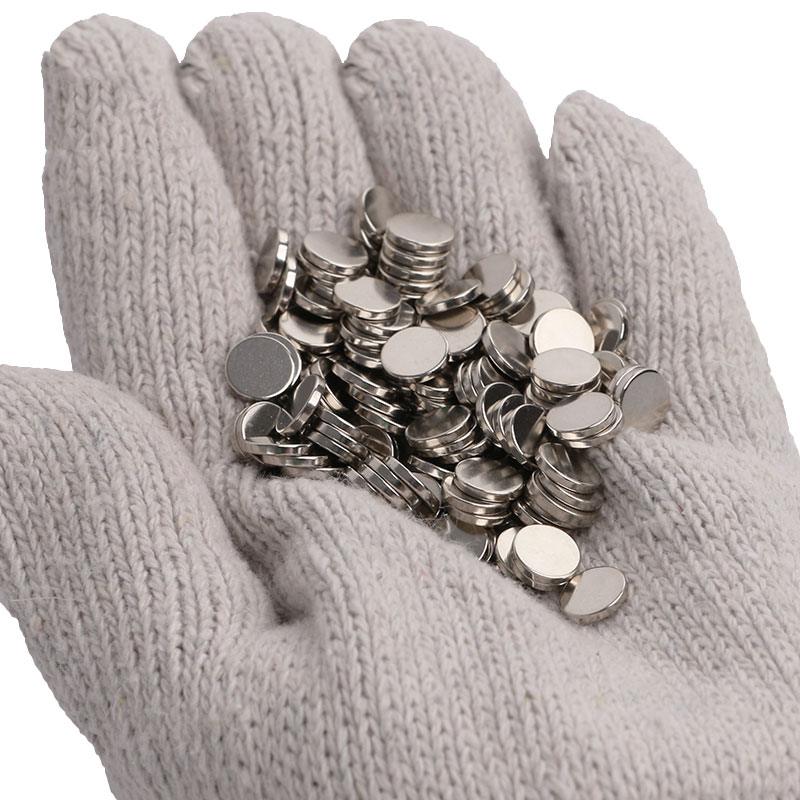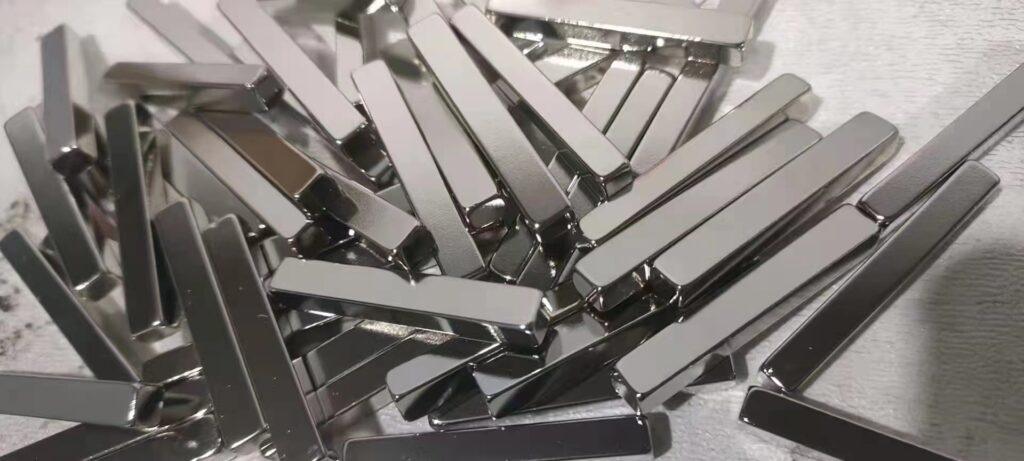
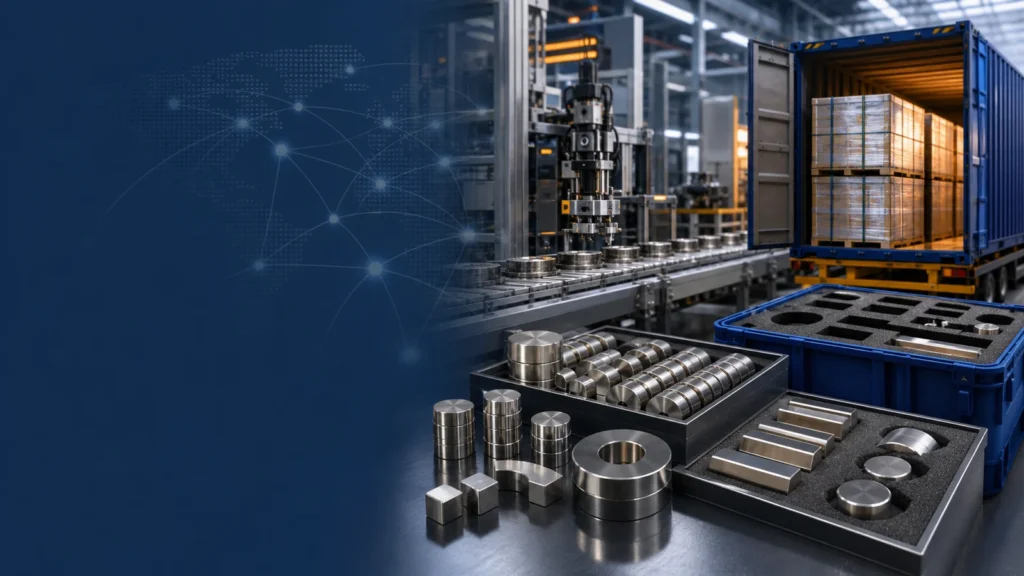
For industrial buyers, the rare earth magnet supply chain is no longer just a pricing topic. It is now a continuity, compliance, and product-launch issue. Electric mobility, industrial automation, robotics, wind power, aerospace, and advanced electronics all depend on high-performance permanent magnets. At the same time, the steps between a rare earth mine and a production-ready sintered NdFeB magnet remain highly concentrated.
The International Energy Agency reported in April 2026 that demand for the magnet rare earths neodymium, praseodymium, dysprosium, and terbium has doubled since 2015 and is projected to grow by more than 30% by 2030 under current policy settings. The same report estimates that China accounted for 91% of refined magnet rare earth output and 94% of sintered permanent magnet production in 2024. These figures explain why a short disruption can quickly affect long downstream supply chains.
Key takeaway: The best procurement response is not to chase the lowest unit price. It is to build a specification, validation, and supply plan that can survive material volatility and regulatory change.
Why the Rare Earth Magnet Supply Chain Is Difficult to Diversify
A permanent magnet is the result of several technically demanding stages: mining, beneficiation, separation, oxide production, metal refining, alloying, powder preparation, pressing, sintering, heat treatment, machining, coating, magnetization, and final inspection. Adding a new mine does not automatically create qualified magnet capacity. The downstream steps require specialized equipment, process knowledge, quality systems, and customer validation.
This is why the IEA identifies magnet manufacturing as a major bottleneck in supply diversification. Planned capacity outside the dominant supplier is expanding, but refining, alloy production, and finished magnet capacity still lag projected demand. Buyers should therefore treat supplier capability and production control as strategic data, not just sales claims.
Six Actions Industrial Buyers Can Take in 2026
1. Separate Material Risk From Part-Number Risk
Start by identifying which drawings depend on high-coercivity grades, heavy rare earth additions, unusual coatings, or tight magnetic tolerances. A standard N35 block magnet and a thin-wall N48UH arc segment do not carry the same sourcing risk. Create a risk map at the part-number level so that engineering attention goes to the components that can actually stop production.
For each critical part, document the approved grade, intrinsic coercivity requirement, maximum operating temperature, geometry, coating, magnetization direction, and acceptance method. This prevents an emergency purchase from quietly changing the magnetic design.
2. Qualify the Process, Not Only the Sample
A perfect sample proves that one part can be made. It does not prove that every production batch will follow the same route. During supplier qualification, ask how alloy chemistry, pressing orientation, sintering, heat treatment, machining, coating, and final magnetic inspection are controlled. Request a clear change-control process for raw materials, subcontractors, tooling, and production location.
Batch-level traceability and magnetic test data are especially important for motor, sensor, medical, and safety-critical programs. Guande Magnet describes its approach as controlled manufacturing from material processing through final inspection, with documented change control from sample approval to serial production. Buyers can use the same principle as a qualification benchmark, regardless of supplier.
3. Approve a Performance Window, Not a Marketing Grade Alone
Magnet grade is only one input. The finished component must work within a magnetic circuit that includes air gaps, steel parts, temperature, opposing fields, and mechanical tolerances. Instead of approving a drawing based only on “N52,” define the performance window that matters: flux, surface field at a defined point, magnetic moment, pull force in a defined fixture, torque, or motor back-EMF.
This creates room for responsible engineering optimization while preventing unapproved material substitution. It can also reduce cost when the application does not need the highest available energy product.
4. Build Dual Timelines for Samples and Serial Production
Prototype lead time and serial-production lead time should be planned separately. A supplier may machine samples from available stock while serial production requires a dedicated alloy batch, tooling, coating capacity, and export preparation. Ask for both timelines at quotation stage, including the order-release date, drawing freeze, sample approval, pilot build, and recurring production cadence.
For repeat programs, consider forecast sharing, reserved raw material, or a safety-stock agreement. The correct model depends on demand stability, shelf-life considerations, and the cost of a line stoppage.
5. Treat Export Documentation as Part of Product Quality
Permanent magnets can create shipping and customs delays when documentation is incomplete. The shipping plan may require magnetic field inspection, shielding, suitable packaging, correct product descriptions, and coordinated air or sea freight. Confirm responsibilities before the first urgent shipment.
The commercial invoice, packing list, inspection documents, and product classification should describe the same product. A strong supplier will connect engineering, quality, and logistics data instead of treating export preparation as an afterthought.
6. Design a Recovery Path Before You Need One
Every critical magnet program should have a documented response to supply interruption. That can include an approved alternative grade, a second coating, a geometry modification, a validated lower-heavy-rare-earth option, or an assembly redesign that uses flux concentration more efficiently. The alternative must be tested before a crisis, not during one.
Where temperature and demagnetization resistance drive the design, grain-boundary diffusion and other heavy-rare-earth-efficient approaches may help reduce exposure. The correct choice requires magnetic-circuit analysis and application testing; it is not a universal drop-in replacement.
A Practical Supplier Review Checklist
- Can the supplier explain the complete manufacturing route for your part?
- Are material grades verified by batch, with retained test records?
- Is magnetization direction clearly controlled and inspected?
- Are dimensional and magnetic acceptance criteria defined before production?
- Is there written change control for material, process, tooling, and subcontractors?
- Can the supplier support prototype, pilot, and serial-production volumes?
- Are packaging, magnetic shielding, inspection reports, and export documents planned?
- Is there a contingency plan for high-risk grades or coatings?
What This Means for Your Next RFQ
A resilient rare earth magnet supply chain starts with a complete technical RFQ. Share the operating temperature, load case, air gap, steel interface, corrosion environment, magnetization direction, dimensional tolerances, annual volume, and validation method. These inputs allow the supplier to propose a production-ready solution instead of quoting an isolated piece of magnet material.
Guande Magnet supports sintered NdFeB magnets, magnetic assemblies, and engineered magnetic solutions from prototype to serial production. If your project has a supply-risk or performance challenge, send the technical requirements for an engineering review and quotation.
Frequently Asked Questions
Why are rare earth magnet supply chains considered concentrated?
Because multiple high-value steps – especially separation, refining, alloy production, and permanent magnet manufacturing – are concentrated in a small number of locations. The risk is therefore not limited to mining.
Should buyers always dual-source NdFeB magnets?
Not always. Dual sourcing adds qualification and inventory complexity. It is most valuable for high-impact parts with significant supply, launch, or line-stoppage risk. A documented backup grade or process can sometimes provide better value than a second supplier.
Does a higher magnet grade reduce supply risk?
No. A higher grade may increase performance, but it can also narrow the available production window or add temperature and material constraints. Select the grade from the magnetic circuit and operating conditions, then validate the finished component.
What information helps a supplier quote accurately?
Provide geometry, grade or target magnetic performance, temperature, coating, magnetization direction, tolerances, test method, assembly interface, annual volume, sample quantity, and target schedule.