Neodymium-iron-boron technology has been developed for more than four decades, but “the original patents have expired” is not a complete patent assessment. Foundational composition and manufacturing inventions are only one layer. Newer patents can cover alloy formulations, powder preparation, grain-boundary diffusion, magnet shape, magnetization, coating, rotor construction, recycling and application-specific assemblies.
Business point: a product is not cleared by finding one expired patent. Freedom to operate depends on the claims of valid patents in every country where the product will be made, sold, imported or used.
What a Patent Actually Protects
The title and abstract help locate a document, but enforceable scope is defined by the claims. Two patents with similar titles may protect very different details. One may claim a specific alloy composition; another may claim a heat-treatment sequence; a third may claim a rotor that positions magnets in a particular geometry.
Patents are territorial. A US patent does not itself create rights in Germany or China. Related applications may form a patent family, but their claims and legal status can differ after examination. Publication does not always mean grant, and grant does not guarantee that the patent remains in force.
Main Patent Areas in NdFeB Technology
| Patent area | Examples of claimed subject matter | Why buyers should care |
|---|---|---|
| Composition | Rare-earth content, additives and phase relationships | A named grade may use a protected chemistry or range |
| Powder and sintering | Strip casting, hydrogen treatment, milling, orientation and densification | Process history may matter even when dimensions are identical |
| Grain-boundary engineering | Dy/Tb diffusion source, application method, heat treatment and diffusion profile | High-coercivity magnets can be process-sensitive |
| Surface protection | Layer structure, conversion treatment and deposition sequence | Coating stacks may carry separate claims |
| Magnetic assembly | Rotor slots, Halbach orientation, retention and pole layout | The assembly can be patented even if the magnet is conventional |
| Recycling | Hydrogen decrepitation, separation and reprocessing routes | Recycled-content supply chains can involve newer IP |
Why Grain-Boundary Diffusion Receives Attention
Grain-boundary diffusion can raise intrinsic coercivity by placing heavy rare-earth material preferentially near grain surfaces rather than alloying the same amount throughout the magnet. This can reduce Dy or Tb consumption and preserve more remanence. Many patents address diffusion sources, coating or deposition methods, heat-treatment windows, magnet thickness, diffusion depth and resulting microstructure.
Engineers should not treat “GBD magnet” as one generic process. A process step that appears technically routine may still fall within a valid claim in a particular market. Conversely, a patent that mentions diffusion may have narrow claims that do not cover a different route. Claim-by-claim legal review is necessary.
A Practical Patent Review Workflow
| Step | Question | Useful evidence |
|---|---|---|
| 1. Define the product | What composition, process, geometry and application will be used? | Drawing, material spec and process flow |
| 2. Define territories | Where will it be made, imported, sold and used? | Supply-chain and market plan |
| 3. Search broadly | Which keywords, classifications, inventors and assignees are relevant? | Google Patents, WIPO PATENTSCOPE and national databases |
| 4. Group families | Which publications belong to the same invention? | Priority and family records |
| 5. Check legal status | Granted, pending, expired, lapsed or abandoned? | Official register in each country |
| 6. Map claims | Does every element of a claim read on the planned product? | Claim chart and technical evidence |
| 7. Obtain advice | Is a design change, license or written opinion needed? | Qualified patent counsel |
Common Mistakes
The first mistake is searching only the phrase “neodymium magnet.” Patent language may use “R-T-B magnet,” “rare-earth permanent magnet” or a classification code. The second is reading only abstracts. The third is relying on an aggregator’s status without checking the official national register. The fourth is assuming a supplier’s ability to manufacture equals the customer’s freedom to import and sell.
Another mistake is reviewing the bare magnet but ignoring the end product. A standard magnet can become part of a patented magnetic coupling, sensor, motor rotor or holding mechanism. The relevant analysis may therefore include both material patents and application patents.
Patent Status Changes over Time
A patent search is a dated snapshot. Pending applications may later grant with amended claims; granted patents can lapse for unpaid fees, expire at the end of their term, or be limited in proceedings. Continuation and divisional applications may preserve related subject matter after an earlier family member changes status. Teams should record the search date, database, query and jurisdiction so the review can be updated before launch or a major market expansion.
Design changes also require a new check. Moving from a standard grade to grain-boundary-diffused material, changing the coating stack, or adopting a new rotor layout may introduce a different patent set even when the finished product name stays the same.
What a Magnet Supplier Can Provide
A responsible neodymium magnet manufacturer can provide traceable specifications, process descriptions at an appropriate level, material certificates and information about supplied geometry, coating and magnetization. The supplier can also help distinguish a standard product from a customer-controlled design. However, legal clearance should be performed by qualified counsel with knowledge of the target jurisdictions.
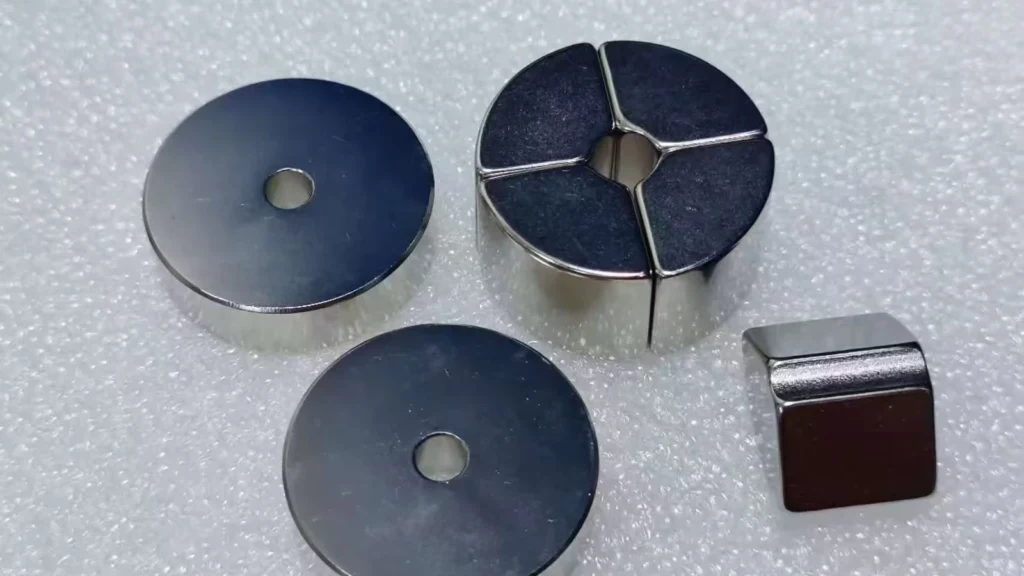
Guande supplies sintered NdFeB magnets, including custom block magnets, arc magnets and application-specific magnetic assemblies. We support drawings, inspection records and technical communication needed for a customer’s own review. We do not replace legal advice or promise blanket patent clearance.
Efficient Information to Request
Before sourcing custom neodymium magnets, document the grade, coercivity class, dimensions, coating, magnetization, assembly configuration, manufacturing origin and intended markets. This creates a stable technical definition for patent searching and avoids reviewing a moving target.
If you need a manufacturability review or transparent specification package from a neodymium magnet supplier, submit the drawing and application through our engineering quote form. For patent conclusions, engage qualified counsel and verify legal status in the relevant official registers.