Yes, neodymium magnets can be shipped by air, but the decision is based on the magnetic field of the complete packed consignment—not simply the magnet grade or pull force. Strong stray fields can affect aircraft compasses and handling equipment. Packaging, pole arrangement, shielding and final measurement therefore determine whether the shipment is unrestricted, handled as magnetized material, or needs additional approval.
Compliance principle: test the finished package in the orientation and configuration that will actually be tendered to the carrier. A calculation or surface-gauss reading on one magnet is not a transport test.
When Is a Package “Magnetized Material”?
ICAO and IATA requirements identify strong magnetic cargo as UN 2807, Class 9. The commonly referenced screening basis is compass deflection caused by the assembled package. A field producing more than 2 degrees of compass deflection at 2.1 m can meet the definition of magnetized material. The equivalent field associated with 2 degrees at 4.6 m is 0.418 A/m, or 0.00525 gauss.
Current carrier and state variations must be checked for every shipment. A package exceeding the applicable 4.6 m limit is not made acceptable by adding a label; it normally requires further shielding or specific authority approval. Airlines may also apply stricter acceptance procedures.
| Screening result | Typical implication | Action |
|---|---|---|
| Very low field at 2.1 m | May be outside regulated magnetized-material treatment | Keep test record and confirm carrier rule |
| Above the 2.1 m screening level but compliant at 4.6 m | May move as UN 2807 under Packing Instruction 953 provisions | Arrange with operator and use required description/marking |
| More than 2-degree deflection at 4.6 m | Exceeds the normal acceptance boundary | Redesign shielding or obtain required approvals |
| Untested package | Compliance cannot be demonstrated | Do not tender until measured |
Why Surface Gauss Is Not the Shipping Criterion
A neodymium magnet may measure several thousand gauss at its surface, yet a properly arranged and shielded package can have a very small field several metres away. Conversely, many magnets aligned in the same direction may produce a significant external field even if each individual part is small. The far field depends on total magnetic moment, spacing, polarity and the return path.
How Magnetic Shielding Packaging Works
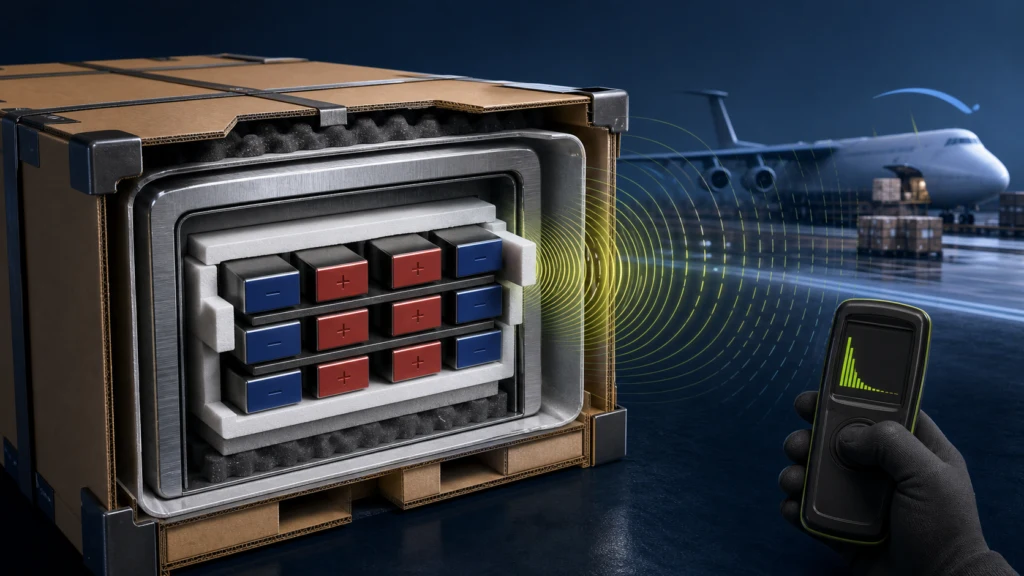
- Opposing polarity: arrange equal magnets so their external moments partially cancel.
- Keeper bars: place suitable low-carbon-steel paths across exposed poles when geometry permits.
- Steel enclosure: use ferromagnetic sheet around the magnet pack to provide a lower-reluctance return path.
- Distance and centering: keep the magnet assembly away from the outer carton surfaces using rigid nonmagnetic spacers.
- Mechanical restraint: prevent magnets from moving, rotating or snapping together during impact.
Magnetic shielding does not block flux like a solid wall blocks light. It redirects flux through a high-permeability path. Gaps, seams, saturated sheet and poor overlap can create leakage. Adding steel indiscriminately can also increase package mass without solving the worst direction.
| Packaging element | Purpose | Failure mode |
|---|---|---|
| Opposed magnet rows | Reduces net magnetic moment | Wrong polarity increases the field |
| Steel shield | Closes flux internally | Thin steel saturates or open seams leak |
| Foam / rigid spacer | Adds distance and prevents movement | Soft material compresses during handling |
| Inner cartons | Separates modules and fixes orientation | Modules rotate after impact |
| Strong outer package | Maintains tested configuration | Crushing changes distances and shield geometry |
How the Package Is Tested
A calibrated gaussmeter with adequate low-field sensitivity or a suitable compass may be used. Measurements are made in an area free from nearby steel, vehicles, electric equipment and other magnetic interference. The package is rotated through 360 degrees because leakage may be directional. Distances are measured from the nearest point on the outside surface, following the applicable instruction.
The report should identify the package, quantity, magnet configuration, shield construction, measuring instrument, calibration status, test distance, maximum reading, direction, date and operator. If packaging changes, the previous report should not be assumed valid.
Documents and Carrier Coordination
For regulated shipping neodymium magnets, the shipper should coordinate with the freight forwarder or airline before booking. Depending on field strength and operator variation, the airway bill, package marking, UN 2807 description or approvals may be required. Requirements can change, so the current IATA Dangerous Goods Regulations, state variations and operator variations take precedence over a general online guide.
Package Design Example
Consider a carton containing several hundred axially magnetized discs. Packing every disc with the same pole facing upward creates a large combined magnetic moment. A better module alternates polarity in balanced rows, adds steel keeper plates above and below the array, and fixes the module at the center of a larger carton. Several modules should also oppose one another. The final consolidated carton is then tested—not the theoretical module.
If the reading is still high, the engineer can increase spacing, improve shield overlap, reduce the number of magnets per package or divide the shipment. Using thicker steel is effective only until the shield is no longer locally saturated. A test-and-adjust loop is more reliable than estimating field reduction from sheet thickness alone.
Common Mistakes
- Testing one inner box instead of the consolidated package.
- Using a phone magnetometer as the only compliance instrument.
- Measuring beside a steel table or vehicle.
- Failing to rotate the package and find the worst direction.
- Allowing magnets to move after testing.
- Assuming “small magnets” are automatically unrestricted.
Guande Packaging Support
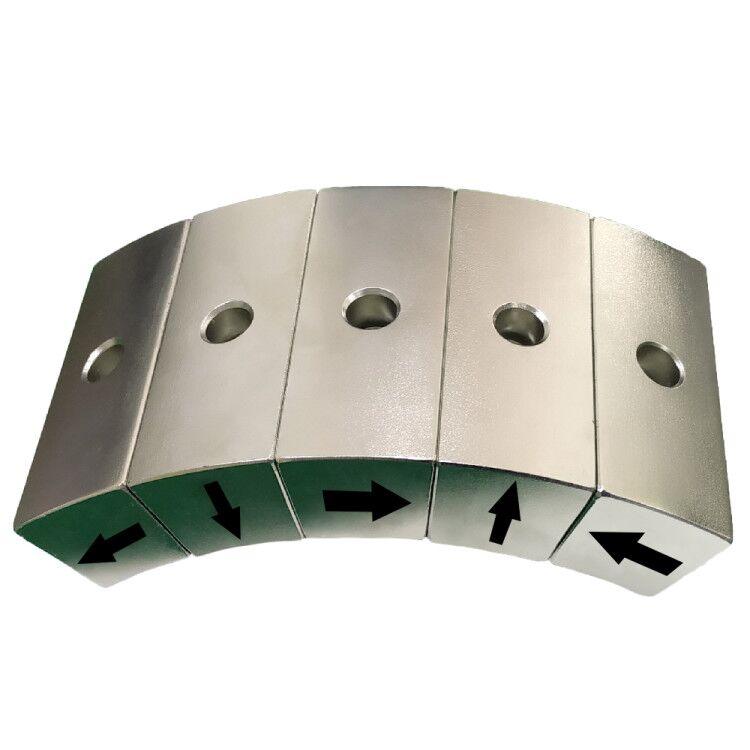
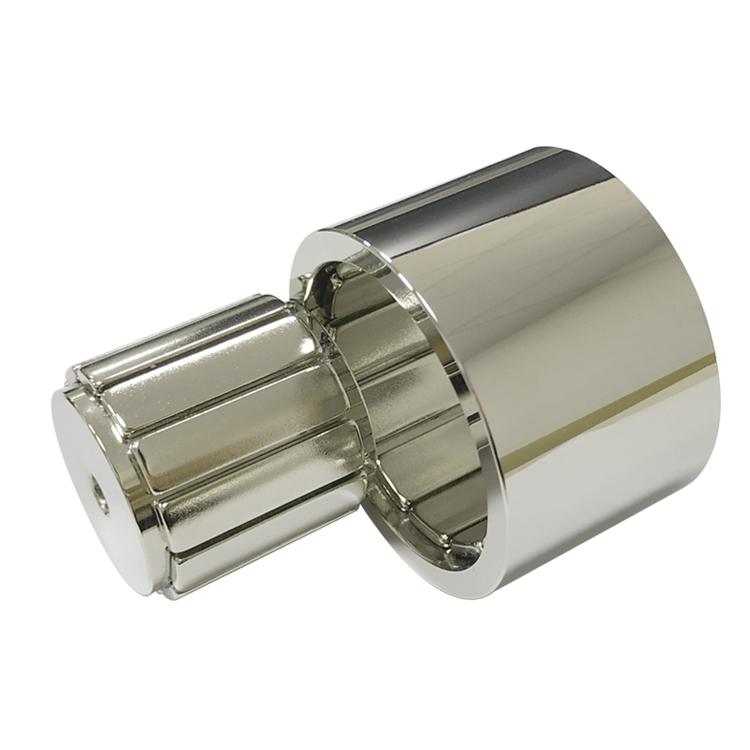
For our sintered NdFeB magnets, we can plan opposed-polarity packing, keeper arrangements, steel shielding and stable inner trays. Product geometry may include block magnets, disc magnets or assembled magnetic circuits. We can also provide package test information requested by the selected logistics channel.
Share the part, quantity per carton, destination and proposed air carrier through Get a Quote. Final transport classification remains subject to the current carrier and regulatory requirements.