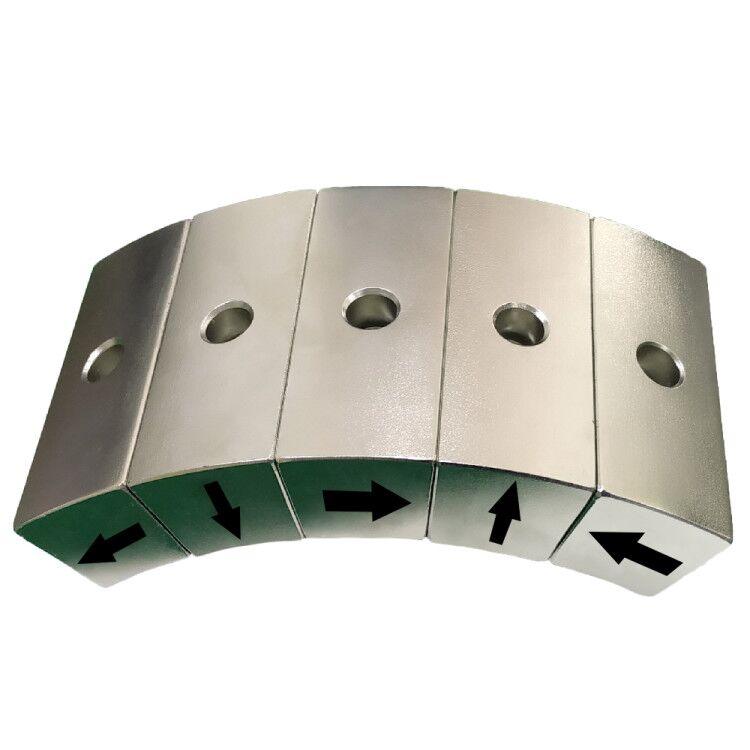
A Halbach array is a permanent-magnet arrangement in which the magnetization direction rotates from one segment to the next. The fields reinforce each other on one side of a linear array or inside/outside a cylindrical array, while partially cancelling on the opposite side. This makes it possible to create a strong, shaped magnetic field without an energized coil.
Key takeaway: “Halbach” describes a rotating magnetization pattern, not one fixed product. Linear, cylindrical, multipole, and curved arrays are selected according to where the strong field must be located and how the assembly moves.
How a Halbach Array Works
In a simple conventional array, adjacent magnets may all point in the same direction or alternate north and south. In a Halbach array, the magnetization vector rotates by a defined angle between segments. A four-step pattern, for example, may use vectors at 0, 90, 180, and 270 degrees before repeating.
The resulting superposition directs more flux toward the strong side and reduces the external field on the weak side. A practical segmented array only approximates the continuously rotating ideal, but additional segments can improve the field waveform when assembly tolerance and cost allow.
Main Halbach Array Structures
Linear Halbach array
A linear array places rectangular magnets in a row with a rotating magnetization sequence. The strong field appears above or below the array, depending on the rotation direction. Repeating the sequence creates a periodic field along the travel direction.
Linear arrays are widely used in linear motors, magnetic levitation demonstrations, material handling, magnetic separation, planar stages, and research equipment. They may be installed as a single-sided track or as two facing arrays to create a controlled working gap.
Cylindrical Halbach array
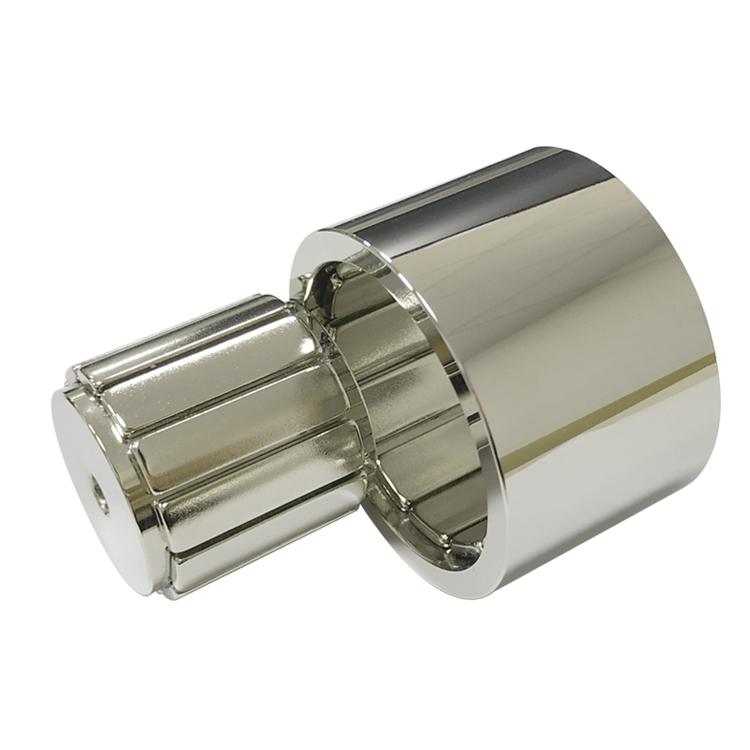
A cylindrical array uses arc segments arranged around a bore. The magnetization vector rotates around the circumference. Depending on the pattern, the strong field can be concentrated inside the bore with a relatively weak outside field, or concentrated outside with a weaker internal field.
Internal-field cylinders are attractive for compact motors, laboratory magnets, magnetic bearings, couplings, beam-control devices, and instruments that need a strong field in a central air space. External-field versions can be used in rotor or coupling systems where the working region surrounds the array.
Halbach ring assembled from blocks
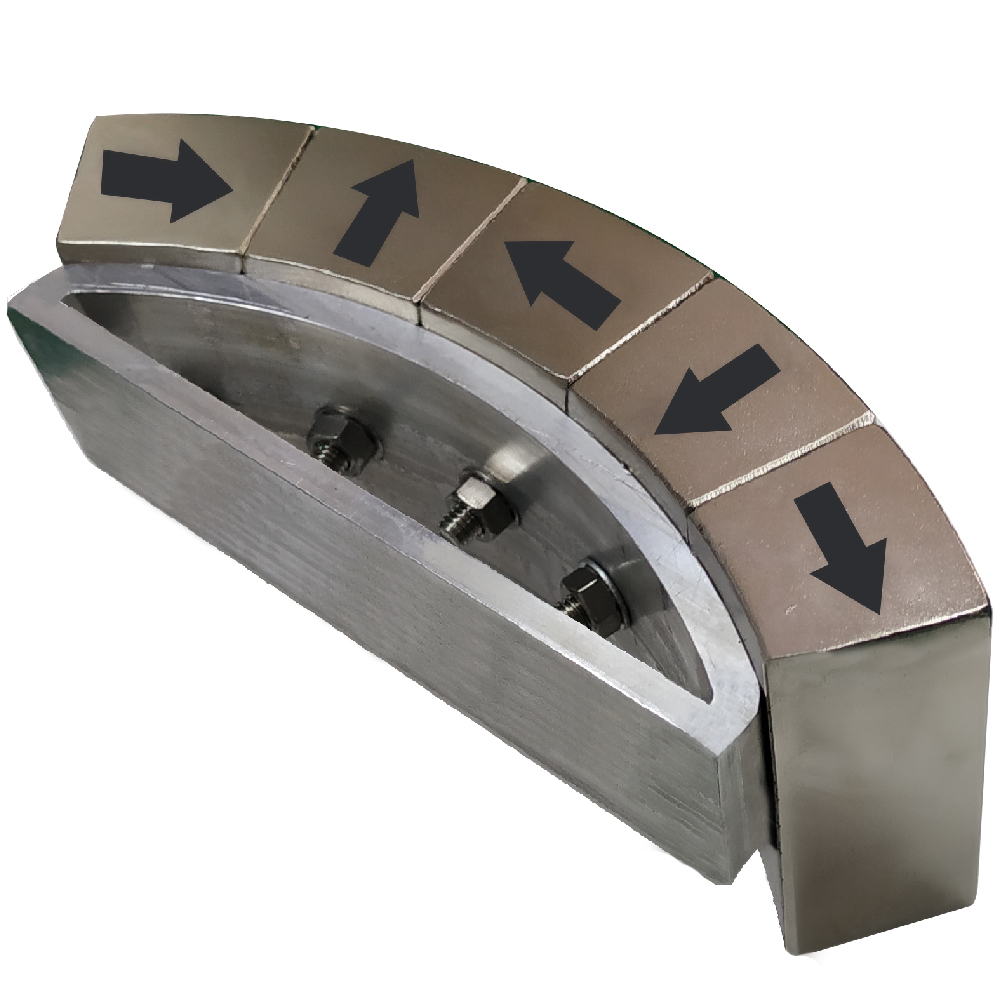
A near-cylindrical field can be created from rectangular or trapezoidal blocks mounted in a polygonal carrier. This approach may reduce arc-magnet tooling cost and simplify sourcing, but it creates geometric gaps and a more segmented field. The carrier must control each block’s position and resist large assembly forces.
Curved or partial Halbach array
Some applications use only part of a circular array or place a Halbach sequence on a curved track. Examples include compact actuators, magnetic wheels, inspection systems, and field-shaping fixtures. End effects become important because the pattern does not repeat indefinitely.
Multipole Halbach rotor
A motor rotor can use a multi-pole Halbach arrangement in which the magnetization direction changes around each electrical pole. The array can improve the air-gap field waveform and reduce rotor-side leakage. However, the benefits depend on pole count, air gap, sleeve, stator geometry, magnet segmentation, and manufacturability.
Where Halbach Arrays Are Used
| Application | Why a Halbach array is useful | Typical structure |
|---|---|---|
| High-performance motors and generators | Concentrates air-gap flux and can reduce leakage on the nonworking side | Cylindrical or multipole rotor |
| Linear motors and precision stages | Creates a periodic high-gradient field along a track | Linear array |
| Magnetic levitation and bearings | Produces strong field gradients with reduced backside field | Linear, ring, or opposed arrays |
| Magnetic couplings and gears | Shapes the transmitted field while limiting leakage | Concentric cylindrical arrays |
| Magnetic separation | Concentrates field and gradient near the material path | Linear or rotating drum array |
| Laboratory and imaging magnets | Creates a strong field in an accessible bore without continuous power | Internal-field cylinder |
| Charged-particle and beam systems | Provides compact periodic or multipole fields | Undulator or multipole array |
| Inspection robots and adhesion systems | Focuses useful flux toward the steel surface | Curved or wheel-integrated array |
Halbach Arrays Are Not Magnetically One-Sided in Every Situation
The weak side is reduced, not perfectly zero. Finite length, segment gaps, magnet-property variation, carrier material, neighboring steel, and assembly tolerance all create leakage. A steel back iron may further shape the field, but it also changes the ideal Halbach solution and can add weight or saturation constraints.
Key Design Parameters
- Number of segments: more segments better approximate continuous rotation but increase cost and assembly complexity.
- Magnetization direction: each block or arc needs a defined vector and angular tolerance.
- Magnet grade: Br, Hcj, temperature coefficient, and batch consistency affect output and stability.
- Working gap: field strength and gradient can change rapidly with distance.
- Array length and end design: finite-length end effects may disturb uniformity.
- Mechanical carrier: the fixture must control position while resisting attraction, repulsion, impact, and centrifugal load.
- Thermal environment: differential expansion, adhesive limits, and irreversible demagnetization must be considered.
Manufacturing and Assembly Challenges
Halbach assemblies can be difficult and hazardous to build because neighboring magnets may attract, repel, twist, or jump out of a fixture. Strong forces can chip brittle NdFeB edges and damage coatings. Assembly tooling should positively locate each segment, control polarity, protect operators, and maintain adhesive bond-line thickness.
Inspection normally includes dimensional position, polarity sequence, surface field mapping, flux density at a defined gap, and sometimes harmonic analysis. Measuring only one point is rarely sufficient for a precision motor or instrument.
When a Conventional Array Is Better
A Halbach array is not automatically the most efficient solution. A conventional magnet plus steel yoke may achieve the required field at lower cost, with fewer magnetization directions and simpler assembly. Halbach designs are most valuable when field concentration, low backside leakage, weight, bore access, or waveform quality justifies the added complexity.
Frequently Asked Questions
Does a Halbach array require special magnet grades?
No specific grade is mandatory. The grade is selected from required field, temperature, demagnetization margin, corrosion protection, size, and cost. Consistent magnetic properties between segments are important.
Can standard block magnets form a Halbach array?
Yes, if the required magnetization directions are available and the polygonal approximation is acceptable. Custom angled magnetization or arc segments may improve the field but require a production review.
Can the weak side be made completely field-free?
No practical finite assembly has zero leakage everywhere. Shielding, back iron, increased segment count, and end compensation can reduce stray field where necessary.
Guande Magnet supports linear, cylindrical, curved, and multipole Halbach assemblies, including magnetic simulation, segment design, magnetization planning, fixtures, assembly, and field mapping. Send the working volume, target field, gap, temperature, envelope, and production quantity for an engineering review.