Motor magnets operate in a much harsher magnetic environment than a room-temperature holding magnet. An arc segment installed in a rotor may face copper loss, iron loss, eddy-current heating, a hot ambient enclosure, repeated acceleration, and a strong reverse magnetic field from the stator. For this reason, many permanent-magnet motors use high-temperature or high-coercivity magnet grades even when the average housing temperature appears moderate.
Key takeaway: a motor magnet is selected for the hottest local temperature and the worst reverse-field operating point—not simply for the motor’s normal surface temperature.
Where Does the Heat Inside a Motor Come From?
The winding is usually the most obvious heat source, but it is not the only one. Current flowing through copper creates I²R loss. The stator core produces hysteresis and eddy-current losses, while high-frequency harmonics can also generate eddy currents in conductive NdFeB magnets. Bearings, mechanical friction, insufficient airflow, and heat from the driven equipment can raise the internal temperature further.
The magnet may therefore be hotter than the temperature measured on the motor housing. Rotor cooling is often less direct than stator cooling, and a small arc segment can develop a local hot spot near an edge, retaining sleeve, adhesive layer, or air-gap discontinuity.
Temperature Reduces Both Flux and Demagnetization Margin
As temperature rises, the remanence of a NdFeB magnet decreases reversibly. The motor may temporarily produce less torque or back-EMF, but much of that flux returns after cooling. The more serious risk is irreversible demagnetization. At elevated temperature, intrinsic coercivity falls and the knee of the demagnetization curve moves into a less favorable position. If the working point crosses that knee under an opposing field, part of the magnet will not recover after the motor cools.
This is why maximum operating temperature is not a stand-alone guarantee. A magnet advertised for a certain temperature can still demagnetize below that value if the magnetic circuit has a large air gap, a thin magnet, leakage, poor pole coverage, or severe armature reaction.
Why Arc Segments Are Especially Sensitive
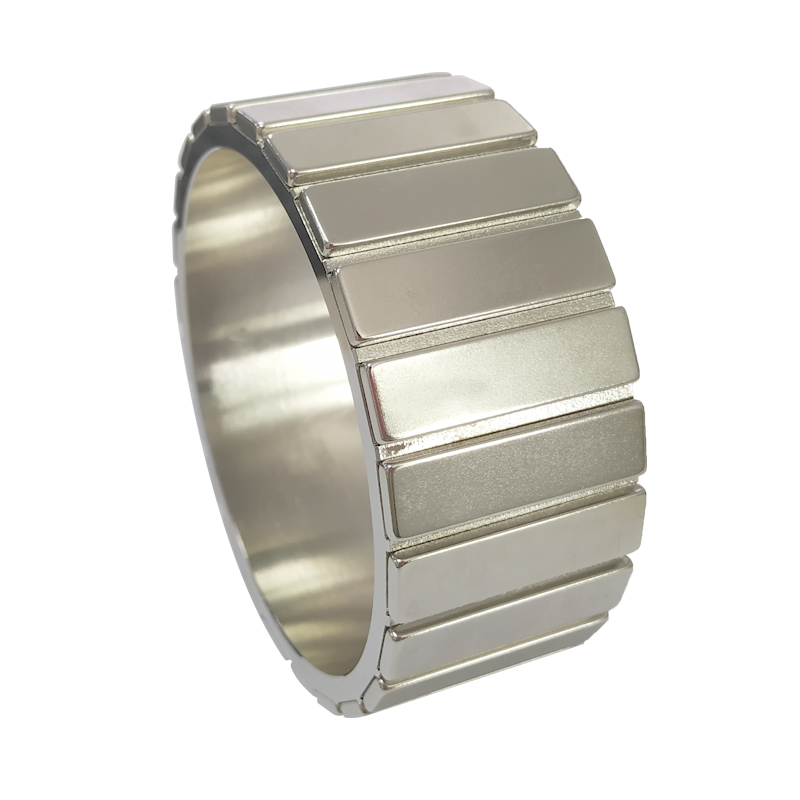
Motor arc magnets are designed to follow the rotor geometry and produce a controlled air-gap field. Their edges and corners often experience a different permeance coefficient from the center. Local reverse fields can concentrate around segment gaps, rotor bridges, mounting features, or areas affected by machining tolerance. A design that looks safe at the average operating point can still suffer edge demagnetization.
High-speed motors add mechanical constraints. Sleeves and adhesives must withstand centrifugal loading, while the coating must survive assembly and thermal cycling. Any change in adhesive thickness, rotor steel, air gap, or magnet position can shift the magnetic operating point.
What Do H, SH, UH, EH and AH Mean?
NdFeB grade suffixes such as H, SH, UH, EH, and AH generally indicate progressively higher intrinsic-coercivity capability within a supplier’s material system. They are often associated with higher recommended operating-temperature ranges. However, the exact Br, Hcj, temperature coefficient, and guaranteed limits must be taken from the supplier’s current datasheet and verified for the finished magnet.
A higher-temperature suffix does not automatically mean a stronger magnet. In many material systems, increasing coercivity can reduce remanence or increase cost. The best grade is the one that maintains adequate flux and demagnetization margin throughout the full duty cycle—not the grade with the highest number or suffix.
How Engineers Select a Motor Magnet Grade
1. Establish the real thermal profile
Define continuous temperature, short-duration peaks, cold start, overload, stalled-rotor conditions, cooling failure, and thermal cycling. Place temperature sensors or use a validated thermal model close to the magnet location rather than relying only on housing temperature.
2. Model the worst reverse field
Finite-element analysis should include maximum phase current, field-weakening operation, fault current, stator harmonics, assembly tolerances, and the lowest expected magnet coercivity. Evaluate local regions of each arc, not only the volume-average flux density.
3. Review geometry and magnetic circuit
Magnet thickness, pole arc, segment gap, rotor steel grade, bridge thickness, sleeve material, air gap, and magnetization direction all affect the load line. A small geometry change can sometimes create more demagnetization margin than moving to a much more expensive material grade.
4. Validate the finished rotor
Material certificates are necessary but not sufficient. Test sample rotors before and after thermal exposure and worst-case current loading. Compare back-EMF, flux waveform, torque constant, cogging torque, and balance. A localized flux scan can reveal partial demagnetization that a simple surface-gauss reading may miss.
When SmCo or Ferrite May Be Better
High-temperature NdFeB is not the only option. SmCo offers excellent temperature stability, corrosion resistance, and high-temperature capability, although it is more brittle and usually more expensive. Ferrite has lower magnetic strength but good temperature resistance and cost stability; it can be attractive when the motor has enough volume. The decision depends on torque density, speed, temperature, corrosion, mechanical design, and total system cost.
Design and Manufacturing Details That Matter
- Specify Br, Hcj, and the demagnetization curve at relevant temperatures.
- Control arc radius, thickness, chord, angle, and segment-to-segment consistency.
- Define magnetization direction and angular tolerance clearly.
- Select coating and adhesive as one compatible system.
- Assess eddy-current segmentation for high-speed or high-frequency motors.
- Use batch traceability and magnetic-property verification.
- Validate rotor assembly, retention, balance, and thermal cycling.
Frequently Asked Questions
Can a standard N-grade NdFeB magnet be used in a motor?
Yes, in a lightly loaded motor with a low internal temperature and a favorable magnetic circuit. The decision must be supported by thermal and demagnetization analysis rather than by motor size alone.
Does a 150°C rating mean the magnet is always safe at 150°C?
No. The safe temperature depends on geometry, load line, reverse field, time at temperature, and the actual material curve. The rating is a screening value, not a complete motor-design limit.
Can high-coercivity grades eliminate demagnetization risk?
They increase margin, but poor geometry, excessive fault current, local hot spots, or incorrect assembly can still cause failure. Grade selection and magnetic-circuit design must be evaluated together.
Guande Magnet supports custom motor arc magnets, material selection, magnetic-circuit review, coating, magnetization, and rotor assembly development. Send your operating temperature, motor geometry, duty cycle, and target performance for an engineering review.