Many magnetic wheels used on steel tanks, pipelines, ship hulls, bridges, and inspection robots are built from axially magnetized ring or disc magnets. At first this can seem counterintuitive: the wheel needs holding force at its outer tread, yet the magnetization direction runs parallel to the axle. The reason is that the magnet is only one part of the magnetic circuit. Ferromagnetic pole pieces redirect and concentrate the flux toward the contact surface.
Key takeaway: axial magnetization is popular because it combines standard magnet geometry with an efficient, modular pole-piece circuit that delivers strong adhesion at the wheel tread.
How an Axially Magnetized Magnetic Wheel Works
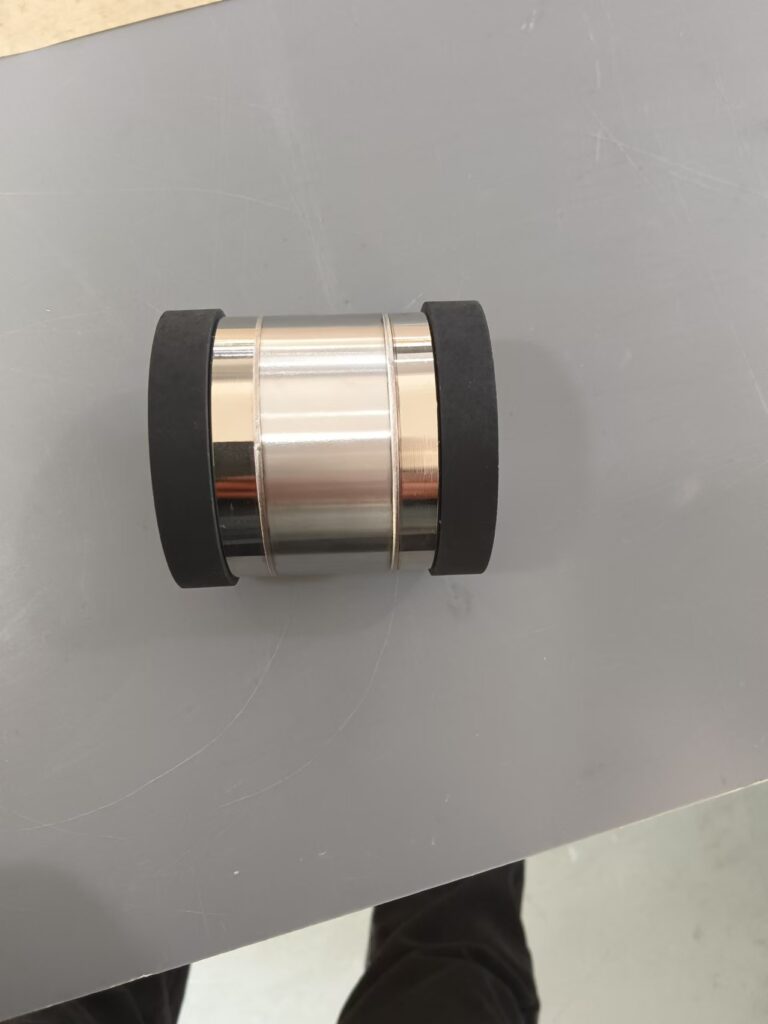
An axially magnetized magnet has its north and south poles on the two flat faces. In a typical magnetic wheel, magnets are assembled between low-carbon-steel pole pieces or yokes. The steel provides a low-reluctance path and turns the magnetic flux outward. At the tread, neighboring pole shoes present opposite polarity to the steel surface. The target plate closes the circuit, creating attraction across the working air gap.
The tread may include rubber or polyurethane for traction and surface protection. That layer is magnetically nonconductive, so it acts as an air gap. The magnetic circuit must be designed to overcome the gap while still providing the required safety factor.
Seven Reasons Axial Magnetization Is Common
1. Ring and disc magnets are straightforward to manufacture
Axial magnetization is a standard configuration for ring and disc magnets. Tooling, orientation, inspection, and production control are mature. By comparison, a one-piece radially magnetized ring—especially with multiple poles—can require specialized orientation and magnetizing fixtures.
2. Steel pole pieces do the difficult flux routing
Instead of asking the magnet itself to create poles around the circumference, the designer can use accurately machined steel components to redirect flux to the tread. Pole-piece width, spacing, material, and saturation level can be optimized without changing the basic magnet.
3. The architecture is modular
Designers can stack magnets and pole plates along the axle to increase active width or create multiple flux loops. The same design language can be scaled for a compact crawler, a heavy inspection robot, or a custom pipe-traversing system.
4. Assembly polarity is easy to define
Flat-face polarity can be inspected before assembly. Alternating magnet orientation and pole-piece sequence can be controlled with fixtures and poka-yoke features. This reduces the risk of an incorrect multipole pattern.
5. It supports a central shaft and bearing system
Ring magnets leave space for a shaft, hub, bearing, fastener, or drive interface. The load-carrying structure can be separated from the magnetic components, improving serviceability and mechanical strength.
6. Leakage flux can be managed
A well-proportioned yoke returns much of the flux inside the wheel and concentrates the useful field near the tread. This can improve holding force while reducing stray field around nearby sensors, fasteners, and electronics.
7. Cost and sourcing are more predictable
Axially magnetized rings or discs often use conventional production routes. This can shorten development time and simplify second-source qualification compared with a highly specialized radially oriented multipole ring.
Axial Magnetization Does Not Guarantee High Holding Force
Wheel performance depends on the entire circuit. Magnet grade and volume matter, but so do pole-piece saturation, tread thickness, surface curvature, contact area, steel thickness, paint or rust, wheel load, and the direction of applied force. A magnetic wheel can show a strong static pull test on a clean flat plate and still perform poorly on a curved, coated, or corroded surface.
Rolling also changes the problem. The leading edge continuously opens the magnetic circuit while the trailing edge closes it. Cogging, torque ripple, breakaway force, and steering resistance must be balanced against adhesion.
When Radial or Multipole Magnetization Makes Sense
Radial magnetization can be useful when the design needs a more direct circumferential field, very compact packaging, a specific pole pitch, or reduced dependence on separate pole shoes. A segmented arc arrangement can approximate radial magnetization and may support a custom Halbach pattern. These options can improve flux distribution in selected designs, but they add magnet geometry, assembly, and magnetization complexity.
The correct comparison is not axial versus radial in isolation. Engineers should compare complete wheel assemblies at the same envelope, mass, air gap, steel target, and operating condition.
Inputs Needed for a Custom Magnetic Wheel
- Required normal holding force and safety factor.
- Robot weight, number of wheels, and center of gravity.
- Vertical, overhead, curved, or transitional travel.
- Target steel thickness, radius, coating, rust, and roughness.
- Maximum allowable rolling resistance and drive torque.
- Wheel diameter, width, shaft, bearing, and speed.
- Tread material, thickness, wear life, and chemical environment.
- Operating temperature, corrosion exposure, and cleaning method.
- Nearby sensors or electronics with stray-field limits.
How Guande Magnet Optimizes the Design
Our engineering process considers magnet grade, magnetization direction, pole-piece steel, saturation, working gap, mechanical hub, tread, and assembly tolerances together. Prototypes can be evaluated for normal adhesion, shear resistance, rolling torque, transition behavior, and temperature stability. The result is a wheel designed around the robot and target surface rather than a catalog pull-force number.
Frequently Asked Questions
Does axial magnetization mean the wheel pulls sideways?
No. The steel pole pieces redirect the magnetic flux toward the outer contact surface, so the useful holding force acts between the tread and the steel target.
Why not use the strongest available NdFeB grade?
The pole pieces may saturate before a higher grade produces proportional benefit. Temperature, corrosion, cost, and demagnetization margin also matter. Circuit optimization usually delivers better value than grade escalation alone.
Can one wheel work equally well on flat and curved steel?
Not necessarily. Curvature changes contact area and working gap. The pole geometry, wheel width, tread compliance, and robot suspension should be matched to the smallest target radius.
Need a magnetic wheel for a crawler or inspection robot? Share the target surface, robot load, wheel envelope, speed, and safety factor for a custom magnetic-circuit review.