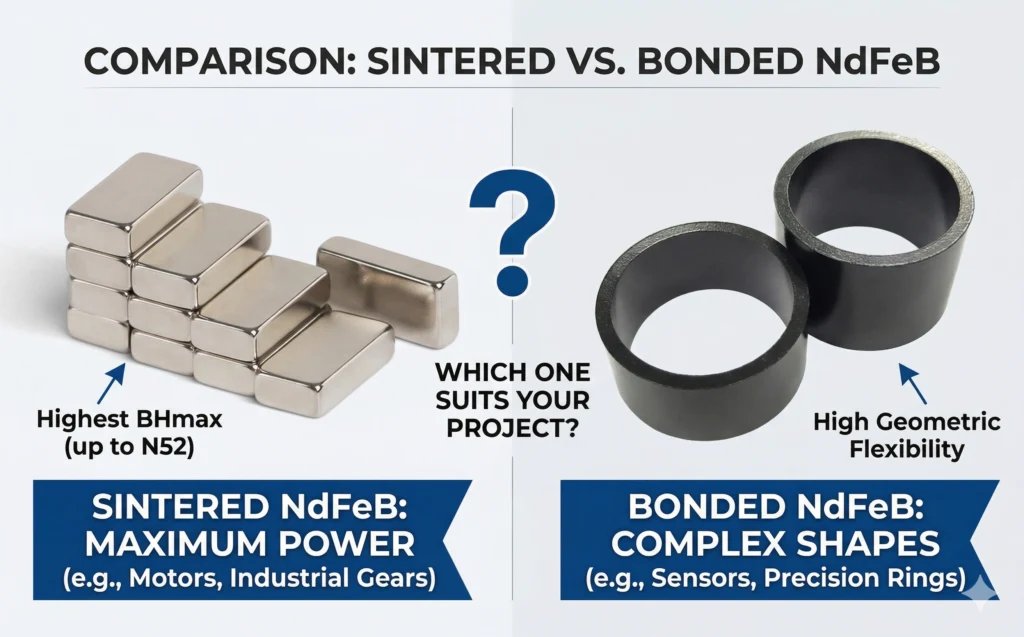
A higher surface-gauss reading does not always mean a magnet is stronger in the way an application needs. Surface gauss is a local magnetic-flux-density measurement at one position. Pull force, air-gap field, torque, sensing distance, and resistance to demagnetization depend on additional parameters: magnet volume, pole area, geometry, material grade, magnetic circuit, working gap, target steel, and temperature.
Practical answer: surface gauss is useful for checking consistency when geometry and measurement conditions are fixed. It is not a universal ranking of magnet strength between different shapes, sizes, or assemblies.
What Does “Surface Gauss” Measure?
A gaussmeter with a Hall probe measures magnetic flux density B at the sensor location. One tesla equals 10,000 gauss. A reading described as “surface gauss” is normally taken close to a magnet pole, but the value changes with probe distance, active-sensor position, probe angle, and where the operator places it on the pole.
The field is normally highest near certain edges or pole-transition regions and lower elsewhere. A single peak reading therefore describes one point, not the average field over the working area or the total magnetic output.
Five Different Meanings of Magnet Strength
| Quantity | What it describes | Typical test |
|---|---|---|
| Surface flux density B | Local field at a defined position | Hall-probe gaussmeter |
| Magnetic flux Φ | Field integrated through a defined area | Search coil or fluxmeter |
| Magnetic moment m | Total dipole output of the part | Helmholtz coil |
| Pull force F | Force against a specified steel target and gap | Force gauge and fixture |
| Material capability | Br, Hcb, Hcj, and (BH)max | Hysteresisgraph on a qualified sample |
Why a Small Magnet Can Show High Surface Gauss
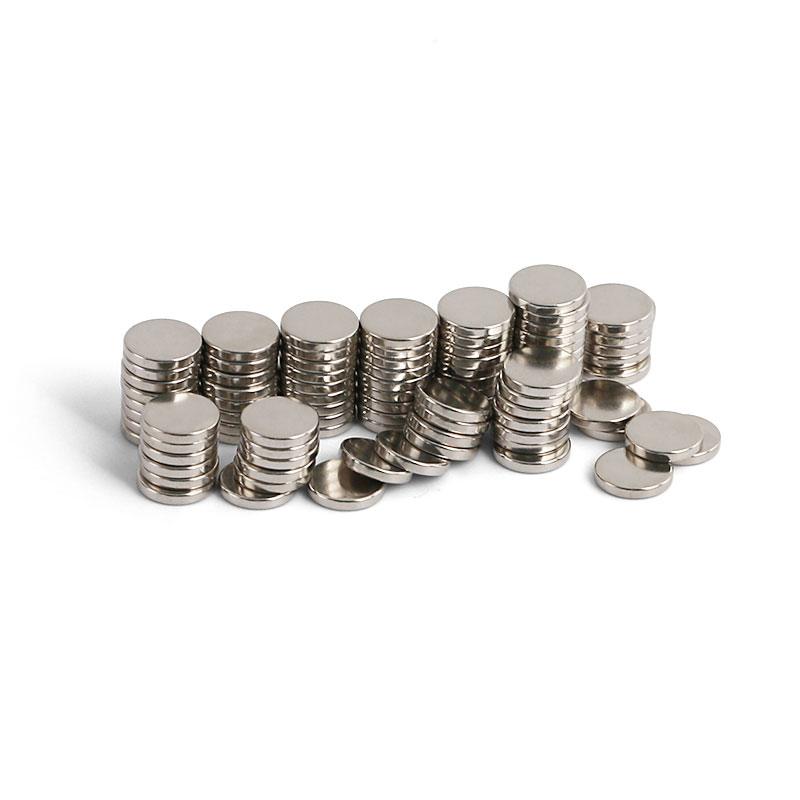
A short measurement distance and concentrated pole geometry can produce a high local reading. A small magnet may have a high peak surface field but limited volume and magnetic moment. Its useful field can decay quickly with distance, and its total pull force may remain below that of a larger magnet with a slightly lower peak reading.
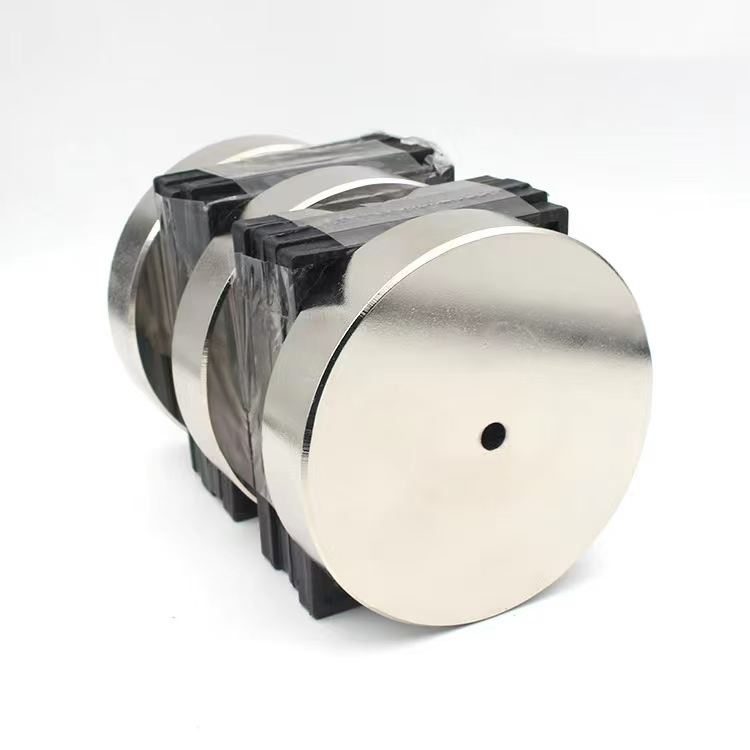
Conversely, a wide magnet or a large assembly may distribute flux across a large pole area. The peak at one point can be lower, yet total flux and holding force can be higher. This is common in magnetic chucks, pot magnets, filter systems, and motor poles.
Geometry Changes the Reading
| Geometry change | Likely effect on surface field | Effect on application output |
|---|---|---|
| Increase thickness in magnetization direction | Usually increases until the geometry becomes magnetically long | Can improve air-gap field and demagnetization resistance |
| Increase pole-face area only | Peak gauss may change little or decrease locally | Total flux and pull area may increase |
| Add a steel pole piece | Concentrates flux at the pole | Can increase useful gap field if steel does not saturate |
| Add coating or cover | Creates measurement distance | Reduces field and force at the real working surface |
| Measure near an edge | May show a local peak | Does not represent average working-area field |
Surface Gauss Versus Pull Force
For an ideal, uniform field acting across a small gap, magnetic pressure can be approximated by:
p ≈ Bg2 / (2μ0), and force by F ≈ Bg2A / (2μ0).
Here Bg is the effective flux density in the working gap, A is effective pole area, and μ0 is the permeability of free space. The equation does not justify inserting a free-space peak surface-gauss reading and calling the result pull force. Real systems include fringing, leakage, steel saturation, uneven contact, finite plate thickness, paint, roughness, and fixture compliance.
Pull-force test diagram
| Force gauge | ↑ controlled pull direction |
|---|---|
| Magnet or assembly | Fixed orientation and pole face |
| Defined spacer | 0 mm contact or specified nonmagnetic gap |
| Steel test plate | Specified grade, thickness, flatness, and size |
Material Grade Cannot Be Confirmed by Surface Gauss Alone
Two magnets with identical surface readings may have different intrinsic coercivity Hcj. One can retain its output at high temperature or under a reverse field, while the other suffers irreversible loss. Surface gauss also cannot separate a high-grade thin magnet from a lower-grade thicker magnet without geometry and curve data.
For sintered NdFeB magnets, grade verification should use a qualified material sample or supplier test data for Br, Hcb, Hcj, and (BH)max. Finished parts are more efficiently controlled by dimensions plus magnetic moment, flux, or a defined application-level test.
How to Measure Surface Field Repeatably
- Use the correct axial or transverse Hall probe and record its active-sensor location.
- Zero the instrument away from magnets and ferromagnetic fixtures.
- Define probe orientation, pole, measurement point, and fixture.
- Control the distance from the magnet, including coating and protective film.
- Allow the magnet and probe to reach the specified temperature.
- Record whether the value is peak, center, average, or a mapped distribution.
- Use the same fixture and method for every production lot.
Which Test Should You Specify?
| Application need | Recommended primary test | Supporting test |
|---|---|---|
| Hall sensor activation | Field at the real sensor position | Dimensions and temperature check |
| Holding or lifting | Pull force at specified steel and gap | Flux or surface-field map |
| Motor or generator | Flux linkage, back-EMF, or magnetic moment | Hot demagnetization validation |
| Magnetic coupling | Torque-angle and pull-out torque | Component flux and pole orientation |
| Incoming magnet consistency | Helmholtz magnetic moment or total flux | Defined-point surface gauss |
Guande Inspection Approach
Guande selects the measurement around the function. We support gauss mapping, magnetic moment, flux, dimensions, pull force, torque, magnetization direction, and application-level inspection. For assembled products, our custom magnetic assembly process defines the target steel, gap, pole geometry, fixture, and acceptance limits before production testing.
This avoids two common problems: rejecting functional parts because of an unstable peak-gauss measurement, or accepting parts that meet surface gauss but fail at the real working gap.
Frequently Asked Questions
Is surface gauss the same as remanence Br?
No. Br is a material property measured from a demagnetization curve. Surface gauss is the local field outside a finished magnet and depends strongly on geometry and measurement distance.
Can two N52 magnets have different surface gauss?
Yes. Size, shape, magnetization direction, coating, temperature, manufacturing tolerance, and probe position can all change the reading.
Does higher gauss always mean higher pull force?
No. Pull force also depends on effective pole area, working-gap field distribution, target steel, contact condition, leakage, and saturation.
Send Guande the magnet drawing, working gap, target material, temperature, and required output so the acceptance test matches the actual function.