A high-cerium magnet is not a completely separate magnet family. It is generally an Nd-Fe-B-based permanent magnet in which cerium replaces part of the neodymium-praseodymium content. The objective is to use a more abundant rare-earth element and reduce material cost while retaining enough magnetic performance for the target duty. The engineering question is therefore not whether cerium is “good” or “bad,” but how much substitution, what microstructure, and what operating margin the application can accept.
Practical definition: specify a high-Ce magnet by measured Br, Hcj, (BH)max, temperature behavior, corrosion protection and part-level validation—not by Ce percentage alone.
What Changes in the Composition?
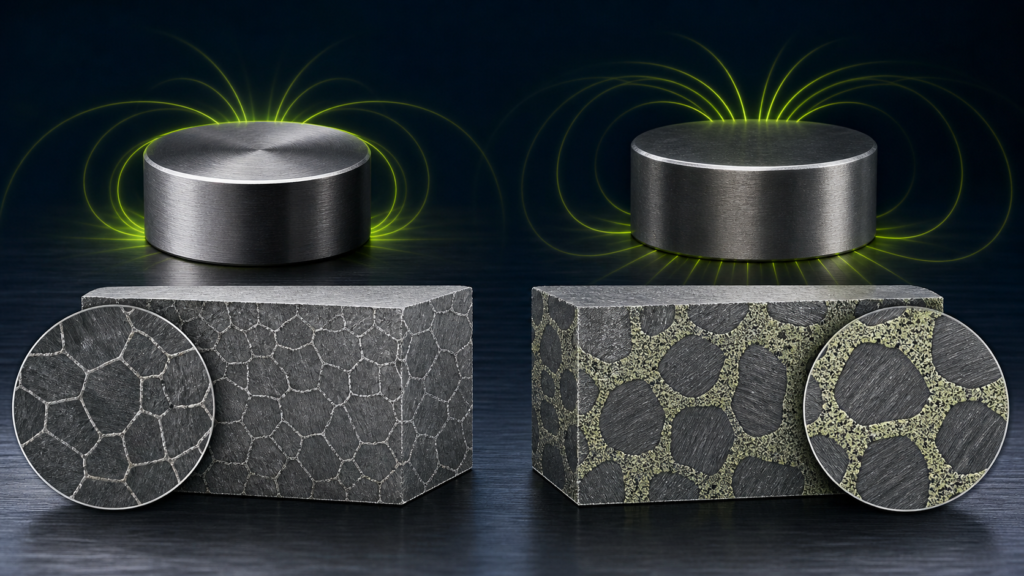
Conventional sintered NdFeB is built around the hard-magnetic RE2Fe14B phase, where RE is mainly Nd and Pr, plus rare-earth-rich grain-boundary phases. In a Ce-substituted material, part of the Nd/Pr is replaced by Ce. The resulting neodymium magnet composition can include Nd-rich and Ce-rich 2:14:1 grains, rare-earth-rich boundary phases and, when processing is not well controlled, CeFe2-type phases that do not contribute useful hard-magnetic performance.
Cerium has lower intrinsic anisotropy and less favorable magnetic properties than Nd in the 2:14:1 structure. Increasing substitution therefore tends to lower remanence, intrinsic coercivity and maximum energy product when the process is otherwise unchanged. Modern dual-main-phase or multi-main-phase routes distribute Ce strategically instead of forcing a completely uniform alloy. Grain-boundary engineering and Nd-rich shells around Ce-containing grains can recover part of the lost coercivity.
High-Ce Versus Conventional NdFeB
| Design factor | Conventional sintered NdFeB | High-cerium NdFeB | Engineering implication |
|---|---|---|---|
| Rare-earth balance | Mostly Nd/Pr, with optional Dy/Tb | Part of Nd/Pr replaced by Ce | Reduces NdPr dependence, but chemistry must be controlled |
| Br and (BH)max | Higher at comparable processing | Usually lower as Ce substitution rises | May require more magnet volume or a shorter air gap |
| Intrinsic coercivity Hcj | Broad grade range is commercially mature | Sensitive to Ce distribution and boundary phases | Hot demagnetization testing is essential |
| Temperature stability | Selectable through grade and diffusion route | Usually a narrower margin without advanced processing | Do not infer temperature capability from room-temperature pull force |
| Raw-material economics | More exposed to NdPr pricing | Can use more abundant Ce | Savings depend on performance, yield and magnet size |
Why “Same Grade” Does Not Mean the Same Magnet
Commercial neodymium magnet grades are defined by magnetic-property windows, not only by alloy recipe. A Ce-containing magnet can be engineered to meet a familiar grade designation, but its temperature coefficient, irreversible flux loss, corrosion behavior or process capability may still differ from a conventional grade. The drawing should state minimum Br, Hcb, Hcj and (BH)max, the maximum working temperature, coating, magnetization direction and test method.
For a motor or actuator, the decisive check is the operating point on the second-quadrant demagnetization curve. Temperature, armature reaction, assembly air gap and geometric tolerances move that point. A material that passes a room-temperature surface-gauss check can still suffer irreversible loss under a hot reverse field.
How Manufacturers Recover Performance
- Dual-main-phase blending: an Nd-rich alloy and a Ce-rich alloy are prepared separately, then blended so the final microstructure is not chemically uniform.
- Grain-boundary control: Cu, Al, Ga or rare-earth-rich additions can improve boundary wetting and magnetic isolation between grains.
- Core-shell structures: Nd-rich regions around Ce-containing grains raise the local resistance to reverse-domain nucleation.
- Grain-boundary diffusion: Dy, Tb, Pr or Nd-based diffusion can increase coercivity near grain surfaces, although depth and cost must be considered.
- Oxygen and phase control: powder handling, sintering and annealing must limit oxidation and avoid excessive nonmagnetic or soft-magnetic secondary phases.
Where High-Cerium Magnets Fit
| Application condition | High-Ce suitability | What to verify |
|---|---|---|
| Moderate flux and moderate temperature | Often a good cost/performance candidate | Part-level flux, Hcj margin and lot stability |
| Consumer motors, speakers, sensors and pumps | Potentially suitable after validation | Size, noise, torque, corrosion and lifetime |
| Compact high-torque motor | Possible only with optimized magnetic circuit | Air-gap flux, current loading and irreversible loss |
| Traction, compressor or wind-generator duty | Not an automatic drop-in replacement | Hot B-H curve, overload field, fatigue and coating |
| Large air gap or minimum-volume design | Conventional high-energy NdFeB often remains preferable | System cost rather than magnet price per kilogram |
Cost Should Be Calculated at System Level
A cheaper alloy does not always produce a cheaper assembly. Lower Br may require a larger magnet, more steel, a smaller air gap or higher coil current. Lower Hcj can require a longer magnetization length or a higher-temperature grade. Additional sorting or lower machining yield can also remove the raw-material advantage. The correct comparison is cost per qualified assembly at the required torque, force or flux—not price per kilogram.
Corrosion and Coating
Both materials are sintered rare-earth magnets with reactive grain-boundary phases. Ce substitution can change electrochemical behavior, but it does not remove the need for environmental protection. Nickel-copper-nickel, zinc, epoxy or application-specific coatings should be selected after humidity, salt, chemical and thermal-cycle requirements are known. Bondline design is equally important because a damaged coating at an edge can become the start of corrosion.
A Practical Selection Checklist
- Define the required air-gap flux, force or torque at operating temperature.
- Provide the worst reverse field and the thermal duty cycle.
- Compare full demagnetization curves, not only Br or surface gauss.
- Run thermal-aging and irreversible-flux-loss tests on the assembled part.
- Confirm corrosion protection and adhesive compatibility.
- Audit lot-to-lot capability for dimensions, Hcj and magnetization.
How Guande Supports Material Substitution
We review the magnetic circuit before treating high-Ce material as a substitute. Our work with custom neodymium magnets can include grade comparison, load-line review, prototype machining, magnetization, coating selection and flux or pull-force inspection. For geometries based on block magnets, arc magnets or motor segments, we recommend an A/B prototype using the same steel circuit and air gap.
If your target is cost reduction, send the operating temperature, geometry, magnetization, coating and minimum magnetic properties through our engineering quotation form. We can evaluate whether high-Ce material, a lower conventional grade, or a circuit change offers the more reliable result.