Most high-performance neodymium magnets are made by powder metallurgy, not by pouring molten metal into the final shape. A controlled alloy is converted into micron-scale powder, aligned in a magnetic field, compacted, sintered, heat-treated, machined, coated and magnetized. Each stage changes the final remanence, coercivity, dimensional capability and reliability of the magnet.
Key point: an NdFeB grade is the result of chemistry, microstructure and process control. The letter-number designation alone does not define geometry, coating, magnetization or usable temperature.
1. Raw Materials and Alloy Design
The main hard-magnetic phase is RE2Fe14B, where RE is primarily neodymium and praseodymium. Iron provides most of the magnetic moment and boron stabilizes the tetragonal phase. Small additions of cobalt, copper, aluminum, gallium, dysprosium or terbium may adjust temperature behavior, grain boundaries and coercivity. This neodymium magnet composition is selected for the required Br, Hcj, (BH)max, cost and operating temperature.
High-temperature designs do not simply add more rare earth. Excess additions can reduce remanence or create unwanted phases. The recipe must match the downstream strip-casting, sintering and heat-treatment route.
2. Melting and Strip Casting
Raw materials are melted under vacuum or inert gas to limit oxygen pickup. The liquid alloy is poured onto a water-cooled rotating wheel, producing thin flakes with a controlled solidification structure. Strip casting helps distribute the rare-earth-rich phase and reduces large alpha-iron regions that would be difficult to remove later.
Hydrogen decrepitation is commonly used next. Hydrogen enters the alloy and causes the flakes to crack into coarse particles. This reduces mechanical milling time while preserving useful microstructural features.
3. Jet Milling into Fine Powder
The decrepitated material is milled in nitrogen or another controlled atmosphere. Colliding gas streams reduce it to powder typically in the few-micrometre range. Particle-size distribution matters: powder that is too coarse limits alignment and coercivity, while excessive fines oxidize easily and can create safety and yield problems.
| Process stage | Main control | Defect if uncontrolled |
|---|---|---|
| Alloy melting | Chemistry, oxygen and inclusions | Inconsistent Br or secondary phases |
| Strip casting | Cooling rate and flake thickness | Coarse or nonuniform microstructure |
| Hydrogen decrepitation | Hydrogen pressure and completion | Uneven coarse feed |
| Jet milling | Median size, fines and oxygen | Low coercivity or poor pressing behavior |
4. Magnetic Alignment and Pressing
NdFeB is anisotropic. Before pressing, powder particles are exposed to a strong orienting field so their easy magnetization axes point in the required direction. The powder is then compacted by transverse-field pressing, parallel-field pressing or isostatic pressing. Alignment quality directly affects Br and maximum energy product.
The pressed compact is fragile and larger than the final magnet because it will shrink during sintering. Tooling, fill uniformity and compact density must be consistent to control distortion and final machining allowance.
5. Vacuum Sintering and Heat Treatment
The compact is sintered in vacuum at high temperature until particles densify and the desired grain-boundary network develops. It is then cooled and annealed through one or more controlled temperature stages. Correct heat treatment improves the continuity and chemistry of rare-earth-rich grain boundaries, increasing resistance to reverse-domain nucleation.
Sintering creates a dense magnetic blank but not a net-shape precision component. Shrinkage and slight warpage are expected. For this reason, tolerances should be assigned after the machining route is agreed.
6. Machining the Brittle Magnet Blank
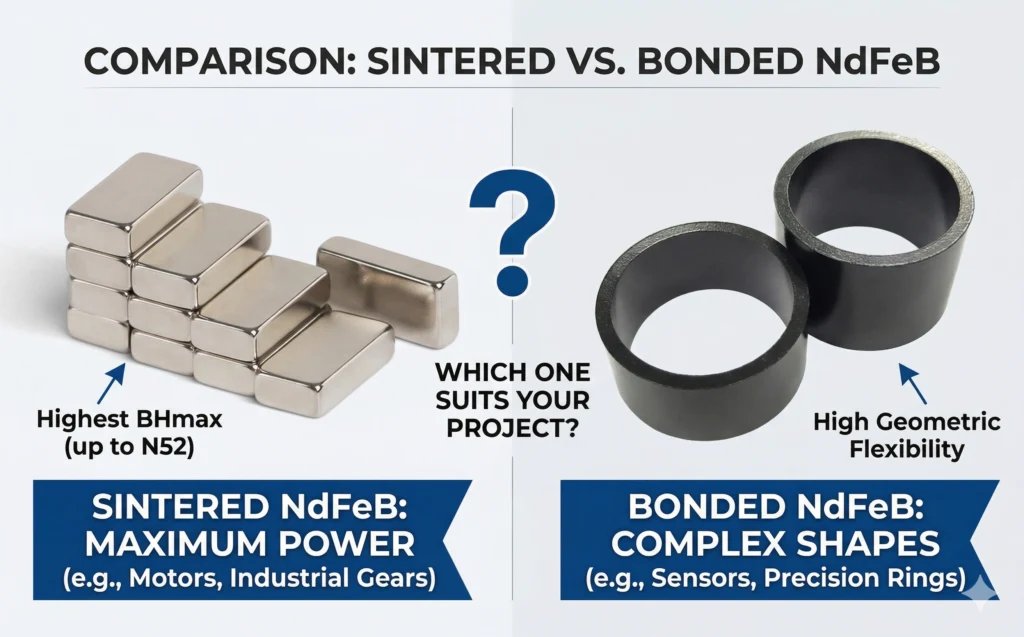
Sintered NdFeB is hard, brittle and electrically conductive. Diamond grinding, slicing, wire cutting and drilling are used with controlled coolant and feed. Conventional aggressive machining can chip edges or create heat damage. Thin parts require support fixtures, and holes or countersinks need realistic wall thickness.
| Geometry | Typical finishing route | Design note |
|---|---|---|
| Block | Slicing and surface grinding | Define magnetization through thickness, width or length |
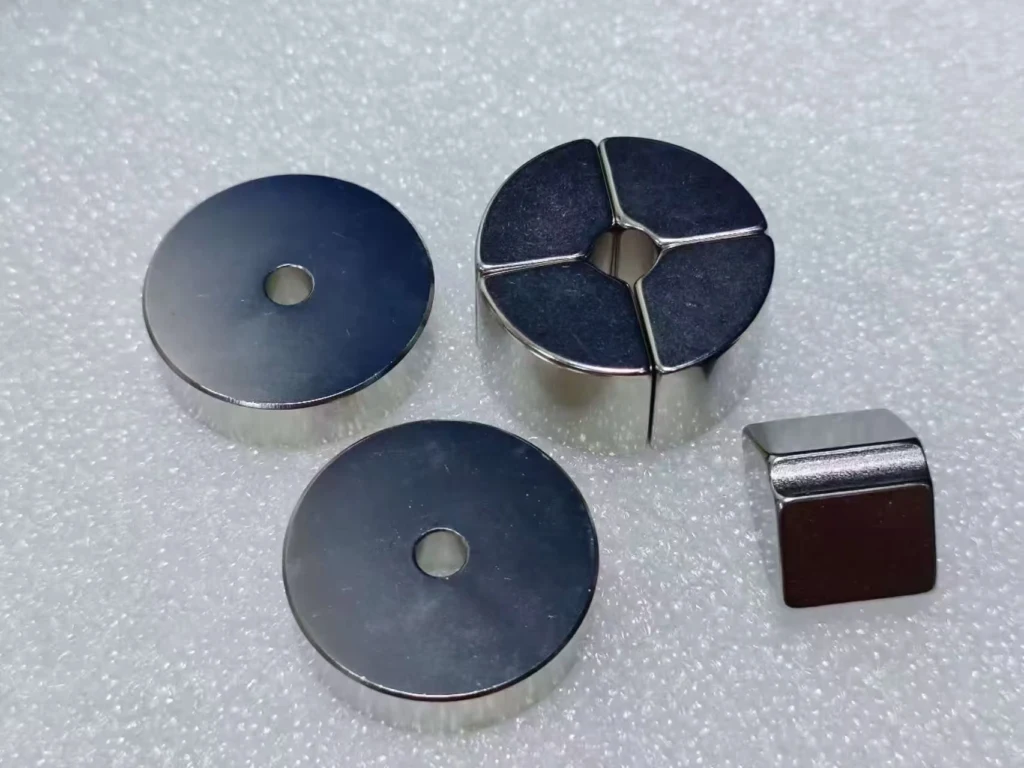
| Disc / ring | Core grinding, OD grinding and slicing | Thin rings are sensitive to chipping |
| Arc segment | Profile grinding and end finishing | Radius tolerance affects rotor assembly gaps |
| Complex shape | Wire cutting and dedicated fixtures | Cost depends strongly on yield and setup |
7. Coating and Corrosion Protection
The rare-earth-rich grain-boundary phase is chemically active, so most sintered magnets need protection. Nickel-copper-nickel is common for clean, moderate environments. Zinc, epoxy, passivation, phosphating and application-specific systems serve different humidity, salt, wear and adhesive requirements. Coating thickness must be included in final dimensions.
8. Magnetization
Finished magnets are magnetized in a pulsed fixture that generates a field high enough to saturate the selected grade. Simple axial or diametrical directions use standard coils; multipole, radial and skewed patterns need dedicated tooling. Large high-Hcj parts require substantial fixture energy and careful handling.
9. Inspection and Lot Release
| Inspection | What it confirms | Typical method |
|---|---|---|
| Dimensions | Fit, air gap and assembly repeatability | Caliper, micrometer, gauge or CMM |
| Magnetic properties | Br, Hcb, Hcj and (BH)max | Hysteresis graph on representative samples |
| Flux / surface field | Magnetization and part consistency | Fluxmeter, Helmholtz coil or gaussmeter |
| Coating | Coverage, thickness and adhesion | XRF, visual and adhesion testing |
| Reliability | Application margin | Thermal aging, humidity, salt spray or pull test |
Why Manufacturing Route Matters to the Buyer
Two suppliers may quote the same neodymium magnet grades but deliver different hot demagnetization margins, coating durability or dimensional capability. A useful drawing states minimum properties, operating temperature, geometry, magnetization, coating, critical dimensions and inspection method. It should also define whether magnetic acceptance applies to an individual part or the completed assembly.
Traceability should connect the released lot to the alloy batch, heat-treatment route, coating batch and final inspection record. This makes later engineering changes measurable instead of relying on visual similarity.
Guande Manufacturing and Engineering Support
We support sintered NdFeB magnets from material review through precision finishing, coating, magnetization and inspection. Our custom neodymium magnets include blocks, arc magnets and application-specific shapes. For bonded steel, rotors or fixtures, we also provide custom magnetic assemblies.
Send the grade, dimensions, magnetization direction, coating, annual volume and operating conditions through Get a Quote. We will review manufacturability before fixing the production route.