A neodymium magnet that has lost flux after overheating can often be magnetized again—but only if the magnetic material and the finished part remain physically and metallurgically intact. A new magnetizing pulse can realign reversed domains. It cannot repair oxidation, cracks, coating failure, adhesive damage or microstructural changes caused by severe temperature exposure.
Short answer: reversible temperature loss returns after cooling; irreversible domain reversal may be recoverable by re-magnetization; material damage is not.
First Identify What “Heat Demagnetization” Means
NdFeB remanence falls as temperature rises. Within a safe operating range, most of that reduction is reversible: flux decreases while hot and returns when the magnet cools. The more serious case occurs when intrinsic coercivity falls and the magnet’s operating point crosses the knee of its hot demagnetization curve. Domains reverse, leaving a lower room-temperature flux after cooling.
The published neodymium magnet operating temperature is not a universal switch point. Geometry, air gap, surrounding steel, opposing field, exposure time and acceptable loss all matter. A thin magnet in an open circuit can lose flux at a temperature that a thicker part of the same grade survives inside a closed steel circuit.
| Observed condition | Physical mechanism | Recovery after cooling | Can re-magnetizing help? |
|---|---|---|---|
| Flux falls only while hot | Reversible Br temperature coefficient | Mostly yes | Usually unnecessary |
| Flux remains low after cooling | Irreversible domain reversal | No | Often, if material is intact |
| Magnet exposed near/above Curie temperature | Long-range magnetic order collapses | No useful self-recovery | Possible only after material condition is confirmed |
| Corrosion, cracking or coating blistering | Magnetic volume and structure are damaged | No | Cannot restore missing or damaged material |
| Bonded assembly distorted or adhesive softened | Mechanical position changes | No | Magnetic recovery does not repair assembly geometry |
Why a Magnetizing Pulse Can Restore Flux
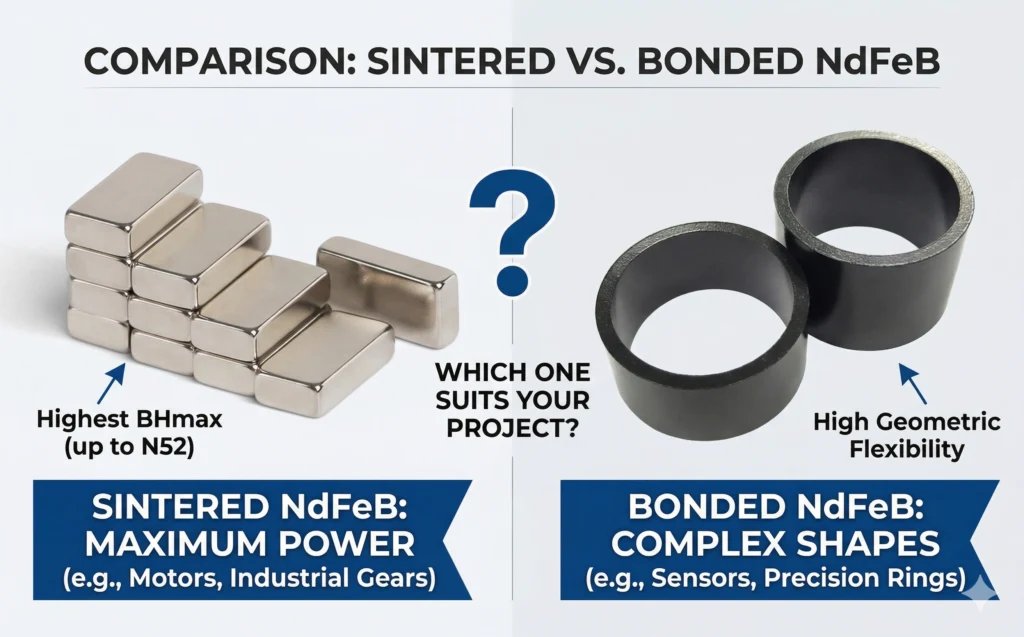
Sintered NdFeB is manufactured with aligned crystallographic easy axes. Heating may reverse some domains without changing that underlying orientation. A sufficiently strong pulse applied in the original magnetization direction can drive those domains back toward saturation. Required fixture field depends on grade, geometry, air gap inside the fixture and permanent magnet coercivity.
High-Hcj material, large cross-sections and multipole patterns require higher magnetizing energy. The fixture must also withstand electromagnetic forces and heating. A workshop electromagnet or a nearby strong permanent magnet usually cannot saturate a modern high-coercivity NdFeB component reliably.
When Re-Magnetization Is Not a Complete Solution
Severe overheating can change grain-boundary phases or accelerate oxidation, especially where a coating has failed. Re-magnetization may produce a room-temperature flux reading that looks acceptable while hot coercivity remains degraded. In a motor, the part could fail again during the next overload. This is why recovery should not be judged only by surface gauss.
Assemblies introduce more limits. Adhesive may have exceeded its glass-transition or service temperature; plastic carriers can creep; steel parts can shift; rotor sleeves may lose preload. If the magnets moved, the original pole pitch, air gap or balance may no longer exist.
| Pre-check | What to inspect | Reject or investigate when |
|---|---|---|
| Thermal history | Peak temperature, duration and cycles | History is unknown or exceeds material/adhesive limits |
| Visual condition | Coating, discoloration, cracks and corrosion | Base material is exposed or geometry is damaged |
| Dimensions and assembly | Position, air gap, runout and bondline | Parts have shifted, warped or loosened |
| Magnetic baseline | Flux, moment, pole map or back-EMF | Loss is nonuniform or localized |
| Material traceability | Grade, batch and hot B-H curve | Actual Hcj and temperature suffix cannot be confirmed |
A Practical Re-Magnetization Workflow
- Cool the part to a controlled reference temperature and measure flux or magnetic moment.
- Inspect coating, dimensions, adhesive and mechanical retention.
- Confirm the original magnetization direction or multipole drawing.
- Select a pulse fixture with enough field margin to saturate the actual grade.
- Re-magnetize under controlled polarity and handling conditions.
- Repeat magnetic measurements and compare them with released production limits.
- Perform a representative thermal-aging or hot-demagnetization test before returning critical parts to service.
What Should Be Measured After Recovery?
For a loose simple magnet, total flux or magnetic moment is more repeatable than a single surface-gauss point. A multipole rotor needs pole sequence and flux mapping; a motor may require back-EMF and balance; a coupling may require torque at the specified gap. Compare at the same temperature and geometry because probe position and steel fixtures can change the result.
Do not use the original room-temperature value as the only acceptance criterion when the magnet will operate hot. Repeat the relevant measurement after a defined temperature soak and cooling cycle. If the recovered part loses flux again, the grade, load line or surrounding circuit still lacks adequate margin. For safety-critical assemblies, replacement with a traceable new lot is often more economical than repeated recovery and qualification.
| Application | Useful release test | Additional reliability check |
|---|---|---|
| Loose block/disc | Flux, moment and dimensions | Thermal aging at defined load line |
| Motor rotor | Pole map, back-EMF and runout | Hot reverse-field test |
| Magnetic coupling | Static torque at working gap | Temperature and overload cycle |
| Holding assembly | Pull force on defined steel | Heat, corrosion and bond retention |
Preventing the Same Failure
Moving to higher-temperature neodymium magnet grades is only one option. Improve cooling, increase magnetic length, reduce air gap, add steel return path, limit fault current or lower the reverse field. Review coating and adhesive limits separately. The previous article Why Are Neodymium Magnets Magnetic, and Can They Lose Magnetism? explains the domain and load-line background.
Guande Engineering Support
Guande supports sintered NdFeB magnets, magnetization fixtures and custom magnetic assemblies. For custom neodymium magnets, we can review hot B-H curves, magnetization direction, flux inspection and assembly retention.
Send the grade, geometry, peak temperature, exposure duration, original and current magnetic readings, and assembly drawing through Get a Quote. We will assess whether controlled re-magnetization, requalification or replacement is the more reliable route.