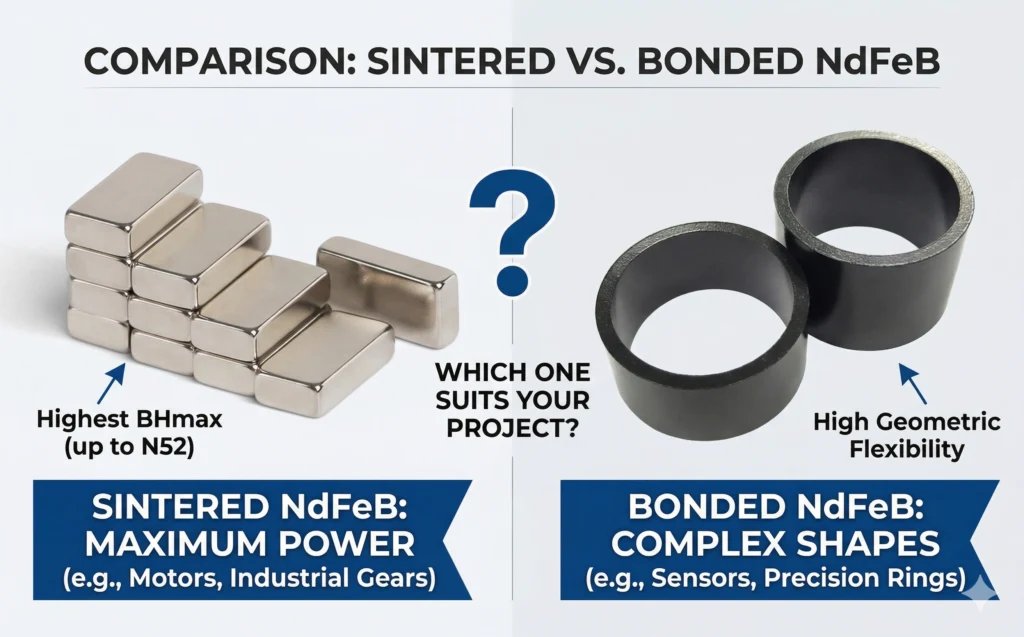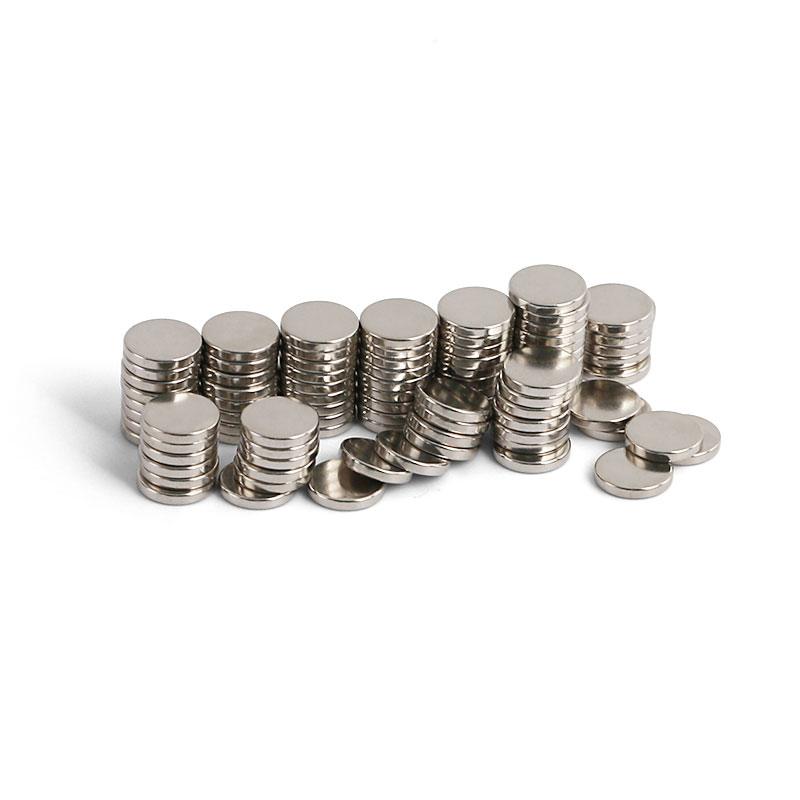
A neodymium magnet becomes magnetic because its crystal structure strongly favors one direction for atomic magnetic moments. Manufacturing aligns that structure, and a high-field pulse then drives most magnetic domains into a common direction. The resulting magnet retains substantial flux after the external field is removed. It can lose magnetism, but the amount and reversibility depend on temperature, opposing field, geometry, corrosion and the selected grade.
Engineering answer: “permanent” means stable remanence under specified conditions—not unlimited resistance to heat, reverse field or material damage.
What Produces Magnetism Inside NdFeB?
The main hard-magnetic phase in sintered NdFeB is Nd2Fe14B. Iron provides most of the magnetic moment through unpaired 3d-electron spins. Neodymium contributes strong magnetocrystalline anisotropy, while boron helps stabilize the tetragonal phase. This neodymium magnet composition creates both high magnetization and a strong preference for the moments to remain along the crystal’s easy axis.
Inside an unmagnetized part, microscopic regions called domains point in different directions, so their external fields largely cancel. During powder pressing, manufacturers first orient the particles in a magnetic field. After sintering, machining and coating, a short, intense pulse from a magnetizing fixture moves domain walls and rotates domains toward the designed direction. When the pulse ends, the high anisotropy and coercivity resist randomization, leaving useful remanent flux.
| Property | What it describes | Why it matters |
|---|---|---|
| Br, remanence | Flux density retained after saturation | Strongly affects useful field and force |
| Hcj, intrinsic coercivity | Resistance to irreversible domain reversal | Critical for heat and opposing-field margin |
| Hcb, normal coercivity | Field needed to reduce B to zero | Used with the working load line |
| (BH)max | Maximum magnetic energy density | Helps compare material volume efficiency |
| Temperature coefficients | Change of Br and Hcj with temperature | Predicts hot performance, not just room-temperature force |
Why the Magnet Stays Magnetized
Domain alignment alone is insufficient. Fine grains, controlled grain boundaries and high anisotropy create barriers against reverse-domain nucleation and growth. Heat treatment and alloy additions tune those barriers. This is why two neodymium magnet grades with similar room-temperature Br may have very different Hcj and hot demagnetization behavior.
The application also matters. A magnet operates on a load line determined by its length-to-area ratio, air gap and surrounding steel. A thin magnet measured along its magnetization direction has a stronger self-demagnetizing field than a long magnet. Opening a magnetic circuit or increasing the air gap can therefore move the working point closer to the knee of the demagnetization curve.
Can Neodymium Magnets Lose Magnetism?
Yes. Some loss is temporary, while some remains after the magnet returns to room temperature. The distinction should be made during design and validation.
| Cause | Typical effect | Does flux recover? | Design response |
|---|---|---|---|
| Normal temperature rise below the knee | Br falls according to its temperature coefficient | Mostly yes after cooling | Calculate hot flux and force |
| Excess heat or low load-line margin | Some domains reverse | No, unless the intact part is re-magnetized | Select adequate Hcj and geometry |
| Strong opposing field | Partial or complete demagnetization | Usually requires re-magnetization | Model fault current and nearby magnets |
| Temperature near/above Curie point | Long-range magnetic order collapses | Not reliably without reprocessing and magnetization | Never use Curie temperature as the operating limit |
| Corrosion or fracture | Magnetic volume and circuit geometry change | No | Choose coating, sealing and mechanical support |
Operating Temperature Is Not Curie Temperature
The maximum recommended neodymium magnet operating temperature is well below the Curie temperature. It is an application-dependent limit influenced by grade, shape, permeance coefficient, reverse field and acceptable flux loss. A grade often described as suitable for 120°C can still demagnetize below that value if it is very thin, operates in a large air gap or sees a motor fault field. Conversely, a well-supported magnetic circuit may retain more margin.
For motors, couplings and actuators, review the complete B-H curve at the highest magnet temperature. The relevant check is whether the operating point stays above the knee under normal and fault conditions. A room-temperature surface-field measurement cannot answer this.
Does Magnetism Fade Simply with Age?
Properly designed sintered NdFeB magnets do not normally show meaningful spontaneous loss over ordinary product life. Small stabilization changes may occur early, especially after the first thermal exposure, but long-term problems are more often caused by repeated overheating, corrosion, shock damage or an underestimated reverse field. Accelerated thermal aging is useful when a project requires a defined flux-change limit.
Storage next to ordinary steel or another correctly oriented magnet does not automatically consume magnetism. The practical risks are uncontrolled heat, a strong opposing pole arrangement and mechanical handling that chips the protective coating. Keep high-energy magnets separated with stable spacers, control pinch hazards and avoid forcing unlike magnetic circuits together without a reviewed fixture.
Can a Demagnetized Part Be Re-Magnetized?
If the material has not corroded, cracked or suffered damaging microstructural change, a sufficiently strong pulse can often restore saturation. The required fixture must match the direction and pole pattern, and high-Hcj or large parts need substantial magnetizing energy. Re-magnetization does not repair missing material, coating failure or permanent changes caused by severe overheating.
Practical Selection Checklist
| Input to define | Engineering question |
|---|---|
| Maximum magnet temperature | Is this measured at the magnet, including short overloads? |
| Magnetic circuit | What are the minimum steel thickness, air gap and magnet dimensions? |
| Opposing field | Can coils, adjacent poles or fault current reverse the field? |
| Environment | Are humidity, salt, coolant or condensation present? |
| Acceptance test | Will flux, surface field, pull force or assembled torque be controlled? |
How Guande Supports Magnetic Reliability
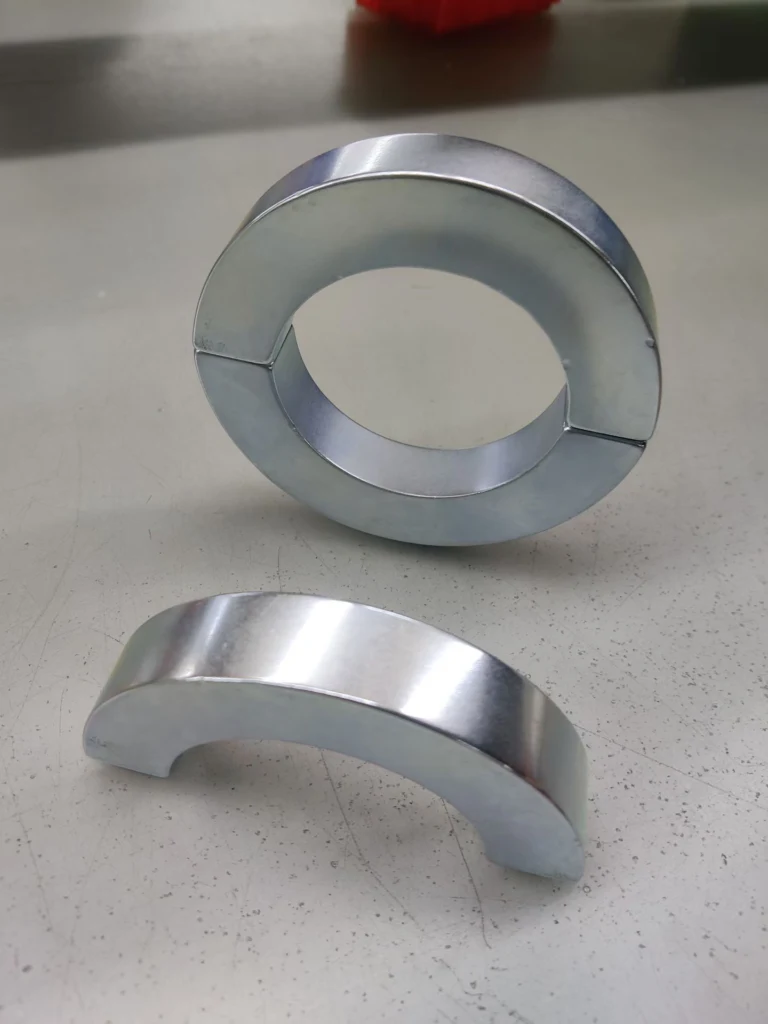
Guande reviews material, geometry and the working magnetic circuit together. Our sintered NdFeB magnets include block magnets, arc magnets and application-specific shapes. For assemblies, we can assess steel return paths, air gaps, magnetization direction and inspection method.
For custom neodymium magnets, send the drawing, peak temperature, duty cycle, surrounding steel and any reverse-field condition through Get a Quote. We will recommend a practical grade and validation plan rather than selecting from surface field alone.