Magnetic filter grid applications extend well beyond a hopper under a bag-dump station. Magnetic tubes and grates can protect mills, extruders, pumps, nozzles and packaging equipment; reduce ferrous contamination in ingredients; and provide an inspectable control point in powders, granules, liquids and slurries. Performance depends on where the grid is installed and how the product passes the active surfaces.
Key point: an industrial magnetic filter is a capture device, not a universal metal detector. It is effective for ferromagnetic contamination that passes sufficiently close to a high-gradient surface. It cannot guarantee removal of every stainless-steel, aluminum, copper, stone or glass particle.
How the Grid Captures Metal
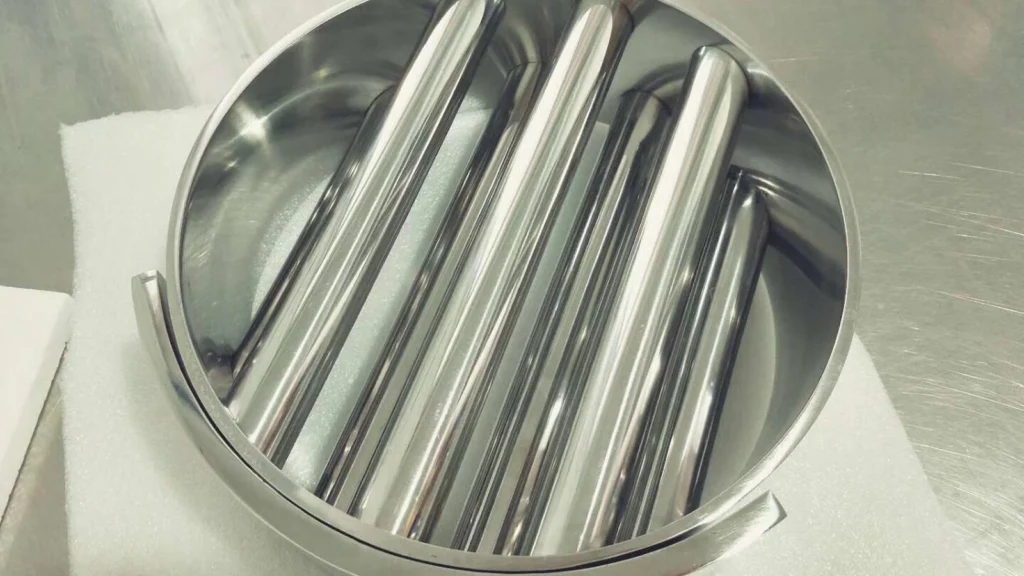
Each tube contains permanent magnets and steel pole pieces inside a stainless shell. Alternating pole transitions create high local field gradients at the tube surface. Ferrous particles experience a force toward these gradients and remain attached until cleaning.
A grid places multiple tubes across the flow so product cannot remain far from all active surfaces. Staggered rows increase exposure. Field strength matters, but capture also depends on gradient, distance, particle size and shape, velocity, viscosity, tube spacing and accumulated contamination.
Application Matrix by Industry
| Industry | Typical product | Common installation point | Main purpose |
|---|---|---|---|
| Food and ingredients | Flour, sugar, starch, spice, grain, milk powder | Hopper outlet, chute, before mill or packaging | Capture wire, scale, fastener wear and ferrous fines |
| Plastics and rubber | Pellets, regrind, masterbatch, additives | Dryer, blender, extruder feed throat | Protect screws, dies and hot-runner systems |
| Chemicals | Pigment, powder, catalyst carrier, granules | Bag dump, transfer chute or reactor feed | Reduce process contamination and equipment damage |
| Ceramics and minerals | Clay, glaze, silica, sand, mineral powder | Before mill, press or slurry process | Reduce iron staining and protect machinery |
| Pharmaceutical and nutraceutical | Qualified powders and ingredients | Controlled transfer and final feed | Provide a validated, cleanable contamination-control step |
| Recycling | Plastic flake, shredded material, granulate | After size reduction or before sorting/extrusion | Capture liberated steel fragments |
| Liquid processing | Oil, coolant, syrup, glaze or slurry | Housing, tank outlet or low-velocity bypass | Remove ferrous wear debris from circulation |
Gravity-Fed Powder and Granules
A magnetic filter for powder is commonly installed in a chute or hopper outlet. Free-flowing granules can pass through moderate tube spacing, while cohesive powder may bridge if clear openings are too small. High flow velocity can carry particles past the tube before the magnetic force changes their trajectory.
Single-row grates suit clean, free-flowing products and limited installation height. Double-row staggered grids reduce straight-through paths and increase exposure, but add pressure drop, hold-up and cleaning time. The correct arrangement balances capture probability with stable production flow.
Plastics: Protecting Extruders and Molds
Ferrous fragments in resin pellets or regrind can damage an extruder screw, barrel, screen pack, die or hot runner. A magnetic grate near the dryer discharge or feed throat is easy to inspect and can capture fastener wear, screen fragments and steel introduced during grinding or conveying.
Regrind usually has more variable particle size and contamination than virgin resin. A robust frame, larger openings and a second capture stage may be justified. The grid should be removable without dropping captured metal into the feed throat.
Food and Sanitary Processing
Food applications add requirements for stainless grade, surface finish, weld quality, seals, drainage, cleanability and documented inspection. A high peak-gauss value does not compensate for dead zones, rough welds or a cleaning method that reintroduces captured metal.
The grid should be integrated into the facility’s hazard analysis and preventive controls. Cleaning frequency should reflect the observed contamination load. A thick captured layer can shield active areas and can release particles when struck by product.
Liquids, Oils and Slurries
A magnetic filter for liquid must account for viscosity, pressure drop, seals, corrosion, drainability and safe isolation. Magnetic tubes can be mounted in a pressure housing, tank, return line or low-velocity bypass. Slower flow and more residence time generally improve the opportunity for small particles to migrate toward the tube.
Highly abrasive slurry can wear the tube shell, while sticky product can build a nonmagnetic layer that increases the effective gap. Tube-wall thickness, stainless alloy and inspection interval should be chosen for the process, not copied from a dry-powder grid.
Choosing the Correct Grid Layout
| Product behavior | Useful configuration | Risk to control |
|---|---|---|
| Free-flowing pellets | Single or staggered grate | High velocity and bounce |
| Fine cohesive powder | Polished tubes with carefully selected spacing | Bridging and surface buildup |
| Large flakes | Large openings and reinforced frame | Blockage and impact |
| Low-viscosity liquid | Streamlined grid in a housing | Seal and pressure rating |
| Viscous slurry | Fewer tubes, bypass or easy-clean assembly | Pressure loss, abrasion and cleaning access |
| High-temperature material | High-temperature NdFeB or SmCo circuit | Hot irreversible loss and cleaning temperature |
Surface Field Is Only One Control
Peak surface field should be measured at a defined pole location with a specified probe. Two grids with the same peak gauss can behave differently if tube spacing, pole pitch, active length or product path differs. A practical acceptance plan can combine field mapping, a standardized pull test, dimensional inspection and a documented installation drawing.
For fine contamination, the field gradient and distance from the tube are particularly important. Increasing tube wall thickness or adding a nonmagnetic easy-clean sleeve increases the gap and may reduce capture. That tradeoff must be tested against cleaning efficiency.
Cleaning and Verification
- Stop and isolate flow using the approved plant procedure.
- Remove the drawer or grate without passing captured metal over clean product.
- Move the assembly to a designated collection area.
- Wipe or wash fixed tubes, or withdraw magnetic cores from easy-clean sleeves.
- Inspect tubes, welds, frames and seals for wear, dents and trapped residue.
- Record contamination and trend unexpected changes.
- Reinstall with the correct orientation and gasket before restart.
Common Specification Mistakes
- Specifying only “12,000 gauss” without probe position or temperature.
- Ignoring product bridging, pressure drop or residence time.
- Assuming all stainless-steel contamination will be captured.
- Using standard NdFeB near a hot dryer or cleaning cycle without margin.
- Choosing an easy-clean sleeve without accounting for the added magnetic gap.
- Setting cleaning intervals by calendar rather than captured load.
For a deeper explanation of the magnetic circuit, see our guide to how magnetic filter grids work.
Guande Magnetic Filter Capability
Guande develops magnetic tubes, round and rectangular grids, drawer assemblies and custom process interfaces. We support magnetic-circuit design, NdFeB or SmCo selection, 304/316L tube and frame fabrication, welding, polishing, sealing, field mapping, pull testing and temperature validation.
Our custom magnetic assembly workflow can adapt the product path, mounting flange and cleaning method. High-energy circuits use inspected sintered NdFeB magnets with lot-level magnetic control.
Send the product, flow rate, chute or pipe drawing, temperature, contaminant and cleaning method for a practical grid layout and validation proposal.