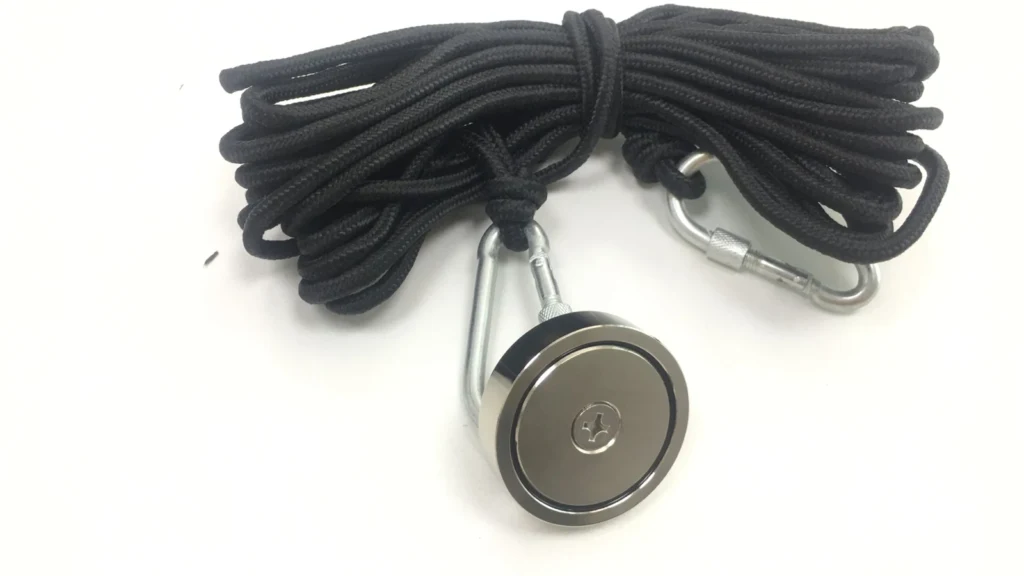
A fishing magnet is a compact permanent-magnet retrieval tool connected to a rope or cable. Most modern products use a high-energy NdFeB magnet inside a steel housing, with an eyebolt that transfers the retrieval load into the body. The same basic magnetic circuit can recover ferrous objects from canals, lakes, wells, tanks, drains, construction sites, and workshop areas.
Important: a catalogue pull rating is normally measured by separating the magnet perpendicular to a clean, flat, thick low-carbon-steel plate. Rust, paint, mud, curvature, thin sheet, an edge contact, shear loading, water movement, and the object’s own geometry can reduce the real retrieval force dramatically.
How Does a Fishing Magnet Work?
A typical fishing magnet design is a form of pot magnet. A sintered NdFeB disc or ring sits inside a low-carbon-steel cup. The steel protects the magnet from side impact and redirects flux from the rear pole to a rim around the working face. The exposed magnet face and steel rim become opposite poles positioned close together.
This circuit produces high contact force on ferromagnetic targets while limiting wasted rear and side field. It is efficient for direct contact, but it is short-range: even a small layer of rust, sediment, coating, or uneven geometry increases magnetic reluctance and leakage. The field does not become weaker simply because it is underwater; the practical loss comes mainly from the increased gap, poor contact, load direction, and surface condition. Our guide to pot-magnet force across an air gap explains this decay in more detail.
Main Components and Their Design Roles
| Component | Function | Design concern |
|---|---|---|
| NdFeB magnet | Provides magnetic energy in a compact volume | Grade, temperature, corrosion, chipping, saturation |
| Steel cup or yoke | Concentrates flux and protects the magnet | Material permeability, wall thickness, saturation, impact |
| Eyebolt and thread | Connects the rope and transfers the retrieval load | Thread engagement, loosening, bending, proof load |
| Coating or sealed housing | Reduces corrosion and wear | Scratches, salt water, crevice corrosion, sealing |
| Rope, carabiner and knot | Transmits load to the user or winch | Breaking strength, abrasion, water absorption, inspection |
Nickel-copper-nickel is common on the internal magnet, while the steel body may be nickel plated, zinc coated, painted, or made with a corrosion-resistant outer enclosure. Standard plating is not permanent waterproofing. Abrasion from concrete, rocks, scrap, and dragging can expose steel, so the complete product must be rinsed, dried, inspected, and stored away from moisture after use.
Common Fishing Magnet Sizes and Pull-Force Ranges
Commercial products range from compact 48–60 mm magnets for light retrieval to 120 mm and larger assemblies for experienced users. The following table is an engineering reference, not a universal rating. Different steel circuits can produce different force from the same diameter, and double-sided or 360-degree sellers may quote a combined value that cannot be applied to one contact face.
| Approx. body diameter | Typical advertised class | Common use | Design note |
|---|---|---|---|
| 48–60 mm | 60–150 kgf (130–330 lbf) | Keys, tools, small scrap, shallow water | Easy to handle, but limited target area and reach |
| 65–80 mm | 150–300 kgf (330–660 lbf) | General hobby retrieval and canal dragging | Balanced size for beginners and portable kits |
| 85–100 mm | 300–500 kgf (660–1,100 lbf) per strong face | Bicycles, heavier tools, larger ferrous debris | Requires stronger rope and careful pinch control |
| 110–120 mm | 500–600+ kgf (1,100–1,320+ lbf) on a single face | Heavy retrieval and professional field work | High self-weight and greater risk of permanent attachment |
| 120–136+ mm multi-face | Combined ratings may exceed 1,000 kgf | Advanced dragging and broad-direction capture | Compare direct force per face, not only the summed label |
For context, one current 120 mm commercial single-sided product is advertised at 1,200 lbf (about 544 kgf), while a 94 mm double-sided design is advertised at 1,700 lbf combined—850 lbf per face. A 360-degree product can publish a very high combined rating yet a much lower direct-pull value. These examples show why diameter and headline force alone are not sufficient for product comparison.
How Pull Force Should Be Specified
A useful specification defines the test method. At minimum, record the target steel grade and thickness, surface finish, contact area, test temperature, pull direction, speed, fixture alignment, number of cycles, and whether the result is initial, minimum, or average force.
| Condition | Effect on practical recovery | Recommended response |
|---|---|---|
| Thick flat steel, normal pull | Closest to laboratory maximum | Use for controlled incoming inspection |
| Rust, paint or sediment | Adds air gap and reduces flux density | Test representative surfaces and keep margin |
| Curved or irregular object | Only part of the pole face contacts | Prefer a larger face or multi-direction design |
| Dragging from the side | Load becomes shear; friction and snagging dominate | Use a side eye or double-sided geometry |
| Thin sheet | Steel may saturate and flex or peel | Do not infer capacity from thick-plate data |
| Deep water or current | Adds rope weight, drag and unstable load direction | Increase rope capacity and control the retrieval path |
One kilogram-force is approximately 9.81 N, and one pound-force is approximately 4.45 N. Those conversions do not correct for different test methods. A reliable supplier should state whether a value is measured per face, combined across faces, or calculated.
Main Types of Fishing Magnets
Single-sided top-pull magnet
The active face points downward when the rope attaches to the back. This architecture gives strong perpendicular pull and is suitable for lowering into wells, docks, tanks, and known drop locations. It may roll or present its inactive side when dragged horizontally.
Double-sided magnet
Two active faces provide a useful contact surface regardless of which side lands on the bottom. A top eyebolt can support vertical lifting, while a side eyebolt supports dragging. The advertised combined force is normally the sum of two faces; a single object contacting one face does not receive the combined number.
360-degree or all-around magnet
A radial or multi-surface circuit presents attraction around the body as well as on one or both faces. It increases the chance of catching irregular scrap while dragging, but it is more complex, expensive, and difficult to release if it attaches to a large fixed structure. Direct pull, side pull, and combined force must be listed separately.
Protected, anti-collision and corrosion-resistant versions
Some products use a replaceable shell, tapered bumper, stainless outer case, or recessed working surface to reduce chipping and snagging. Protection inevitably changes the working gap and force. Saltwater products require material and sealing decisions beyond a cosmetic coating.
Switchable or releasable retrieval systems
Professional systems may use a mechanically movable magnet, shunt, lever, or pulley arrangement to reduce holding force before release. These are useful when the tool might attach to immovable infrastructure. They should not be confused with a simple permanently energized hobby magnet.
When Did Magnet Fishing Become Popular?
Magnetic retrieval itself is not new. Maintenance, construction, maritime, and law-enforcement teams used magnets to recover ferrous objects long before the recreational name became common. The modern hobby developed when high-energy NdFeB assemblies, online retail kits, action cameras, and social-video channels made the activity accessible and shareable.
| Period | Development | Market effect |
|---|---|---|
| Before the 2000s | Industrial and professional magnetic retrieval already exists | Specialized tools rather than a broad leisure category |
| Early 2000s | European hobby communities and online discussions emerge | Consumer use begins to separate from professional retrieval |
| 2016–2018 | Search interest and social-video visibility rise sharply | Dedicated kits, ropes and multiple magnet architectures appear |
| 2018–2021 | News coverage and waterway-safety warnings increase | Public awareness grows together with legal and safety scrutiny |
| 2022–2026 | Single-, double- and 360-degree kits become established online categories | Market shifts toward stronger products, complete kits and differentiation |
Google Trends is useful for the direction of public interest, but its 0–100 scores are normalized rather than absolute sales volume. Historical searches show a strong rise from about 2016. Government and waterway authorities now describe magnet fishing as a popular or relatively new activity and publish guidance on permission, safe disposal, weapons, and unexploded ordnance.
Fishing Magnet Market: Growth, Maturity and Limits
There is no audited public dataset that cleanly isolates global fishing-magnet revenue. Published commercial reports use inconsistent definitions and sometimes produce incompatible totals. A responsible market assessment should therefore avoid presenting one precise number as established fact.
The observable market is a fragmented outdoor-recreation and retrieval-tool segment, with strongest visibility in Europe and North America. Sales include the magnet itself, rope, gloves, carabiners, threadlocker, grappling hooks, storage cases, protective shells, and complete neodymium magnet fishing kits. Demand expanded with social media and e-commerce, while current competition increasingly centers on multi-direction force, corrosion protection, safer handling, complete kits, and truthful test data.
As of 2026, the category appears established rather than disappearing. Growth may be slower than its initial social-media surge, and local restrictions can limit use. Suppliers should expect more scrutiny of safety, landowner permission, recovered-waste disposal, material durability, and whether pull-force claims are comparable.
Applications Beyond Recreational Magnet Fishing
- Waterway cleanup: recovering ferrous debris from canals, ponds and docks when permission and safe disposal are arranged.
- Lost-tool retrieval: retrieving wrenches, chains, keys, fasteners, covers and components from wells, tanks, drains and pits.
- Construction and maintenance: locating or removing ferrous items from inaccessible spaces, subject to site procedures.
- Marine and dock service: recovering dropped equipment with corrosion-resistant hardware and controlled lifting methods.
- Forensic recovery: authorized law-enforcement work for objects of evidentiary interest; chain-of-custody procedures apply.
- Workshop cleanup: collecting ferrous swarf, nails and offcuts with a purpose-built guard or release mechanism.
- Inspection and robotics: magnetic attachment or retrieval heads integrated with cameras, ROVs or manipulators.
A fishing magnet is not automatically a certified lifting magnet. It should not suspend people, lift overhead loads, or replace rated lifting equipment. Professional recovery needs a defined working-load limit, proof testing, secondary retention, and the applicable local safety standard.
How to Select a Fishing Magnet
- Define whether the tool will be lowered vertically, dragged, or used in both directions.
- Describe expected targets: mass, steel thickness, curvature, rust, coating, and likely contact area.
- Choose the architecture before selecting the headline force.
- Specify the force per active face under a repeatable test method.
- Check rope, eye, thread, carabiner, and knot capacity with an appropriate safety margin.
- Review corrosion, impact, storage, and release risks for the actual water and site.
Higher NdFeB grade is not always the best answer. The steel cup may saturate, corrosion protection may control life, and a larger contact diameter can be more useful than higher remanence. The assembly should be optimized as a circuit.
Guande Design, Assembly and Inspection Capability
Guande supports sintered NdFeB magnets, steel-cup design, coating selection, eye and threaded-interface review, bonding, controlled magnet insertion, and custom magnetic assemblies. Inspection can include magnet dimensions, coating, magnetic moment, finished-assembly pull force, force-versus-gap testing, thread gauges, torque checks, corrosion validation, and lot traceability.
For custom development, provide the target material, minimum force at the real surface condition, pull direction, body diameter, thread, water chemistry, impact exposure, rope interface, test method, and annual volume. We will separate magnetic-force requirements from mechanical safety requirements before fixing the design.
Safety and Legal Responsibilities
Obtain the landowner or waterway operator’s permission and check local rules before use. Wear cut-resistant gloves and suitable water-edge protection; keep the rope clear of other users and vessel lines. Strong NdFeB assemblies can crush fingers, damage electronics, and affect implanted medical devices.
Recovered sharp or rusty material must be removed and disposed of responsibly. If an object resembles a firearm, ammunition, grenade, explosive, or other dangerous item, do not handle or transport it. Follow local emergency guidance, mark the location, and contact the responsible authority. Canada’s Department of National Defence specifically advises treating suspected unexploded ordnance as dangerous and contacting police.
References
- Broads Authority: permission, disposal and waterway safety
- Government of Canada: magnet fishing and unexploded ordnance
- Google News Initiative: how to interpret Trends data
- Commercial double-sided example: combined versus per-face pull
Send Guande your target, working direction, minimum pull force, diameter, corrosion exposure and production volume for a practical fishing-magnet design and test proposal.