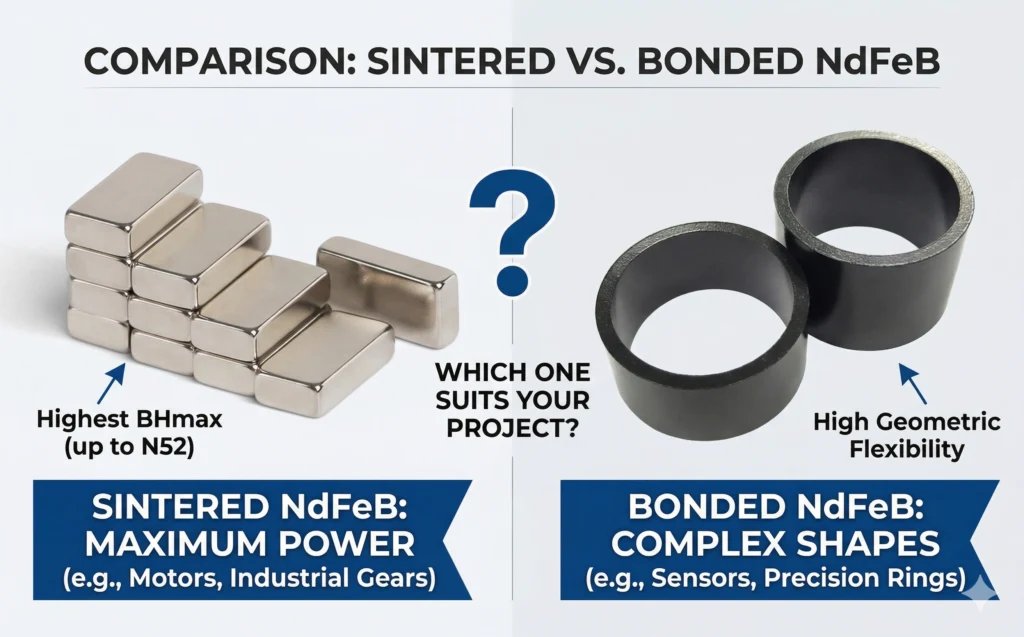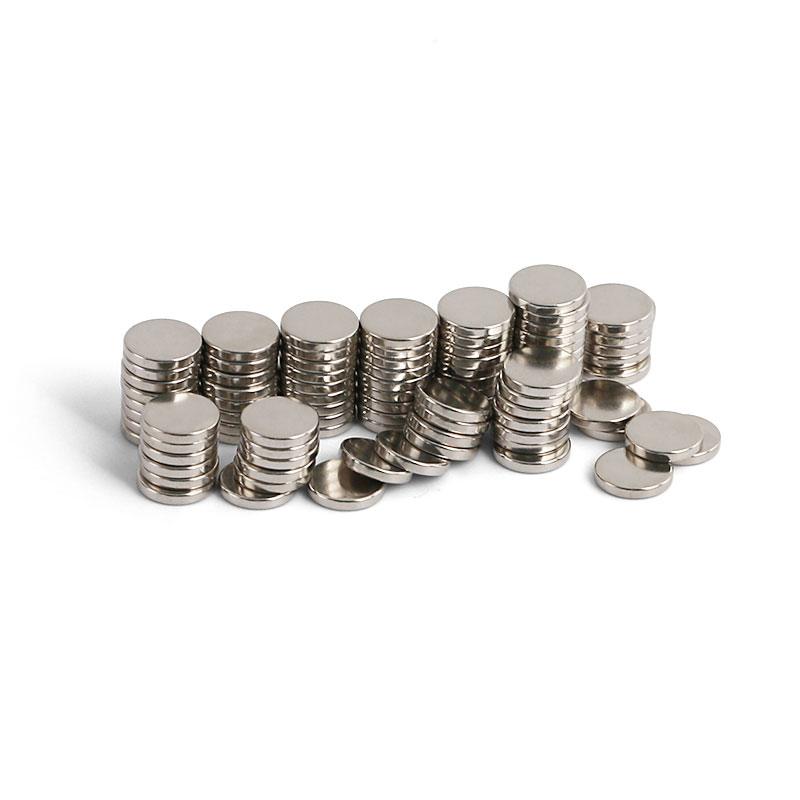
For conventional commercial N-grade notation, N55 is currently the practical top end of widely specified, mass-produced sintered NdFeB material. Some suppliers advertise N56, N58, N60, or N62, and some major manufacturers use proprietary series numbers above 55. Those labels are not automatically equivalent to a standard N-grade. The delivery specification must show the guaranteed remanence, coercivity, maximum energy product, temperature limits, and test method.
Direct answer: use N55 as the highest broadly recognized catalog grade, but do not approve a design from the grade name alone. A proprietary “62 Series” is not necessarily an N62 magnet, and a claimed N60 or N62 should be verified against measured properties and production capability.
What the Number in N55 Means
The number in a room-temperature NdFeB grade is linked to the magnet’s maximum energy product, (BH)max, expressed in MGOe. It describes how much useful magnetic energy the material can supply at the best point on its demagnetization curve. It does not directly state pull force, surface gauss, operating temperature, or resistance to demagnetization.
| Nominal grade | Representative (BH)max range | Typical design position |
|---|---|---|
| N48 | About 46-49 MGOe | High output with broader sourcing flexibility |
| N50 | About 48-51 MGOe | Compact motors, sensors, and assemblies |
| N52 | About 50-53 MGOe | Common high-energy catalog grade |
| N54 | About 52-55 MGOe | Higher flux where geometry is constrained |
| N55 | About 53-56 MGOe | Top end of broadly recognized mass-production N grades |
These are representative ranges, not a purchase specification. Grade tables differ slightly by manufacturer and standard. The approved drawing should reference the actual Br, Hcb, Hcj, (BH)max, dimensions, coating, magnetization direction, and inspection method.
Why Higher Labels Need Careful Verification
The theoretical energy-product ceiling of perfectly oriented Nd2Fe14B is only moderately above today’s best production materials. Moving from N52 to N55 requires tight control of alloy purity, powder particle size, magnetic alignment, oxygen level, density, and sintering microstructure. Production yield and property uniformity become increasingly demanding.
Major producers also use proprietary family names. TDK, for example, publishes 55 Series materials and a proprietary 62 Series using its HAL diffusion process. The “62” in that family name should not be read as an automatic guarantee of 62 MGOe. Individual material names and guaranteed curves still define performance. The same caution applies to marketplace listings marked N60 or N62.
Minimum documents to request for a grade above N55
- A signed material-property table showing minimum and maximum Br, Hcb, Hcj, and (BH)max.
- The test temperature, sample geometry, magnetizing condition, and referenced standard.
- Production-lot data rather than one laboratory sample.
- Demagnetization curves at the application’s maximum temperature.
- Part-level flux or magnetic-moment acceptance limits.
- Evidence that the requested size and magnetization direction are available in repeatable production.
The Highest Grade Is Often Not the Best Grade
N55 maximizes room-temperature energy density, but many applications fail because of insufficient intrinsic coercivity rather than insufficient Br. A thin magnet, large air gap, high winding current, or elevated temperature can move the operating point into an irreversible-loss region.
| Design condition | Primary parameter | Practical response |
|---|---|---|
| Minimum volume at room temperature | Br and (BH)max | Compare N52, N54, and N55 |
| Motor reverse field | Intrinsic coercivity Hcj | Consider M, H, SH, UH, EH, or AH families |
| High operating temperature | Hcj and temperature curve | Choose grade from the hot operating point |
| Long, open magnetic circuit | Permeance coefficient | Review geometry before increasing grade |
| Corrosive environment | Coating and sealing system | Select protection independently of grade number |
| Tight output tolerance | Lot uniformity and inspection | Specify part-level flux or moment limits |
A Practical Grade-Selection Diagram
| 1. Operating temperature | → | 2. Reverse field and load line | → | 3. Required Hcj margin |
|---|---|---|---|---|
| Define normal and fault temperatures | → | Calculate the worst operating point | → | Select M/H/SH/UH/EH/AH family |
| 4. Required air-gap output | → | 5. Geometry and grade | → | 6. Prototype validation |
| Set flux, force, torque, or back-EMF target | → | Optimize magnet volume before choosing N55 | → | Test hot output and irreversible loss |
N52 Versus N55 in a Real Assembly
If N55 and N52 magnets have the same geometry and both operate safely, N55 may provide a modest increase in magnetic output. The system improvement is normally much smaller than the difference between the grade numbers suggests. Steel saturation, leakage, air-gap variation, coating thickness, magnet tolerances, and assembly position can absorb part of the theoretical gain.
In many projects, a slightly larger N52 magnet, a reduced working gap, improved pole-piece geometry, or a better-controlled assembly produces a more economical result. This is why Guande reviews the complete magnetic circuit instead of recommending the highest grade by default.
Temperature Suffixes Change the Answer
N55 normally refers to a high-energy room-temperature material. Adding coercivity for high-temperature service usually reduces the maximum achievable Br and (BH)max. A grade such as N48H or N42SH can therefore be more reliable than N55 in a motor, even though its energy-product number is lower.
The suffix is not a universal temperature guarantee. Safe temperature depends on the magnet’s length-to-area ratio, surrounding steel, reverse field, duty cycle, thermal gradients, and acceptable irreversible loss. Review the full demagnetization curve at temperature.
How Guande Specifies High-Performance NdFeB
For sintered NdFeB magnets, we support grade review, geometry, magnetization direction, coating selection, machining, and part-level magnetic inspection. For motor or high-force projects, the normal workflow is:
- Confirm the operating environment and magnetic-circuit geometry.
- Calculate the hot operating point and demagnetization margin.
- Compare candidate grades by usable system output, not catalog Br alone.
- Define dimensional and magnetic acceptance limits that production can measure.
- Validate prototype flux, force, torque, back-EMF, or magnetic moment at relevant temperatures.
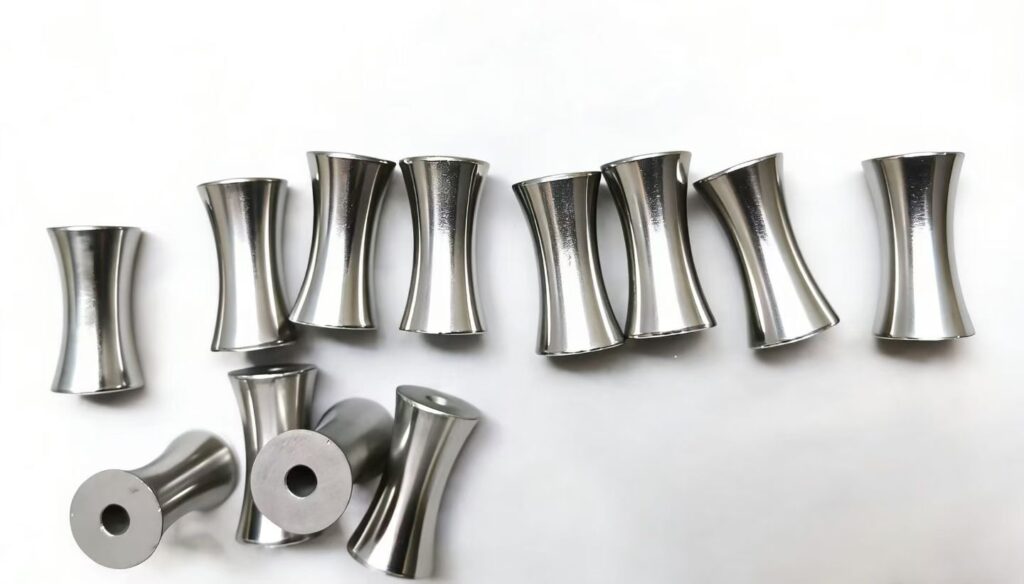
Custom shapes can be reviewed through our NdFeB block magnet and other sintered magnet capabilities.
Frequently Asked Questions
Is N55 stronger than N52?
At the same geometry and safe operating point, N55 can provide higher room-temperature magnetic output. The improvement in the complete assembly may be limited by air gap, steel saturation, leakage, and tolerance.
Is N62 a standard commercial grade?
It is not as broadly standardized or independently comparable as N52 or N55. Some suppliers use N62 as a marketing grade, while some manufacturers use “62 Series” as a proprietary family name. Request the guaranteed property table and production-lot evidence.
Can N55 be used at high temperature?
Only after checking its Hcj, geometry, reverse field, and temperature curve. A lower-energy high-coercivity grade may retain more usable output in the actual machine.
Send Guande your drawing, temperature profile, reverse field, and required magnetic output for an efficient and evidence-based grade comparison.