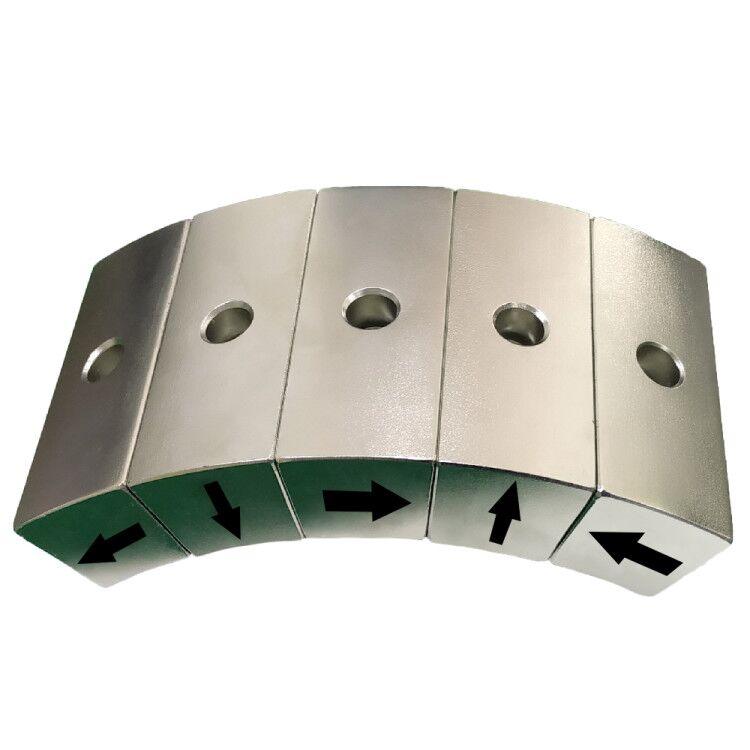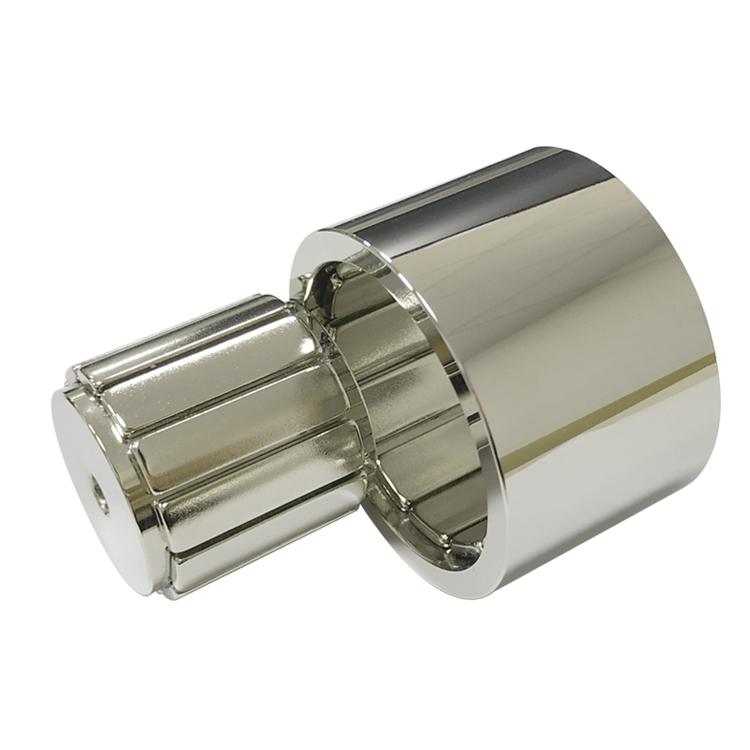
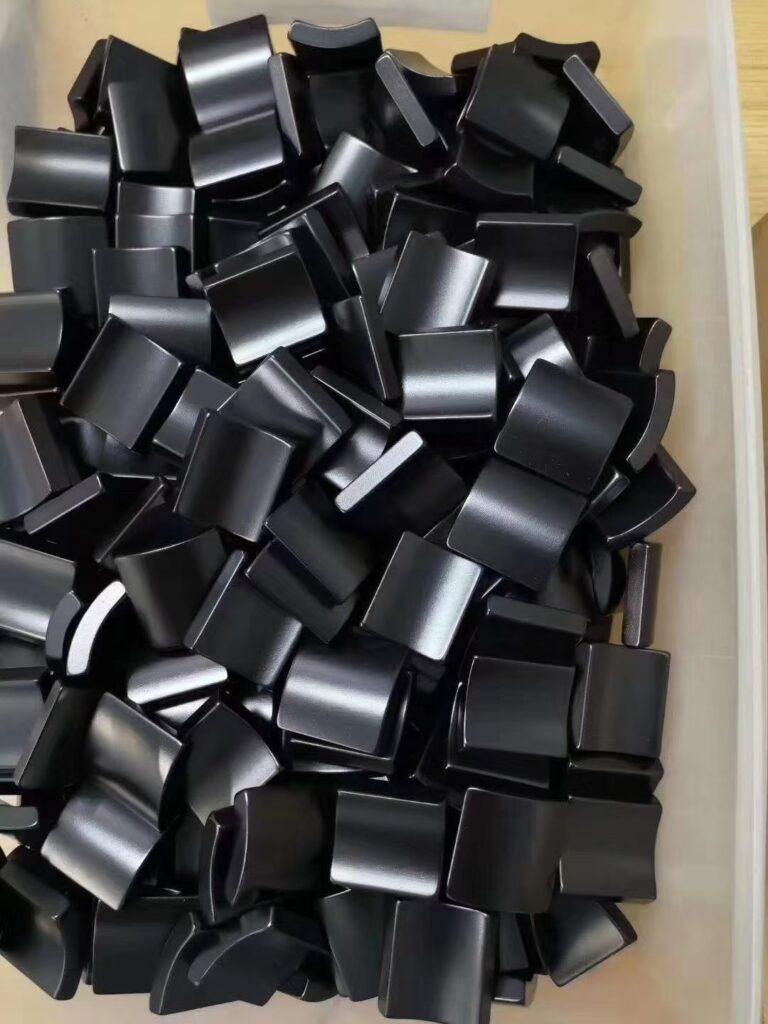
Sintered NdFeB magnets contain a reactive rare-earth-rich phase and normally need surface protection. The correct coating slows corrosion, protects the magnet during handling, supports bonding or assembly, and helps the finished component survive its real operating environment. However, no thin coating can compensate for a poor seal, sharp-edge damage, standing water, or an incompatible chemical.
Key takeaway: select a magnet coating from humidity, salt, chemicals, wear, temperature, dimensional tolerance, and assembly method—not from color or salt-spray hours alone.
Why NdFeB Magnets Corrode
Moisture and electrolytes can attack the microstructure of a sintered NdFeB magnet. Corrosion may start at pores, coating defects, edges, or damage created during assembly. The reaction products expand and can cause blistering, flaking, loss of dimensions, reduced mechanical integrity, or eventual magnetic-performance loss.
The coating is therefore part of the component specification. Base-material density, surface preparation, edge radius, layer adhesion, porosity, and inspection quality are as important as the nominal coating type.
Common Magnet Coatings and Their Typical Uses
| Coating | Typical strengths | Limitations | Common environments |
|---|---|---|---|
| Ni-Cu-Ni | Good wear resistance, bright finish, tight dimensional control, mature process | Conductive; scratches and sharp edges can expose the magnet; not ideal for long-term salt or chemical immersion | Indoor motors, sensors, electronics, fixtures, protected assemblies |
| Zinc | Economical, useful sacrificial behavior, generally good for moderate humidity | Softer finish and different appearance; chemical and high-temperature limits must be checked | General industrial products, indoor or mildly humid service |
| Epoxy | Good barrier protection, electrical insulation, available in black or other finishes | Can chip or scratch; thickness and edge coverage require control; wear resistance varies by system | Humid equipment, motors, marine-adjacent equipment, bonded assemblies |
| Ni-Cu-Ni + epoxy | Combines metallic underlayer adhesion with an additional barrier | Higher cost and thickness; damage can still compromise protection | Higher-humidity or splash exposure where dimensions permit |
| Electroless nickel | Uniform coverage on complex geometry, good hardness and chemical resistance in suitable systems | Process chemistry and phosphorus content affect performance; application-specific qualification needed | Precision components and selected chemical environments |
| Parylene | Very conformal, pinhole-resistant thin-film barrier, electrical insulation | Higher cost; adhesion, wear, and high-temperature limits require validation | Medical devices, electronics, sensors, clean or tightly controlled assemblies |
| Gold over nickel | Stable surface, solderability or biocompatibility potential in qualified systems | Expensive; thin gold layer depends on the undercoat; not automatically suitable for implants | Special electronics, laboratory and selected medical applications |
| Phosphate/passivation | Very thin, low dimensional impact, can aid bonding | Limited stand-alone corrosion resistance | Dry internal assemblies that are subsequently bonded or encapsulated |
How the Environment Changes the Choice
Dry indoor equipment
Ni-Cu-Ni is often a practical default because it is durable, dimensionally consistent, and widely available. Zinc may be suitable for cost-sensitive products with moderate handling requirements.
High humidity and condensation
Epoxy or a duplex metallic-plus-epoxy system may provide a better barrier, especially when condensation can remain on the surface. The assembly should avoid water traps and include drainage or sealing.
Salt spray, marine and outdoor service
A thin coating alone is rarely the complete answer. Salt, temperature cycling, UV exposure, impact, and crevices can accelerate failure. Consider epoxy, multilayer coatings, stainless or polymer encapsulation, potting, overmolding, and replaceable mechanical protection. Test the full assembly on the actual substrate.
Oil, fuel, coolant and cleaning chemicals
Compatibility depends on the exact fluid, concentration, temperature, and exposure time. A coating that performs well in humidity may soften, swell, discolor, or lose adhesion in a solvent or alkaline cleaner. Immersion testing with production parts is strongly recommended.
Food, medical and vacuum applications
Regulatory, cleanliness, outgassing, sterilization, and biocompatibility requirements may dominate the decision. A commercial coating name does not prove compliance. Use documented material systems and validate the finished device. Hermetic encapsulation may be preferable where coating damage cannot be tolerated.
Why Salt-Spray Hours Can Be Misleading
Neutral salt-spray testing is useful for comparing controlled samples, but it does not reproduce every real environment. Results depend on sample preparation, edge condition, coating thickness, defect criteria, and test method. A flat coupon with rounded edges can outperform a thin arc magnet that is pressed into a rotor and scratched during assembly.
Use salt spray as one qualification tool, then add humidity cycling, thermal cycling, immersion, adhesion, abrasion, and assembly-process testing where relevant.
Coating Thickness and Tolerance
Coating adds material to every coated surface. For a press fit, narrow air gap, bonded rotor, or precision sensor, a few tens of micrometers may affect assembly and magnetic performance. Drawings should state whether dimensions apply before or after coating and identify critical surfaces.
Sharp corners are difficult to coat uniformly and are easy to damage. A controlled edge radius, compatible handling fixture, and nonmetallic assembly tools can significantly improve field reliability.
A Practical Selection Checklist
- Temperature range and thermal-cycle count.
- Humidity, condensation, salt, immersion, and outdoor exposure.
- Chemicals, cleaners, oils, fuels, and sterilization media.
- Abrasion, impact, press fitting, and handling damage.
- Electrical insulation or conductivity requirement.
- Bonding, soldering, overmolding, or potting compatibility.
- Final dimensional tolerance and working air gap.
- Appearance, cleanliness, regulatory, and documentation needs.
- Validation method and acceptable failure criteria.
Frequently Asked Questions
Is epoxy always better than nickel?
No. Epoxy can provide a better moisture barrier, while Ni-Cu-Ni is often more resistant to handling wear and provides tighter dimensional control. The application decides which property matters most.
Can a scratched magnet coating be repaired?
Local repair may be possible for noncritical prototypes, but it rarely reproduces the original controlled coating system. Production parts with exposed base material should normally be rejected or reprocessed through an approved procedure.
What is the best coating for seawater?
Continuous seawater exposure usually calls for more than a thin coating. Consider full encapsulation, overmolding, potting, corrosion-resistant housings, and system-level testing.
Guande Magnet can compare coating systems, edge design, tolerance impact, bonding compatibility, and encapsulation options for your application. Send the fluid, temperature, exposure time, geometry, and validation requirement for a coating recommendation.