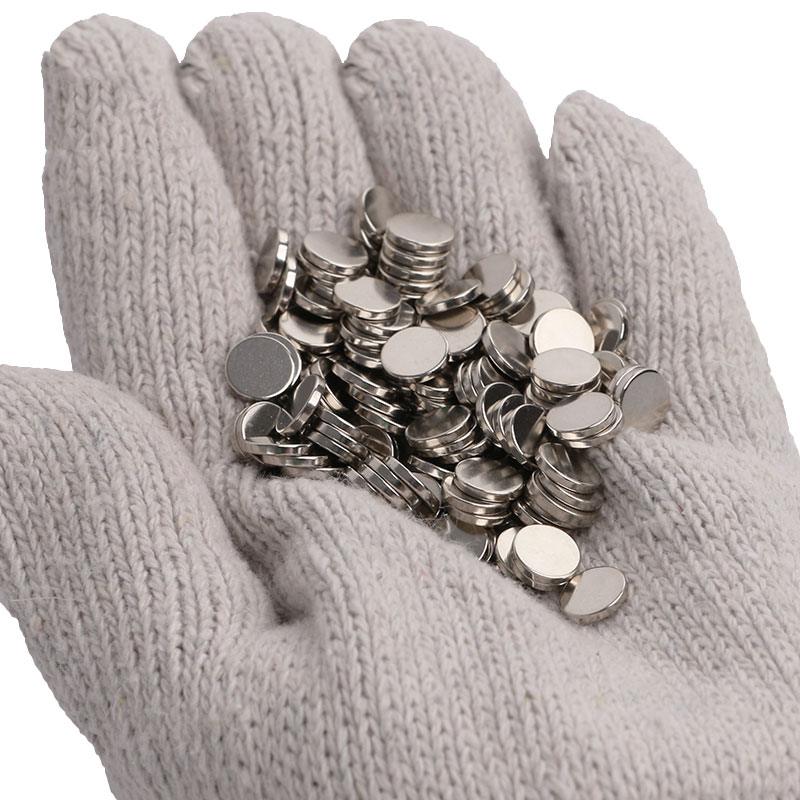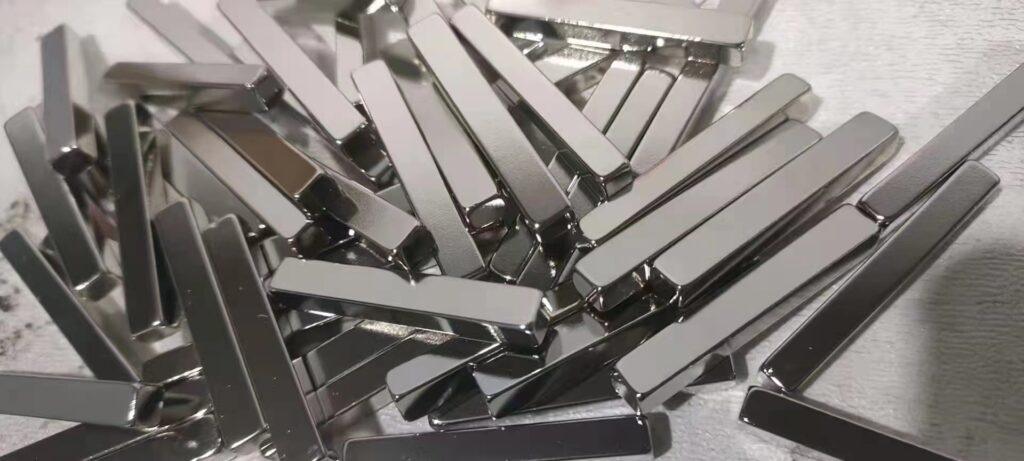
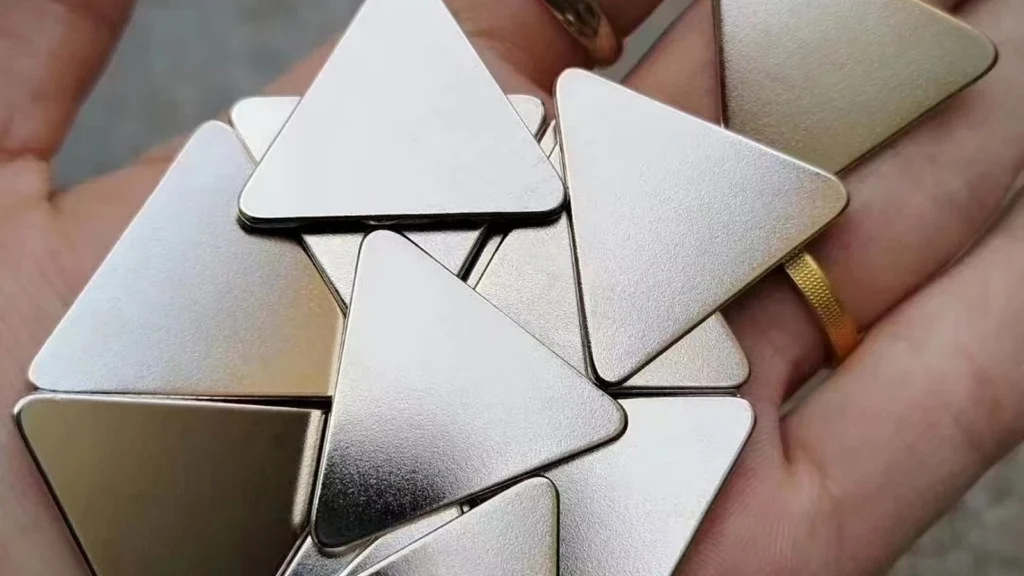
Near-net-shape NdFeB manufacturing aims to create a blank close to the finished magnet geometry so that only critical surfaces require grinding. The objective is not to eliminate precision machining at any cost. It is to reduce rare-earth material loss, shorten process time and improve repeatability without sacrificing magnetic properties.
Why the Industry Is Interested
Conventional sintered NdFeB provides high magnetic performance, but blocks often need slicing, grinding, slots, radii and chamfers. Every removed millimeter consumes machine time and becomes kerf, powder or sludge that must be collected and recycled. Custom shapes also increase fixture complexity and breakage risk.
Recent research reviews identify net-shape processes as a route to lower material consumption. A 2023 review of NdFeB powder injection molding highlighted its ability to form complex shapes and avoid machining steps, while also noting that oxygen and carbon contamination remain serious barriers to high magnetic performance.
Main Near-Net-Shape Routes
| Route | Main advantage | Current constraint |
|---|---|---|
| Closer-to-shape pressing and sintering | Retains high-performance sintered material | Shrinkage, orientation and tooling limit complexity |
| Bonded injection molding | Complex net shapes and integrated features | Binder lowers magnetic loading and energy product |
| Powder injection molding of sintered material | Potential complex dense shapes | Debinding and carbon/oxygen control |
| Hot deformation | Near-net rings and controlled texture | Process window, tooling and property uniformity |
| Additive manufacturing | Rapid prototypes and geometry freedom | Density, anisotropy, throughput and qualification |
Precision Finishing Is Not Disappearing
A near-net blank still needs functional datums, tight air-gap surfaces, coating preparation and dimensional verification. Motor magnets may require controlled thickness and profile; sensor magnets may need a precise notch; assemblies may need matched pole dimensions. The likely production model is therefore hybrid: shape efficiently first, then finish only the critical features.
| Feature | Near-net potential | Likely finishing need |
|---|---|---|
| Noncritical outside contour | High | Deburr or light edge finishing |
| Air-gap face | Medium | Precision grinding and flatness control |
| Small slot or datum notch | Medium | Profile grinding or wire cutting |
| Coating surface | Medium | Cleaning, chamfering and surface preparation |
| Magnetic orientation | Process-dependent | Fixture magnetization and magnetic inspection |
Where Automation Adds Value Now
Automation already improves conventional production through vision-guided loading, fixture mistake-proofing, in-process gauging, tool-wear monitoring, controlled washing and robotic magnetic inspection. These steps reduce operator variation even when the basic magnet remains a sintered and ground component.
Automation also improves material traceability. Segregating sludge by magnet family, recording dry weight and linking scrap to a production lot can increase recycling value. A 2025 review of NdFeB recycling identifies manufacturing fragments, cutting scraps, grinding powder and sludge as important process-waste streams, while a 2026 review emphasizes matching recycling routes to impurity and downstream quality requirements.
What Buyers Should Ask
| Question | Why it matters |
|---|---|
| Is the quoted blank standard or near-net? | Changes tooling, lead time and material yield |
| Which dimensions are ground after sintering? | Identifies the real capability and datum plan |
| How are shrinkage and orientation controlled? | Determines magnetic and dimensional consistency |
| How is machining scrap segregated? | Affects recycling quality and traceability |
| Which properties are verified after coating and magnetization? | Connects the new process to functional performance |
Guande’s Practical Approach
Guande evaluates near-net blanks when volume, geometry and material savings justify tooling. For lower volumes or evolving designs, a flexible machining route may remain more economic. Our sintered NdFeB capability covers blank review, grinding, coating, magnetization and inspection for custom-shaped magnets.
Fixture design remains essential in both routes; see our guide to custom magnet machining fixtures. For integrated products, we also provide custom magnetic assemblies.
References
- Materials Today Physics: NdFeB powder injection molding challenges
- Journal of Environmental Management: review of NdFeB waste recycling
- Journal of Environmental Sciences: closed-loop NdFeB supply chain review
Send the shape, grade, critical dimensions, annual volume and target application. We will compare standard-blank machining and near-net options using the real production requirements.