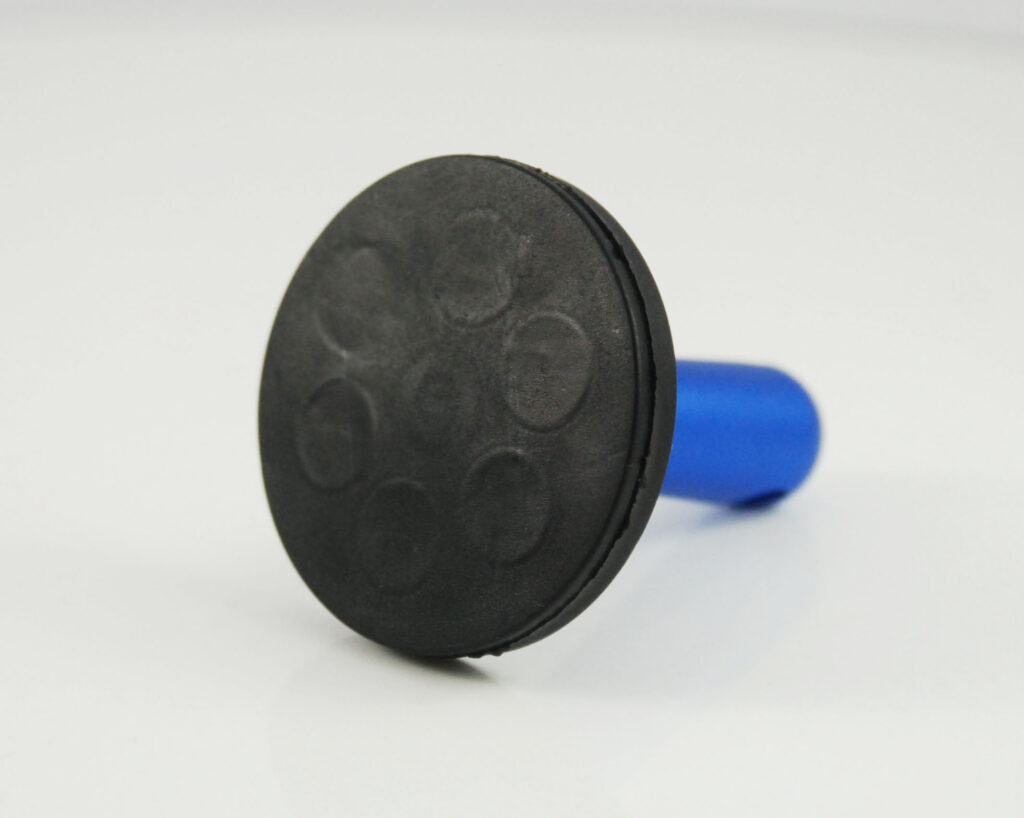
Rubber-coated magnets are compact holding assemblies designed for removable mounting on ferromagnetic surfaces. They normally combine one or more NdFeB magnets, a low-carbon-steel back plate or cup, a threaded connection, and an elastomer cover. The steel directs useful flux toward the working face; the rubber protects the target surface and increases resistance to sliding.
Design principle: the magnetic circuit creates normal holding force, while the rubber layer adds friction and surface protection. The coating also creates an air gap, so a successful design balances magnetic pull, shear resistance, durability, and overmolding thickness.
How Do Rubber-Coated Magnets Work?
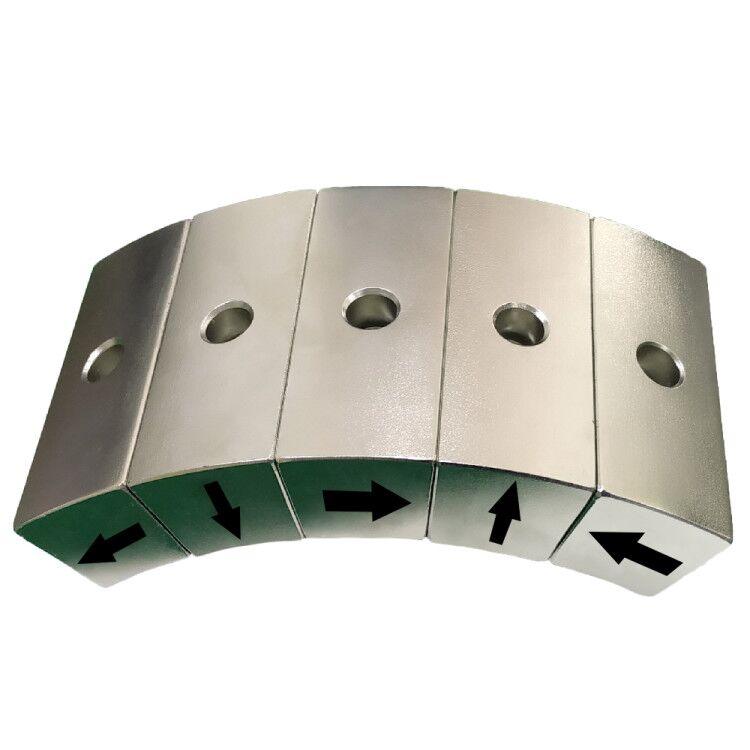
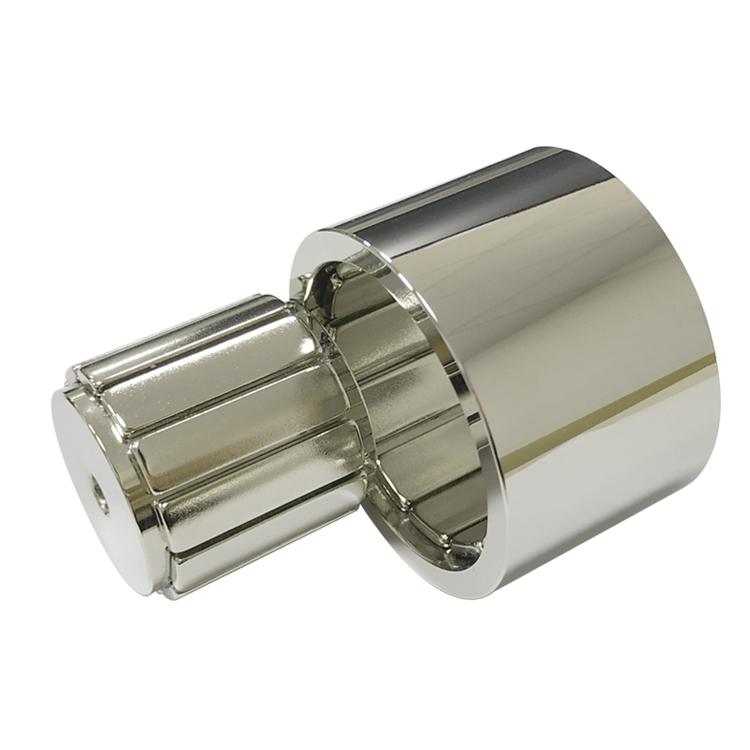
A basic pot magnet design places an NdFeB disc or ring in a steel cup. The steel carries flux from the rear pole to a rim near the working face, concentrating both poles on one side. Many rubber-coated designs use several small magnets arranged with alternating poles under a steel plate. This creates multiple pole transitions across the contact face and can improve useful flux distribution over a larger diameter.
The steel should be thick enough to carry the flux without excessive saturation, but unnecessary steel adds weight and height. Magnet position, pole spacing, back-plate thickness, target steel, and contact gap are usually evaluated with magnetic-circuit calculations or finite-element analysis.
Typical Structure of a Rubber Pot Magnet
| Component | Function | Design questions |
|---|---|---|
| Sintered NdFeB magnets | Provide magnetic energy | Grade, quantity, shape, orientation, temperature |
| Low-carbon-steel cup or plate | Returns and concentrates magnetic flux | Thickness, saturation, flatness, corrosion finish |
| Rubber / elastomer cover | Protects surfaces, increases friction, shields edges | Material, hardness, thickness, oil/UV/temperature resistance |
| Threaded insert or stud | Connects the load or accessory | Thread size, pull-out torque, corrosion, molding retention |
| Adhesive or molded encapsulation | Locks components and limits moisture paths | Cure, bond line, chemical compatibility, sealing level |
Why Rubber Improves Wall-Mount Performance
Catalog pull force is normally measured perpendicular to a thick, flat, clean steel plate. A load hanging on a wall mainly creates shear. A simple first estimate is:
Fshear ≈ μ × Fnormal
where μ is the effective friction coefficient and Fnormal is the magnetic preload at the real interface. Smooth nickel against painted steel can have a low μ. Rubber can raise friction substantially, so the same magnetic preload supports more vertical load.
This equation is only a starting point. Rubber creep, peel moment, vibration, curvature, dust, paint quality, temperature, and an off-center load can reduce capacity. Use a mechanical safety factor and test the actual mounting orientation.
The Air-Gap Trade-Off
Rubber is nonmagnetic. A thicker cover protects better and may improve compliance, but it increases the magnetic gap. Holding force falls rapidly as the gap grows because magnetic reluctance increases and more flux leaks between nearby poles instead of entering the target steel.
| Design change | Likely benefit | Likely penalty |
|---|---|---|
| Thicker rubber | More impact and scratch protection | Lower normal pull force |
| Softer rubber | Conforms to small surface irregularities | More creep and deformation under load |
| Larger diameter | More pole area and better moment stability | More size, cost, and weight |
| More / larger NdFeB magnets | Potentially higher useful flux | Steel saturation, cost, assembly force |
| Wider pole spacing | Can improve field reach across a gap | Changes contact-force distribution |
Choosing the Elastomer
“Rubber” is a product category, not one material. TPE or TPR is common for general indoor use and efficient overmolding. EPDM can provide better outdoor weather and ozone resistance. NBR may be selected for oil contact. Silicone supports a broader temperature range and can offer a clean surface, but tear strength, molding, and cost require review.
| Elastomer family | Useful starting application | Check before release |
|---|---|---|
| TPE / TPR | Indoor fixtures, signs, sensors, lighting | Heat, plasticizer migration, UV, compression set |
| EPDM | Outdoor and weather-exposed mounts | Oil/fuel compatibility and bond system |
| NBR | Oil-contact industrial equipment | Ozone, weather and low-temperature flexibility |
| Silicone | High/low temperature or clean applications | Tear, adhesion, molding flash and cost |
Representative cover thicknesses may be around 0.5–2.0 mm and hardness around 50–80 Shore A, but these are not universal values. The required pull force and service environment should define the specification.
Common Mechanical Interfaces
- Female thread: compact attachment for hooks, cameras, sensors, and brackets.
- External stud: fast installation through a plate or component.
- Countersunk hole: low-profile screw fixing, with torque controlled to avoid crushing.
- Cable or handle mount: temporary routing, display, lifting aids, and removable accessories.
- Custom insert: molded geometry for a dedicated housing or load direction.
Rubber-Coated Magnet Applications
Typical pot magnet uses include mounting sensors, antennas, cameras, lights, signs, cable guides, protective curtains, temporary machine guards, inspection equipment, and vehicle accessories. They are also used on retail displays, steel furniture, production fixtures, and maintenance tools where drilling is undesirable.
Outdoor or vehicle use requires more than a black cover. UV, temperature cycling, road salt, oil, wind load, vibration, and surface curvature must be considered. A rubber pot magnet is not automatically waterproof, approved for road use, or suitable for overhead lifting.
How to Specify Pull and Shear Force
- Define the target steel grade, thickness, coating, flatness, and curvature.
- State whether the critical load is direct pull, shear, peel, or an overturning moment.
- Specify the real gap, including paint, rubber, labels, and surface roughness.
- Provide operating and storage temperatures plus oil, salt, UV, and chemical exposure.
- Define thread load, tightening torque, and mechanical safety factor.
- Test the complete assembly in the actual orientation and vibration condition.
Guande’s Design and Assembly Capability
Guande develops rubber-coated products as a complete magnetic assembly. We can review magnet grade, pole layout, steel saturation, cover material, insert geometry, moldability, pull force, shear behavior, coating thickness, and inspection fixtures. Where needed, prototypes are compared at the real working gap rather than only against a polished laboratory plate.
Our production support covers magnet sorting, steel-part machining, adhesive and overmolding process control, threaded-insert checks, dimensional inspection, and lot-level pull-force testing. The underlying sintered NdFeB magnets can be customized for grade, size, and magnetization direction.
Send the target surface, load direction, required force, available diameter, thread, temperature, and environment. We will recommend a practical circuit and rubber system without inflating the design beyond the actual requirement.
Frequently Asked Questions
Does rubber increase the magnetic field?
No. Rubber is nonmagnetic and increases the gap. It can improve usable shear holding by increasing friction, even while normal pull force is lower.
Can a rubber-coated magnet be used underwater?
Only if the complete assembly and interfaces are specifically qualified for immersion. A rubber skin alone does not prove a permanent water seal.
Why is catalog pull force higher than field performance?
Catalog testing usually uses thick, flat, clean steel and direct pull. Paint, thin steel, curvature, shear load, vibration, and an off-center bracket all reduce practical capacity.