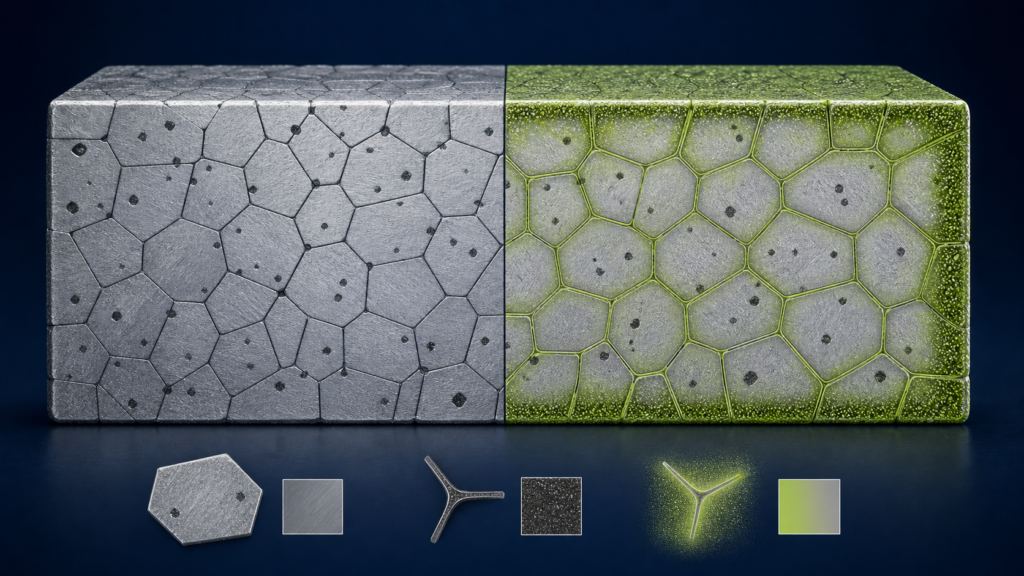
Grain boundary diffusion is a post-sintering treatment used to raise the intrinsic coercivity of sintered NdFeB magnets while limiting the loss of remanence. Instead of adding a large amount of dysprosium or terbium throughout the alloy, the process places a diffusion source on the finished magnet surface and drives selected elements inward along rare-earth-rich grain-boundary paths.
Engineering purpose: concentrate high-anisotropy material where magnetic reversal is most likely to start—around the outer region of Nd2Fe14B grains—rather than replacing neodymium throughout every grain.
Why Standard High-Temperature Alloying Has a Trade-Off
NdFeB coercivity decreases as temperature rises. Motors, generators, compressors and actuators may also impose a reverse magnetic field during overload or fault conditions. Traditional high-coercivity grades can use Dy or Tb additions in the melt. These elements raise the anisotropy field, but uniform substitution can reduce saturation magnetization and remanence. Heavy rare earths are also expensive and supply-sensitive.
That creates a practical conflict: the designer wants high Hcj for demagnetization resistance and high Br for torque or air-gap flux. NdFeB grain boundary diffusion addresses this conflict by using the added element more selectively.
How the Grain Boundary Diffusion Process Works
- A suitable sintered and machined NdFeB substrate is cleaned and prepared.
- A diffusion source—often based on Tb, Dy, Pr, Nd, Cu or a designed alloy—is applied by coating, spraying, dipping, electrophoretic deposition or another controlled method.
- The magnet is heat-treated below the main sintering temperature. A liquid or highly mobile rare-earth-rich boundary phase enables transport inward.
- Diffusing elements travel preferentially along grain boundaries and triple junctions.
- A higher-anisotropy shell forms around parts of the Nd2Fe14B grains, while the grain cores remain comparatively low in heavy rare earth.
- A lower-temperature anneal adjusts the boundary phase and magnetic isolation before final coating and inspection.
What Changes in the Microstructure?
| Region | Before diffusion | After a well-controlled process | Magnetic effect |
|---|---|---|---|
| Grain core | Nd-rich Nd2Fe14B main phase | Largely retained | Preserves much of the remanence |
| Grain shell | Lower local anisotropy than a Dy/Tb-rich phase | (Nd,Pr,Dy/Tb)2Fe14B shell may form | Raises the field needed to nucleate reversal |
| Grain boundary | May be thin, discontinuous or partly ferromagnetic | Boundary chemistry and continuity are modified | Improves magnetic isolation between grains |
| Depth profile | Uniform substrate composition | Highest diffusing-element concentration near surfaces | Creates a coercivity gradient through thickness |
Why Coercivity Increases
Magnetization reversal often begins at defects or locally weak regions near grain surfaces. A Dy- or Tb-enriched shell has a higher anisotropy field than the original Nd-rich main phase. It therefore makes reverse-domain nucleation more difficult. A continuous, non-ferromagnetic rare-earth-rich boundary phase can also reduce exchange coupling between neighboring grains, preventing one reversed grain from triggering a larger reversal event.
The process is not simply “metal soaking into a magnet.” Coercivity depends on shell composition, shell continuity, boundary chemistry, grain size, substrate composition, oxygen content, diffusion depth and heat-treatment history.
Typical Benefits and Design Limits
| Potential benefit | Why it matters | Limit to verify |
|---|---|---|
| Higher intrinsic coercivity Hcj | More resistance to heat and reverse fields | Gain varies with substrate and geometry |
| Smaller Br penalty than bulk HRE alloying | Maintains useful air-gap flux | Some remanence change can still occur |
| Lower heavy-rare-earth consumption | Improves material efficiency and cost control | Diffusion source and yield still affect economics |
| Application-targeted performance | Useful for thin motor segments and compact parts | Diffusion depth limits thick cross-sections |
| Improved hot demagnetization margin | Supports motors, generators and compressors | Must be confirmed on hot B-H curves and load line |
Why Magnet Thickness Matters
Diffusion starts at exposed surfaces, so the concentration falls with distance from those surfaces. Thin blocks, slices and motor segments can be good candidates because a larger fraction of their volume is within the effective diffusion depth. A thick part may develop excellent coercivity near the surface but retain a weaker center.
For this reason, a grain-boundary-diffused grade should not be specified by a room-temperature Hcj value alone. Part thickness, diffusion direction, usable surface area, coating allowance and the required minimum property through the section must be stated.
GBD Versus Conventional NdFeB Grades
| Approach | Heavy rare-earth distribution | Br / Hcj balance | Best fit |
|---|---|---|---|
| Standard low-HRE magnet | Low and relatively uniform | High Br, moderate Hcj | Cool, magnetically stable applications |
| Bulk Dy/Tb alloying | Distributed through the magnet | High Hcj with a larger Br trade-off | Thick or severe-duty parts where deep protection is needed |
| Grain boundary diffusion | Concentrated at boundaries and near grain surfaces | High Hcj with efficient HRE use | Thin, high-performance motor and generator magnets |
| HRE-free boundary modification | Pr/Nd/Cu/Al-rich boundary phases | Can improve isolation without Dy/Tb | Cost-sensitive designs after validation |
Applications
Common targets include traction motors, electric compressors, EPS motors, servo motors, industrial drives, wind generators and compact actuators. These systems benefit from high coercivity but cannot always accept the flux-density penalty of heavy bulk alloying. The process is especially relevant to NdFeB arc magnets and thin motor segments.
Inspection and Production Controls
- Confirm substrate composition, grain size and initial magnetic properties.
- Control diffusion-source mass, uniformity and surface cleanliness.
- Record heat-treatment temperature, time, atmosphere and loading pattern.
- Test Br, Hcb, Hcj and (BH)max on representative samples.
- Use hot demagnetization or irreversible-loss testing for the real operating condition.
- Check dimensional change, surface condition and coating adhesion after treatment.
- Validate lot consistency because edge, center and thickness effects can differ.
How Guande Supports GBD Magnet Projects
Guande reviews neodymium magnet grades against the actual temperature, reverse field, geometry and operating load line. For custom neodymium magnets, we coordinate substrate selection, diffusion route, precision grinding, coating, magnetic orientation and inspection instead of treating GBD as an isolated material label.
Our rotor magnet assembly support can also include pole sorting, bonding fixtures and hot-performance acceptance criteria. If your design has a demanding neodymium magnet operating temperature, send the magnet drawing, peak temperature, fault condition and target Hcj for review.
Frequently Asked Questions
Does grain boundary diffusion always use Dy or Tb?
No. Dy and Tb are widely used for high coercivity, while Pr-, Nd-, Cu- and Al-containing systems can modify boundary phases with less or no heavy rare earth. The achievable result is different for each route.
Can GBD turn any N-grade magnet into an ultra-high-temperature grade?
No. The substrate, thickness, diffusion depth and process window determine the result. Qualification must use the finished geometry and the relevant hot demagnetization curve.
Does GBD improve maximum operating temperature directly?
It increases coercivity and can improve thermal demagnetization resistance. The allowable operating temperature still depends on the magnetic circuit, exposure time, coating, adhesive and required irreversible-loss limit.