There is no single “wind turbine magnet grade.” Permanent-magnet wind generators range from compact kilowatt axial-flux machines to multi-megawatt direct-drive generators. The magnet must satisfy the air-gap flux target while resisting irreversible demagnetization during operating temperature, fault current, assembly, transport, and service.
Useful starting point: many industrial designs evaluate N35H–N48H, N35SH–N45SH, or N35UH–N42UH families. The final choice must come from the magnetic load line, temperature-dependent demagnetization curves, rotor topology, coating, and loss calculation—not the grade number alone.
Where Permanent Magnets Are Used in Wind Turbines
A neodymium magnet generator uses permanent magnets on or inside the rotor to provide excitation without rotor copper current. Most large applications are permanent-magnet synchronous generators (PMSGs). They may be direct-drive, medium-speed geared, radial-flux, or axial-flux machines.
Direct-drive generators operate at low speed and therefore use many poles and a large diameter. Medium-speed generators use a gearbox but can reduce generator size and magnet mass. Not every wind turbine uses permanent magnets; doubly-fed induction and electrically excited synchronous generators remain valid alternatives.
What the NdFeB Grade Code Means
In a designation such as N42SH, “42” indicates the approximate maximum energy product in MGOe, while “SH” identifies a higher intrinsic-coercivity family. The suffix is especially important because NdFeB coercivity falls as temperature rises.
| Grade family | Common industry temperature reference* | Why it may be considered | Typical caution |
|---|---|---|---|
| Nxx (no suffix) | About 80°C | High Br and cost efficiency for cool, low-demagnetizing designs | Often insufficient margin for industrial generator faults |
| M | About 100°C | Moderate coercivity increase | Requires careful hot load-line review |
| H | About 120°C | Useful balance of Br, Hcj and cost | May not cover high hot-spot or fault stress |
| SH | About 150°C | Common high-coercivity starting family for motors and generators | Higher grade number and high Hcj are a trade-off |
| UH | About 180°C | Extra demagnetization margin at elevated temperature | Cost and remanence can be less favorable |
| EH | About 200°C | Special high-temperature or severe reverse-field cases | Not automatically needed; verify curve and economics |
*These are common family labels, not guaranteed application limits. Magnet shape, permeance coefficient, reverse field, coating, adhesive, and supplier-specific curves determine the safe operating point.
Why Wind Generators Often Need H, SH or UH Grades
Temperature and irreversible loss
Generator magnets see copper loss, iron loss, eddy-current heating, ambient variation, and cooling-system limits. A large machine may have a moderate average temperature but a higher local hot spot. During a short-circuit or converter fault, the stator can impose a strong reverse field. High coercivity NdFeB magnets give the rotor more margin against irreversible flux loss.
Large air gaps and structural tolerances
Wind turbine generators must accommodate rotor deflection, bearing tolerance, vibration, and manufacturing scale. A larger air gap lowers the magnet load-line slope and may require more magnet volume or higher remanence to reach the target flux. The mechanical air-gap requirement therefore cannot be separated from grade selection.
Long service life and difficult maintenance
Offshore maintenance is expensive. Grade, coating, adhesive, mechanical retention, and corrosion sealing are selected as one system. A neodymium magnet for wind turbine service is normally qualified more rigorously than a general-purpose catalog magnet.
Representative Grade Families by Design Condition
| Design condition | Representative starting families | What must be verified |
|---|---|---|
| Small, well-cooled axial-flux generator | N38–N48, or H family where fault margin is needed | Maximum magnet temperature, open-circuit voltage, short-circuit field |
| Industrial medium-speed PMSG | N35H–N48H or N35SH–N45SH | Hot B-H curve, rotor retention, eddy loss, coating |
| Large direct-drive PMSG | SH or UH family commonly evaluated | Local hot spots, fault demagnetization, segment consistency, life testing |
| Severe hot spot or compact rotor | UH or EH family | Whether extra Hcj offsets lower Br and higher material cost |
These ranges are engineering starting points, not purchase specifications. For example, N42 and N42SH can have similar room-temperature remanence but very different intrinsic coercivity. Conversely, an N35UH may be safer than a higher-energy standard grade when the rotor is hot and exposed to a reverse field.
Magnet Shape, Segmentation and Magnetization
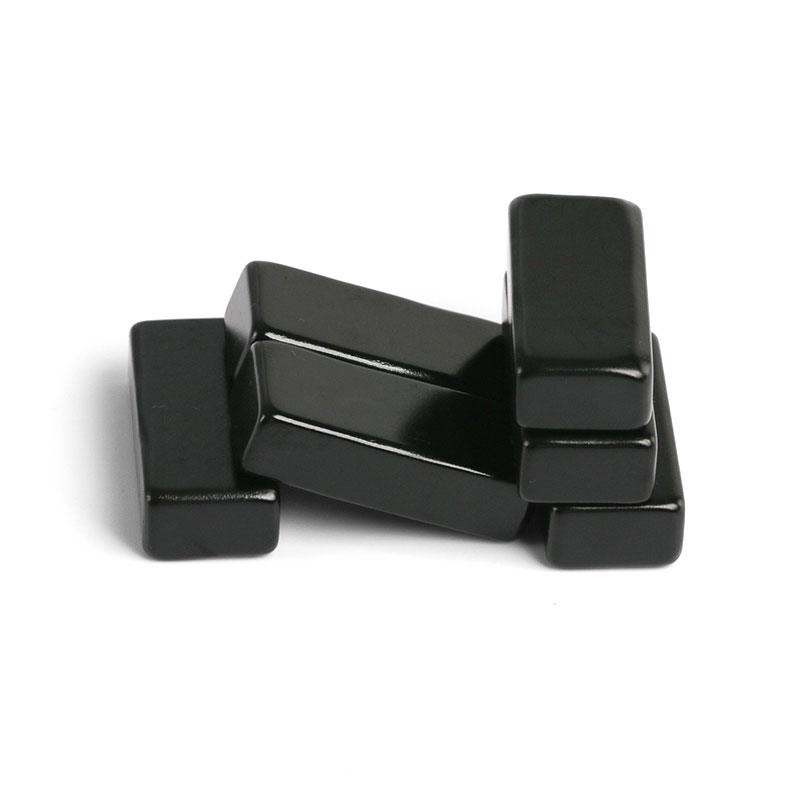
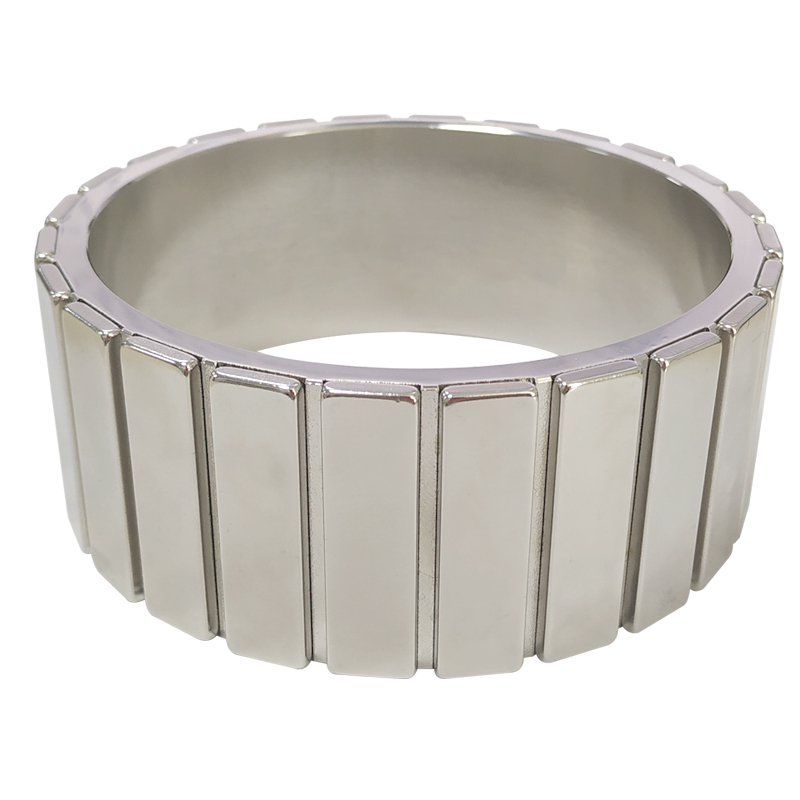
Radial-flux machines often use arc magnets, trapezoidal segments, or rectangular blocks around a rotor. Axial-flux machines commonly use sector or trapezoidal pieces on discs. Each segment is oriented to build alternating north and south poles.
Large poles may be divided into smaller pieces to simplify pressing and grinding, control dimensional variation, and reduce eddy-current loss. Electrical insulation between segments can reduce circulating current, but the segmentation pattern must still meet assembly strength and flux requirements. Magnetization direction, pole arc, skew, and air gap influence voltage, cogging torque, torque ripple, and loss.
Coating and Mechanical Retention
NdFeB is vulnerable to corrosion, particularly in humid or salt-laden environments. Epoxy, Ni-Cu-Ni plus epoxy, or other qualified multilayer systems may be used. The rotor may also include adhesive bonding, stainless or composite sleeves, retaining plates, and sealed interfaces. Coating selection must match the adhesive and cure cycle.
The magnet should never be treated as a structural fastener. Centrifugal load, thermal expansion, vibration, and overspeed are carried by a validated retention system. For rotor magnet assemblies, dimensional runout and pole-position accuracy are as important as room-temperature surface field.
Data Required to Select a Grade
| Input | Why it matters |
|---|---|
| Maximum continuous and transient magnet temperature | Sets the temperature-dependent Br and Hcj requirement |
| Worst reverse field / fault current | Defines demagnetization stress |
| Rotor geometry and working air gap | Determines permeance coefficient and useful flux |
| Target voltage, torque and speed | Links grade and volume to generator output |
| Loss and cooling model | Identifies local magnet hot spots |
| Environment and life target | Defines coating, sealing and validation |
Guande’s Wind Generator Magnet Support
Guande supports custom NdFeB segments, arc geometry, magnetization planning, coating, dimensional inspection, flux or magnetic-moment testing, pole sorting, bonding, and custom magnetic assemblies. We compare candidate grades using the expected operating point rather than recommending the highest grade by default.
If you are sourcing a neodymium magnet for generator development, provide the rotor drawing, magnetic orientation, maximum temperature, fault condition, coating, inspection method, and annual volume. Send the specification for a practical grade and assembly review.
Frequently Asked Questions
Is N52 the best grade for a wind generator?
Not necessarily. N52 offers high room-temperature energy product, but a lower-number SH or UH grade may provide more coercivity and safer hot operation.
Do all wind turbines contain NdFeB magnets?
No. NdFeB is used in permanent-magnet generator architectures; induction and electrically excited generator designs do not require the same permanent-magnet rotor.
Can grade be chosen from maximum operating temperature alone?
No. The B-H curve, load line, fault field, shape, coating, adhesive, and validation criteria must be evaluated together.