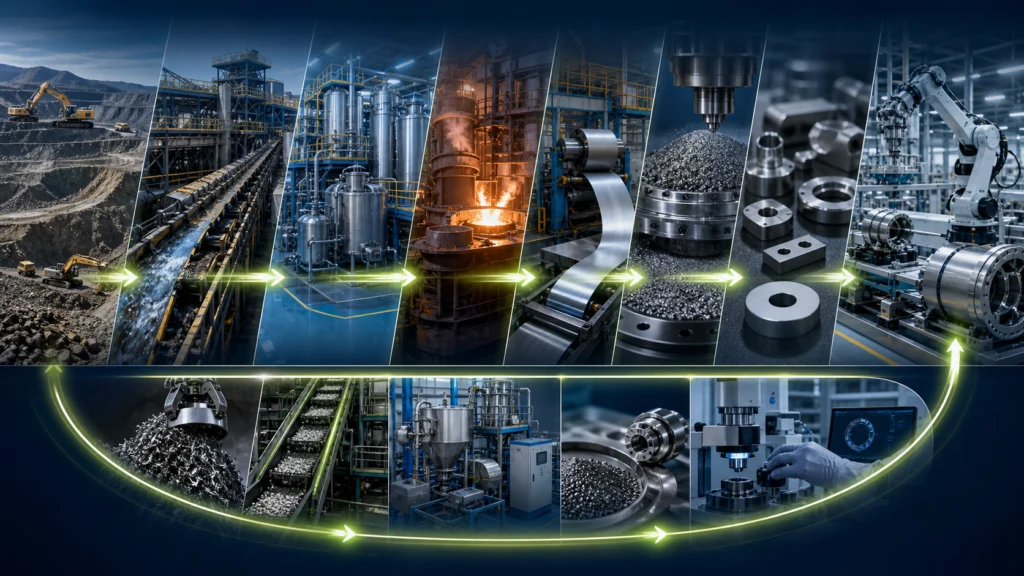
China’s permanent-magnet supply chain can be diversified, but it is unlikely to be replaced quickly. The difficulty is not explained by mining alone. Competitive NdFeB production requires connected capacity in rare-earth separation, metal refining, alloy preparation, powder metallurgy, precision machining, coating, magnetization, equipment, quality control, motor manufacturing and recycling.
According to the International Energy Agency’s 2026 rare-earth analysis, China accounted for about 60% of global mined magnet rare earths in 2024, 91% of refining and 94% of sintered permanent-magnet production. Those shares show why opening a new mine does not immediately create an independent rare earth magnet supply chain.
Balanced conclusion: diversification is progressing and is strategically important. The constraint is the time required to build qualified midstream and downstream capacity at competitive yield and scale.
The Value Chain Has Many Interdependent Steps
| Stage | Required capability | Why capacity is difficult to add |
|---|---|---|
| Mining and concentration | Orebody development and mineral recovery | Permitting, geology, financing and long construction cycles |
| Separation and refining | Individual Nd, Pr, Dy and Tb products | Complex chemistry, waste treatment and purity control |
| Metal and alloy | Oxide-to-metal conversion and strip-cast alloy | Energy, atmosphere control and customer-specific recipes |
| Magnet production | Powder, alignment, sintering and heat treatment | Yield, oxygen control and proprietary process windows |
| Finishing and assembly | Machining, coating, magnetization and bonding | Dense supplier network and specialized tooling |
| Application integration | Motors, generators, sensors and robotics | Long qualification and change-control cycles |
1. Separation and Metallisation Are Major Bottlenecks
Rare-earth ores contain mixtures of chemically similar elements. Producing magnet-grade oxides requires repeated separation stages, process control and responsible management of reagents and residues. Refined oxide must then be converted into metal and alloy before a magnet plant can use it. These midstream stages are less visible than mines but are technically and commercially critical.
The IEA notes that ex-China project pipelines are much stronger in mining than in refining, metals, alloys and finished magnets. Without balanced capacity, a mine outside China may still send material through an established Asian midstream route.
2. Manufacturing Know-How Is Embedded in Yield
A published alloy formula is not a production line. Competitive magnets depend on strip-cast microstructure, powder size, oxygen management, alignment, pressing density, sintering, heat treatment and grain-boundary control. Small deviations affect Hcj, Br, cracking and machining yield. A new plant must develop stable statistical capability across many grades and part geometries.
Customers also need more than standard blocks. Arc segments, thin slices and complex assemblies require grinding, wire cutting, coatings, multipole magnetization and high-force assembly fixtures. China’s large supplier base supports fast troubleshooting across these processes.
3. Scale Creates Cost and Learning Advantages
High throughput spreads laboratory, tooling, energy, environmental and maintenance costs. More production lots also generate process data and manufacturing scrap that can be recycled. Dense regional clusters shorten the feedback loop between a neodymium magnet manufacturer, coating supplier, motor plant and automation-equipment maker.
| Cluster advantage | Operational effect |
|---|---|
| Nearby alloy and powder suppliers | Shorter lead time and easier recipe adjustment |
| Specialist machining and coating | More geometry and environmental options |
| Motor and electronics customers | Rapid prototype-to-application feedback |
| Tooling and equipment base | Faster maintenance and production expansion |
| Manufacturing-scrap recovery | Higher material utilization and closed-loop potential |
4. Qualification Cannot Be Compressed Indefinitely
Automotive, aerospace, medical and industrial customers often require audits, PPAP-style documentation, traceability, thermal aging, coating tests and application validation. Equivalent grade labels do not guarantee identical demagnetization curves or corrosion performance. Motors may need new control maps or geometry when magnetic properties change.
Dual sourcing is therefore a technical project, not a purchasing switch. It can take multiple prototype and reliability cycles before a second source is released for volume production.
5. Export Controls Increase Urgency but Not Instant Capacity
China introduced controls affecting several heavy rare-earth elements and related products in 2025. The IEA reported sharp short-term supply disruptions and production reductions for some downstream manufacturers outside China. These events strengthened investment in alternative supply, inventory and recycling. They did not remove the time needed for permits, equipment, workforce development and customer qualification.
What Diversification Can Realistically Achieve
| Action | Near-term value | Long-term value |
|---|---|---|
| Qualify a second magnet source | Reduces single-plant risk | Builds regional capability |
| Develop refining and metal capacity | Limited immediate output | Closes critical midstream gaps |
| Recycle manufacturing scrap | Provides clean feedstock | Creates a circular supply base |
| Recover end-of-life magnets | Volumes remain limited today | Can reduce primary demand as EV and wind scrap grows |
| Design for lower Dy/Tb use | Reduces exposure per product | Improves resource efficiency |
Why “Hard to Replace” Does Not Mean “Impossible to Diversify”
New mines, separation plants and magnet factories are being built in the United States, Australia, Europe, Japan, Korea and Southeast Asia. Public funding, long-term offtake agreements and recycling programs can accelerate these projects. The IEA estimates that substantial additional investment through 2035 is needed, particularly in refining and magnet manufacturing.
Successful diversification will probably produce several regional chains connected by trade rather than one country reproducing China’s full scale. Buyers can support this transition through realistic forecasts, qualification budgets and contracts that reward verified capacity instead of only the lowest spot price.
What Magnet Buyers Should Do Now
- Map exposure by element, alloy, magnet plant, coating and application.
- Separate supply risk for Nd/Pr from Dy/Tb and specialized processing.
- Qualify alternatives using hot B-H curves and assembly tests.
- Maintain traceability and formal change control for raw-material routes.
- Evaluate inventory, recycling and design changes together.
Guande’s Role in a More Resilient Supply Chain
Within the China permanent magnet supply chain, Guande focuses on engineering response, repeatable production and transparent inspection. We supply sintered NdFeB magnets, motor arc segments and custom magnetic assemblies. Our work includes grade review, machining, coating, magnetization, assembly and lot-level verification.
Customers developing dual-source or cost-risk plans can share their drawings, annual demand, qualification standard and operating conditions through Get a Quote. We will identify which specifications are transferable and which require application testing.