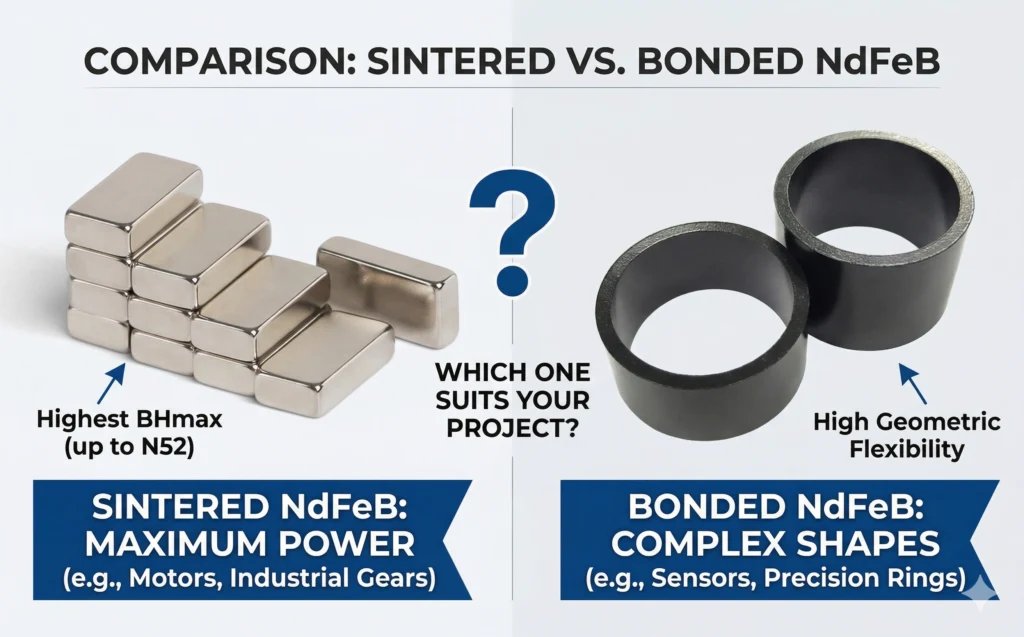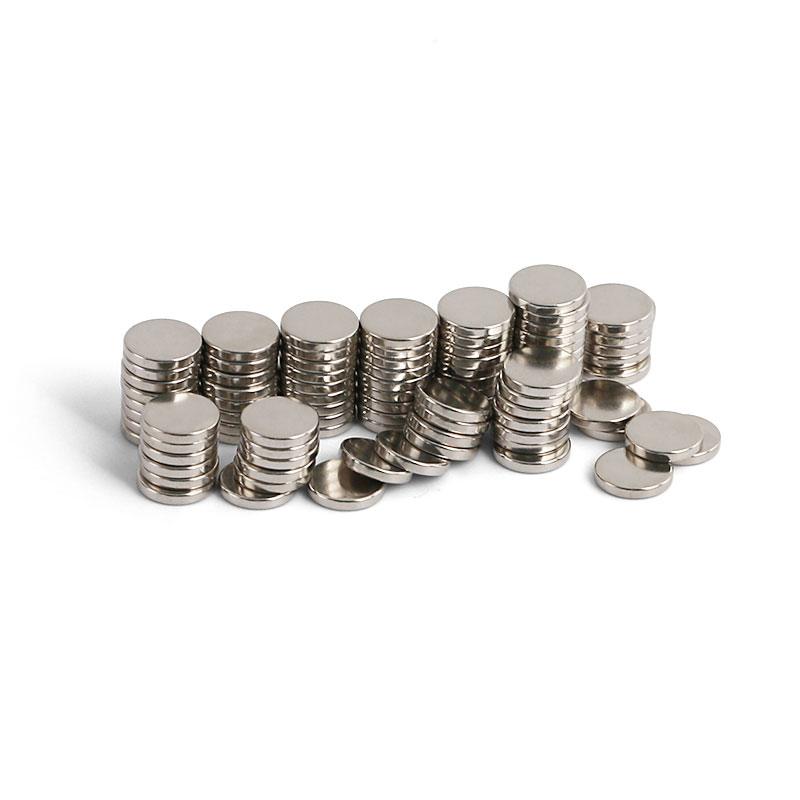
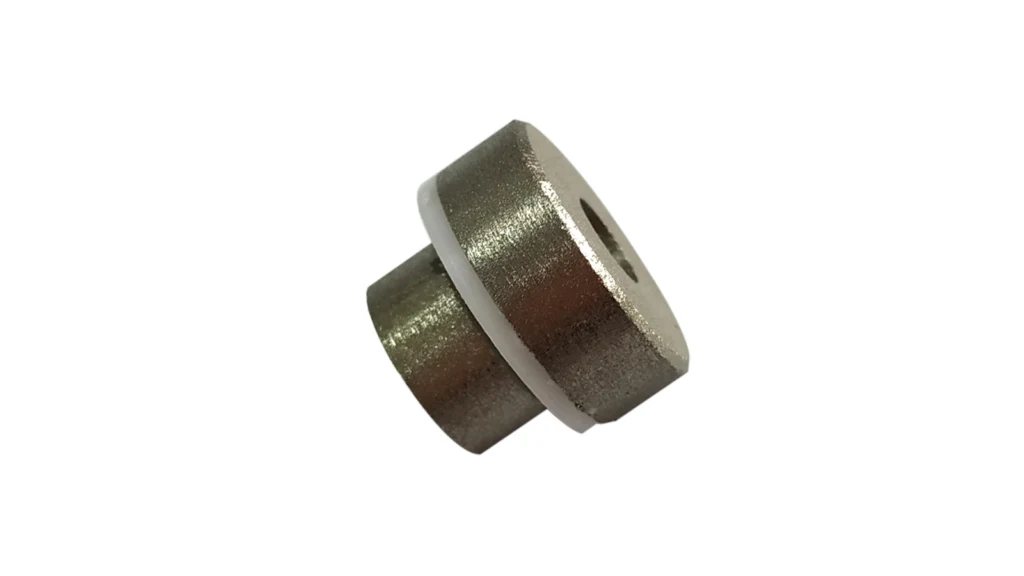
NdFeB vs SmCo magnets is not simply a choice between “strong” and “heat resistant.” Sintered neodymium-iron-boron usually provides the highest room-temperature energy density and the lowest magnetic volume for a target field. Samarium cobalt generally provides better thermal stability, high-temperature coercivity and inherent corrosion resistance. The correct choice depends on the magnet’s operating point inside the real magnetic circuit.
Practical rule: choose NdFeB when compact room-temperature output and cost efficiency dominate. Evaluate SmCo when sustained temperature, thermal drift, vacuum, corrosion or demagnetizing-field margin is more important than maximum room-temperature energy product.
Typical Property Comparison
The ranges below are representative of common commercial sintered grades, not guaranteed limits for every supplier. Grade family, orientation, test method and temperature must be confirmed on the selected datasheet.
| Property | Sintered NdFeB | Sintered SmCo | Design implication |
|---|---|---|---|
| Remanence Br | About 1.0–1.48 T | About 0.8–1.2 T | NdFeB normally produces more flux from equal volume at room temperature |
| Maximum energy product | About 26–55 MGOe | About 16–32 MGOe | NdFeB enables smaller motors, sensors and holding assemblies |
| Intrinsic coercivity | Grade-dependent; high-Hcj families available | Generally high and stable at temperature | Check the reverse field and hot load line, not only Br |
| Typical service-temperature range | About 80°C for standard grades; special grades can reach roughly 180–230°C | Frequently 250–350°C depending on grade and circuit | Use hot B-H curves and the supplier’s geometry-dependent limit |
| Reversible Br temperature coefficient | Typically about −0.10 to −0.12%/°C | Typically about −0.03 to −0.04%/°C | SmCo provides lower flux drift across temperature |
| Corrosion behavior | Usually needs coating or environmental sealing | Better inherent resistance, though not immune | Coating, adhesives and housing still require application review |
| Mechanical behavior | Hard and brittle | Hard, brittle and often more chip-sensitive | Neither should carry structural tensile or impact loads |
| Relative material cost | Usually lower for comparable commercial geometry | Usually higher and more composition-sensitive | Compare total system cost, cooling, coating and qualification |
Room-Temperature Strength Versus Hot Performance
At 20°C, a high-grade sintered NdFeB magnet normally produces more useful flux than an equal-volume SmCo magnet. That advantage can reduce rotor diameter, actuator mass or assembly footprint. It also makes NdFeB the first candidate for compact consumer electronics, servo motors, speakers, automation and high-force magnetic assemblies.
Temperature changes the comparison. NdFeB loses remanence faster as temperature rises, and insufficient intrinsic coercivity can cause irreversible demagnetization when the magnet also experiences a reverse field. SmCo’s lower reversible temperature coefficient and strong hot coercivity can produce more stable system output even when its room-temperature Br is lower.
There is no universal crossover temperature. Magnet thickness, air gap, steel saturation, opposing field, duty cycle and cooling define the load line. Engineers should compare the candidate hot B-H curves at minimum and maximum temperature and verify the complete component.
Corrosion, Coating and Environmental Stability
NdFeB contains a reactive rare-earth-rich phase. Nickel-copper-nickel, zinc, epoxy, phosphating, passivation, Parylene or a sealed housing may be used depending on humidity, salt, chemicals, abrasion and bonding. A coating improves protection but adds tolerance and may crack when the brittle magnet is impacted.
SmCo is generally more chemically stable and is often used without plating in clean, dry applications. Vacuum, particle-generation and outgassing requirements can make an uncoated SmCo component attractive. However, salt spray, acids, mechanical wear and galvanic couples still need validation; “better corrosion resistance” does not mean universal chemical compatibility.
Application Selection Matrix
| Application condition | Usual first candidate | Reason | Required verification |
|---|---|---|---|
| Compact motor below about 120°C | NdFeB | High torque density and broad grade availability | Hot demagnetization and coating life |
| Motor or actuator above about 180°C | SmCo | Thermal stability and high-temperature coercivity | Mechanical retention and actual hot output |
| Aerospace or precision sensor | SmCo often preferred | Low flux drift, vacuum compatibility and stability | Calibration drift, shock and contamination |
| Consumer electronics and compact holding | NdFeB | Maximum force or field per unit volume | Temperature, plating and user safety |
| Downhole or high-temperature instrumentation | SmCo | Heat and reverse-field margin | Pressure, corrosion and long dwell |
| Cost-sensitive industrial assembly | NdFeB | Higher energy density at practical cost | Total circuit optimization rather than highest grade |
| Magnetic coupling in hot or corrosive media | SmCo or protected NdFeB | Environment may dominate material choice | Can wall, temperature and corrosion testing |
SmCo5 Versus Sm2Co17
SmCo is itself a family. SmCo5 is comparatively simple in composition and can provide strong coercivity and corrosion resistance. Sm2Co17 grades generally provide higher energy product and excellent high-temperature performance, but composition and heat treatment are more complex. The supplier must identify the actual grade family; “SmCo” alone is not a complete drawing specification.
Manufacturing and Assembly Differences
Both materials are made by powder metallurgy and are machined after sintering with abrasive grinding or wire cutting. Both are brittle and unsuitable for conventional drilling or milling after magnetization. SmCo’s brittleness increases the importance of edge design, chamfers, fixture support and protective packaging.
NdFeB usually receives surface treatment after machining. SmCo may remain uncoated, which can simplify thickness control, but its higher raw-material and machining cost may offset that benefit. Adhesive selection must consider surface condition, operating temperature and differential thermal expansion. For high-speed rotors, sleeves or other mechanical retention should carry centrifugal load.
How to Make the Final Material Decision
- Define the full temperature profile, including transient peaks and dwell time.
- Calculate the magnet operating point and worst reverse field.
- Compare hot B-H curves for specific candidate grades.
- Review corrosion, vacuum, coating, adhesive and housing requirements.
- Compare total component volume, magnet cost, cooling and qualification cost.
- Build A/B prototypes and test flux, torque or force across temperature.
A higher neodymium magnet grade does not automatically replace SmCo, and SmCo is not automatically necessary at every high temperature. The decision must be tied to a measurable system requirement.
Guande Material and Application Support
Guande supports material comparison, grade selection, custom geometry, magnetization direction, coating, magnetic-circuit review and inspection. For motor and actuator projects, our rotor magnet assembly work can include pole sorting, bonding, retention review and magnetic mapping. For integrated products, we also provide custom magnetic assemblies.
Send the geometry, working temperature, reverse field, coating environment and target output. We will compare NdFeB and SmCo against the operating point instead of recommending a material from temperature alone.