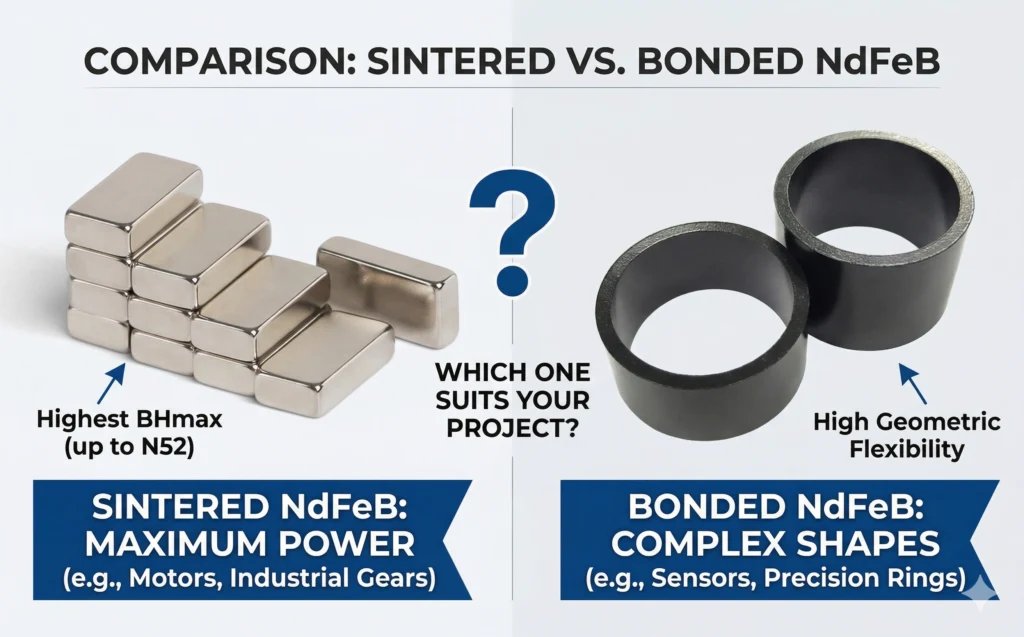
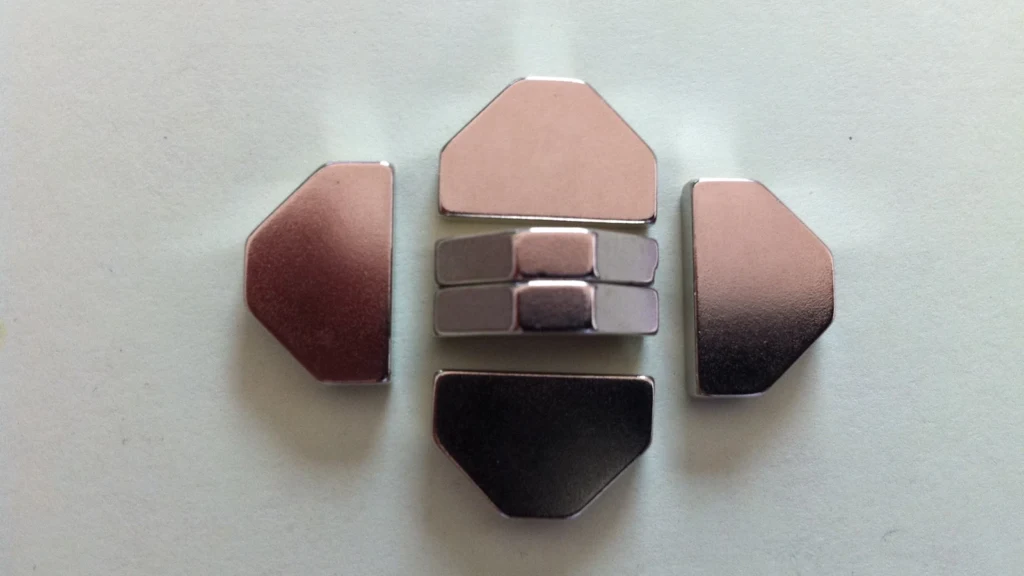
An NdFeB magnet machining fixture does more than hold a part. It establishes the datum, supports a brittle magnet against grinding force, controls heat transfer and determines whether the same profile can be repeated across a production batch. For asymmetric magnets, a weak fixture concept often creates more variation than the grinding machine itself.
Practical rule: fixture design should begin with the process plan and inspection datums—not after the magnet drawing is released.
Why NdFeB Is Sensitive to Fixturing
Sintered NdFeB is hard but brittle. It tolerates compression better than bending or concentrated tensile stress. A clamp applied near a thin bridge, notch or sharp corner can start a crack before the grinding wheel touches the part. Unsupported overhang can vibrate, chip or change thickness under process force.
Most precision machining is completed before final coating and magnetization. Even in the unmagnetized state, the fixture must manage abrasive sludge, coolant and small dimensional changes between sintered blanks.
What a Good Fixture Must Control
| Fixture function | Why it matters | Typical failure if ignored |
|---|---|---|
| Define repeatable datums | Links each operation to the drawing | Hole, notch and outside profile drift relative to each other |
| Support the cutting zone | Limits bending and vibration | Chipping, taper or fracture |
| Distribute holding force | Avoids local stress on brittle sections | Hidden microcracks and inconsistent flatness |
| Provide tool and coolant access | Keeps the cut stable and removes heat | Burning, collision or trapped sludge |
| Control loading orientation | Prevents mirrored or rotated parts | Wrong feature location or magnetization reference |
| Release without damage | Protects finished edges | Parts crack during unloading rather than machining |
Fixture Options for Different Shapes
| Fixture method | Suitable use | Design caution |
|---|---|---|
| Profiled soft jaws | Thicker parts with reliable external references | Clamp force must not distort thin sections |
| Precision nest with top restraint | Polygon, D-shape and notched parts | Provide chip clearance and mistake-proof loading |
| Wax or temporary adhesive plate | Thin parts requiring full-area support | Control bond thickness, temperature and clean removal |
| Collet or expanding mandrel | Rings and parts located from a bore | Avoid excessive radial stress in a brittle ring |
| Multi-part carrier | Volume grinding of repeated profiles | Equalize support and verify cavity-to-cavity variation |
Vacuum or magnetic holding can be useful in selected operations, but neither is a universal answer. Vacuum needs sufficient sealed area. Magnetic workholding can attract swarf and may create release or cleanliness problems. The choice should be proven on the real geometry.
Datum Strategy Comes Before Tight Tolerances
A drawing can specify ±0.05 mm on several features and still be incomplete if the datums are unclear. The first operation should create a stable reference face or profile. Later grinding and inspection then use the same functional relationship. If a notch positions the magnet in a rotor, its location relative to the magnetic working face is usually more important than an unrelated cosmetic edge.
Fixture repeatability must be separated from machine capability. A capable grinder cannot compensate for debris under a locator, inconsistent adhesive thickness or a worn nest. Gauge R&R and cavity correlation are therefore part of process qualification.
Fixture Design Also Affects Yield and Cost
A robust multi-part fixture reduces loading time and keeps wheel engagement consistent. However, increasing cavity count without controlling blank variation can lower yield. The most economic fixture is the one that produces stable critical dimensions—not simply the one that holds the most parts.
| Production stage | Recommended check | Decision |
|---|---|---|
| Prototype | Load/unload trial and crack inspection | Confirm support and clamp method |
| First article | Full dimensional report | Adjust locators and process allowance |
| Pilot batch | Capability by fixture position | Detect cavity or operator bias |
| Mass production | Wear limits and scheduled verification | Replace or requalify the fixture before drift |
Guande Machining and Fixture Support
Guande reviews blank size, fragile sections, grinding sequence, datums, clamp direction, coating allowance and inspection access for sintered NdFeB magnets. Our previous guide covers the broader machining methods and applications of custom-shaped magnets.
For integrated components, we can connect the magnet fixture to a downstream assembly fixture, polarity check and functional test. Send the drawing, critical datums, coating, magnetization direction and annual volume for a manufacturability review.