A common question is: how high can magnetic filter rod surface gauss be designed? For industrial NdFeB filter bars measured at room temperature, practical peak local readings are often specified in bands such as 8,000, 10,000 or 12,000 gauss. Optimized high-intensity circuits may reach roughly 13,000–14,000 gauss at selected pole lines. A higher claim is possible only after the diameter, tube wall, magnetic circuit, probe and measurement position are defined.
Short answer: there is no credible “maximum gauss” without a measurement method. One tesla equals 10,000 gauss, but a peak spot reading on the tube is not the same as the average field, field gradient or contamination-capture performance.
How a Magnetic Filter Rod Produces High Surface Flux
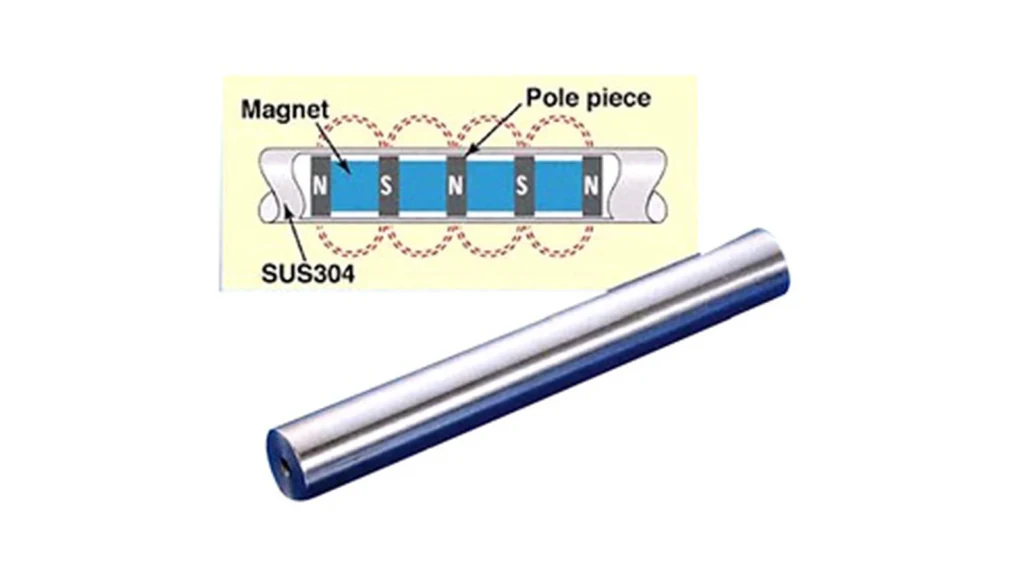
A filter rod normally contains axially stacked permanent magnets separated by low-carbon-steel pole pieces. The magnet poles alternate along the length. Each steel pole piece collects flux and concentrates it toward a narrow region under the nonmagnetic stainless tube. These repeated pole lines create both high local flux density and a steep spatial gradient.
The magnetic force on a small ferromagnetic particle depends strongly on the field gradient as well as field magnitude. This is why a carefully spaced 10,000-gauss rod can outperform a poorly configured rod with a higher isolated peak reading.
Practical Surface-Gauss Bands
| Nominal peak band | Typical circuit approach | Suitable review area |
|---|---|---|
| 6,000–8,000 G | Ferrite or conservative rare-earth stack | Large tramp iron and less demanding processes |
| 8,000–10,000 G | Standard NdFeB rod | General powders, granules and equipment protection |
| 10,000–12,000 G | High-energy NdFeB with controlled pole pieces | Fine ferrous contamination and higher sensitivity |
| 12,000–14,000 G | Optimized high-intensity geometry and thin tube wall | Small weakly magnetic wear particles under controlled conditions |
| Above 14,000 G | Application-specific local peak claim | Requires exact probe, location, temperature and production validation |
These are engineering reference bands, not a universal rating system. The guaranteed value should include a measurement map and tolerance rather than a single marketing number.
Why “Higher Gauss” Is Not Always the Better Specification
Increasing peak gauss may require a thinner stainless wall, narrower pole pieces or a shorter pole pitch. Those changes can reduce wear life, mechanical strength or useful capture distance. A narrow 14,000-gauss peak may decay rapidly away from the surface, while a slightly lower field distributed over a wider active zone can perform better in a real chute.
The correct target is the lowest circuit specification that reliably captures the defined contaminant at the actual flow rate and working gap. This can be confirmed with seeded-product trials, retained-particle checks or a controlled pull test using a reference ferrous object. Surface gauss remains a useful manufacturing control, but it should support—not replace—functional validation.
What Limits the Maximum Gauss?
| Parameter | Effect on surface reading | Design trade-off |
|---|---|---|
| Magnet remanence Br | Higher Br increases available flux | Must retain adequate coercivity at temperature |
| Magnet intrinsic coercivity Hcj | Protects against irreversible demagnetization | High-Hcj grades may have lower Br |
| Pole-piece cross-section | Concentrates and carries flux | Steel saturation limits further gain |
| Stainless tube wall | Creates distance from the active pole | Thinner wall raises field but reduces wear margin |
| Pole pitch | Changes peak spacing and gradient | Must match particle size and working gap |
| Tube diameter | Changes circuit space and surface curvature | Affects flow opening and mechanical strength |
| Operating temperature | Reduces NdFeB output as temperature rises | May require H, SH, UH or another material family |
The pole pieces can approach magnetic saturation, commonly in the broad range of roughly 1.6–2.0 T depending on steel grade and geometry. Once a local section saturates, adding a stronger magnet may increase leakage more than useful surface flux. Finite-element analysis is useful, but the assembled rod still requires measurement.
NdFeB Grade and Temperature Selection
A room-temperature N52 magnet has high remanence, but it is not automatically the best choice for a hot filter. The internal magnet temperature can follow a hot product stream even when the stainless surface is periodically cooled. Higher-coercivity grades may provide better irreversible-demagnetization margin.
| Operating concern | Preferred evaluation | Common mistake |
|---|---|---|
| High continuous temperature | Load-line and Hcj margin at the real internal temperature | Selecting only by room-temperature gauss |
| Thermal cleaning cycle | Peak duration, repetition and cooling rate | Using average process temperature |
| Corrosive liquid | Tube alloy, weld integrity and internal sealing | Relying on the magnet coating alone |
| Abrasive powder | Wear allowance and replaceable sleeve | Reducing wall thickness without service-life testing |
How Surface Gauss Should Be Measured
- Identify the gaussmeter model, probe type and calibration status.
- Define whether the probe measures the normal or tangential component.
- Keep probe orientation and contact pressure consistent.
- Scan along the active length and record each pole peak, not only the highest point.
- Record rod temperature, tube diameter and wall thickness.
- Report minimum, average and maximum peaks across the production lot.
The ends normally show a different pattern from the central active zone. A fair specification excludes non-active end plugs but defines the usable magnetic length. Probe active area also matters: a large sensor averages a narrow peak and can read lower than a smaller Hall element.
Gauss Versus Separation Performance
Capture depends on particle permeability, size, shape, velocity, viscosity, flow path and distance from the rod. Tube spacing must force material close enough to the active surface without creating unacceptable pressure drop or powder bridging. Cleaning frequency matters because a captured layer increases the working gap and can shield new contamination.
For this reason, an industrial magnetic filter application should be assessed using the actual product flow. Our guide to how magnetic filter grids work explains the relationship between tube layout and capture.
Guande Magnetic Rod Design Capability
Guande designs magnetic rods, round and rectangular grids, drawer systems and custom housings as complete magnetic assemblies. We review NdFeB grade, magnet and pole stack, tube alloy, welds, seals, temperature, cleanability and field-mapping method. High-energy circuits use controlled sintered NdFeB magnets with polarity and lot-level magnetic inspection.
Send the required tube size, usable length, target gauss, product temperature, flow medium and cleaning method. We will define a measurable specification rather than quote an unsupported peak number.