Most of the NdFeB value inside a humanoid robot is concentrated in motion systems. Shoulder, elbow, wrist, hip, knee and ankle joints need compact motors with high torque per unit mass. Dexterous hands use smaller permanent-magnet motors, while encoders, brakes, speakers, pumps and cooling fans may add smaller magnets elsewhere in the platform.
Engineering view: the actuator is the robot’s muscle. NdFeB is attractive because high air-gap flux supports compact torque density, but the magnet must survive winding heat, opposing fields, vibration, repeated acceleration and tight assembly tolerances.
1. Rotary Joint Actuators
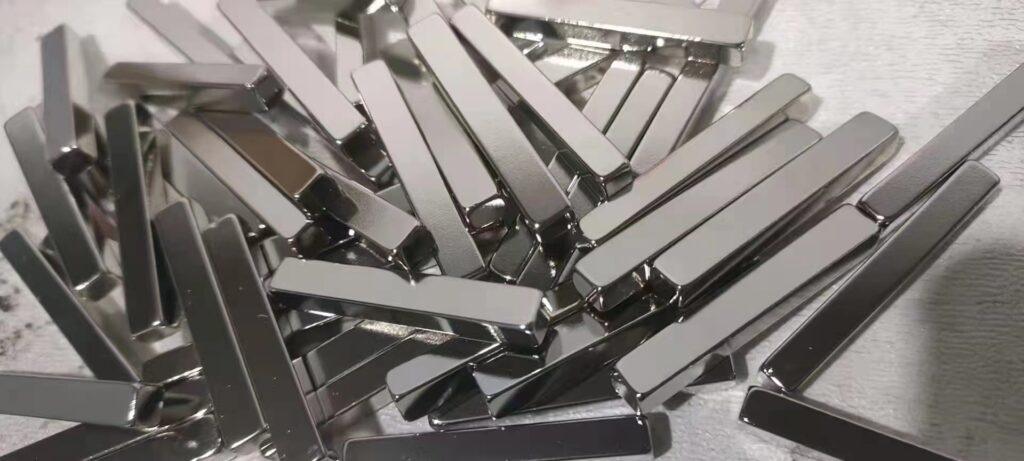
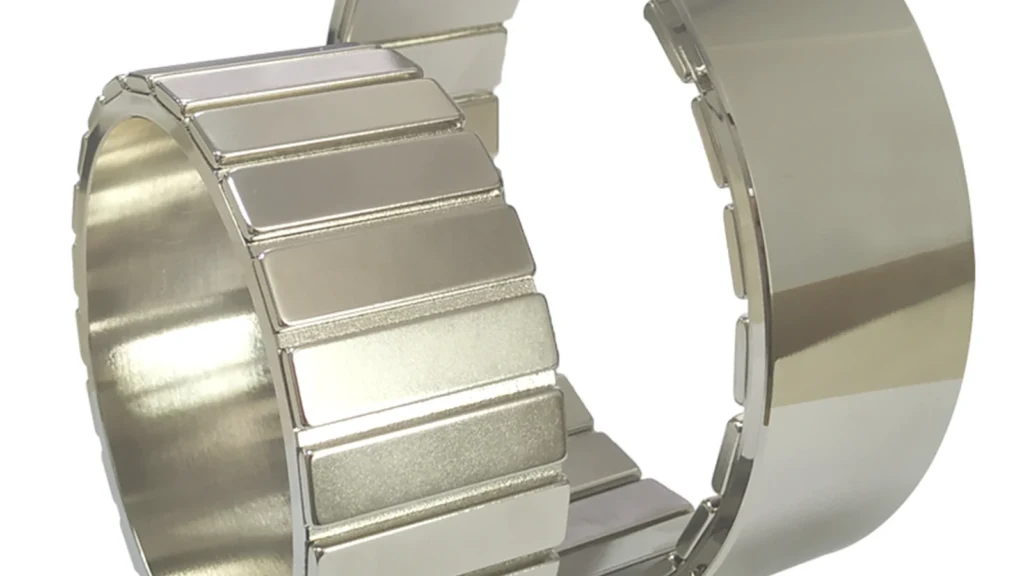
Large joint modules typically combine a permanent-magnet synchronous motor or BLDC motor, a reducer, bearings, encoder and controller. The motor may use an inner rotor, outer rotor or axial-flux layout. NdFeB arc segments, rectangular blocks or preassembled magnet rings create alternating poles around the rotor.
High-torque-density outer-rotor motors are attractive where the available joint diameter is larger than the axial length. Hip, knee and shoulder modules may prioritize peak torque and thermal capacity; wrists and ankles may prioritize low inertia and compact packaging. The right neodymium magnet for motor selection depends on the electromagnetic load and hot operating point, not just the highest (BH)max.
2. Linear Actuators
Some humanoid architectures use ball-screw, roller-screw or direct linear actuators. A rotary PM motor can drive the screw, or a linear motor can use alternating NdFeB blocks along a track. Linear systems convert motor force into joint motion through linkages, and the magnet geometry is designed around force density, stroke, cogging, heat and moving mass.
Halbach-style arrays may concentrate flux toward the coil and reduce leakage on the opposite side, but they require multiple magnetization directions and disciplined assembly. Our custom Halbach array capability supports these field-focused layouts.
3. Dexterous Hands and Fingers
Hands need many degrees of freedom in a small volume. Compact brushed or brushless motors may sit in the palm, forearm or individual fingers and transmit force through gears, tendons or miniature screws. NdFeB enables smaller rotor diameters and lower motor mass, but assembly becomes difficult because adjacent magnets and steel parts interact strongly.
Motor choice is not only about peak gripping force. Backdrivability, current heating, gear friction, fingertip speed, acoustic noise and service life all matter. Small ring magnets may also provide position feedback in magnetic encoders at finger or tendon joints.
Main NdFeB Locations in a Humanoid Robot
| Robot subsystem | Typical magnet function | Common magnet form | Key requirement |
|---|---|---|---|
| Hip, knee and ankle joints | Torque production in PM motors | Arc segments, blocks or magnet ring | High torque, hot coercivity and retention |
| Shoulder, elbow and wrist | Compact rotary actuation | Segmented inner/outer rotor | Low inertia, smooth torque and low cogging |
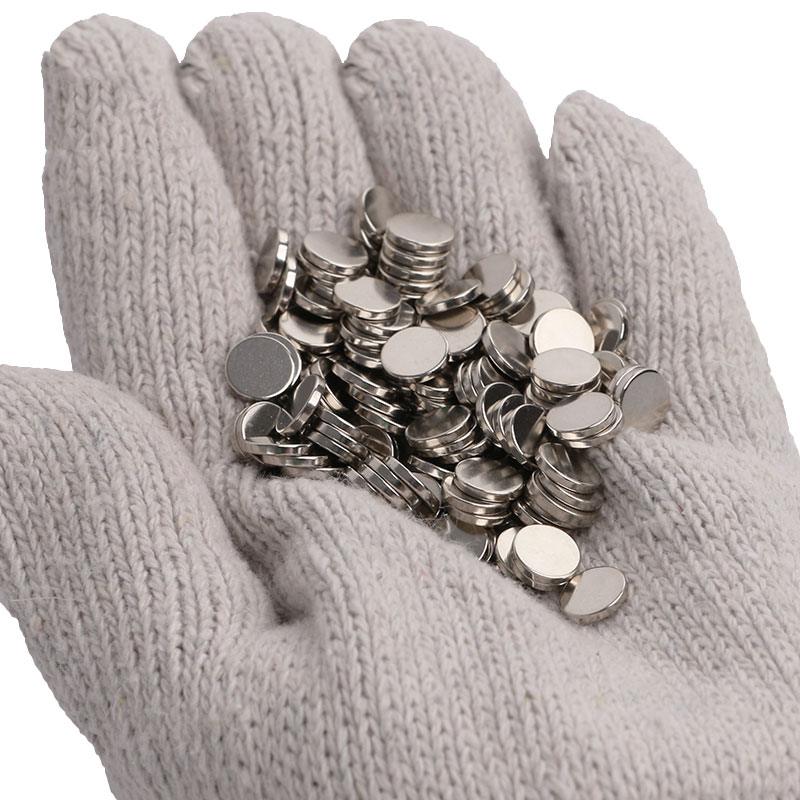
| Hands and fingers | Miniature motors and position feedback | Small rings, arcs, discs | Tight tolerance and controlled multipole magnetization |
| Linear actuator modules | Motor rotor or linear magnet track | Blocks or Halbach segments | Force density and pole-position accuracy |
| Absolute/relative encoders | Magnetic position reference | Diametric or multipole ring/disc | Low harmonic error and stable air gap |
| Brakes and latches | Holding, release or spring-return bias | Ring or disc magnet assembly | Predictable force and fail-state behavior |
| Speakers and haptics | Voice-coil or vibration actuator field | Ring, disc or custom circuit | Compact flux path and acoustic consistency |
| Fans and pumps | Auxiliary BLDC motor rotor | Bonded or sintered magnet ring | Efficiency, balance and corrosion resistance |
4. Magnetic Encoders and Joint Sensors
Magnetic encoders use a small permanent magnet and a Hall or magnetoresistive sensor to measure shaft angle. A diametrically magnetized two-pole disc is common for simple absolute angle sensing; multipole rings support incremental or higher-resolution arrangements. Magnet-to-sensor offset, tilt, air gap and field harmonics directly affect angle error.
Encoder magnets should be treated separately from the motor magnetic field. Leakage from the rotor, brake or nearby steel can bias the reading. System-level field mapping and shielding may be necessary, especially in compact wrists and hands.
5. Brakes, Latches and Auxiliary Devices
Permanent magnets can provide a holding bias in power-off brakes, magnetic latches, covers and tool-changing interfaces. Speakers, microphones with magnetic circuits, tactile actuators, small cooling fans and liquid pumps may also use NdFeB. These are smaller applications than the joint motors, but their temperature, stray-field and reliability requirements still need defined limits.
Magnet Grade and Temperature Selection
Motor windings are usually the dominant heat source. The rotor magnet can see elevated steady-state temperature plus short fault events. High-energy neodymium magnet grades maximize room-temperature torque, while H, SH, UH or EH grades provide increasing coercivity margin. The optimal choice depends on magnet geometry, rotor steel, air gap, peak current and cooling.
| Design condition | Magnet implication | Recommended validation |
|---|---|---|
| High peak joint torque | Strong opposing armature field | Hot load-line and irreversible-loss analysis |
| High electrical frequency | Eddy-current heating in conductive magnets | Segment or laminate magnets where loss analysis justifies it |
| High rotor speed | Centrifugal load on brittle magnets | Adhesive, sleeve, overspeed and balance validation |
| Humid service | NdFeB corrosion risk | Coating, seal, salt-spray or environmental testing |
| Low cogging requirement | Pole geometry and orientation sensitivity | Flux mapping, back-EMF and torque-ripple test |
| Compact encoder spacing | Motor leakage can disturb sensing | Full-module magnetic compatibility test |
Why Demand Cannot Be Estimated from Robot Count Alone
There is no reliable universal “kilograms of NdFeB per humanoid” figure. Designs vary in height, payload, number of powered joints, reducer ratio, motor topology, cooling and whether the hands are fully actuated. A lightweight service robot and an industrial humanoid can have very different magnet content. The more defensible approach is to estimate each motor from torque, speed, thermal limits and electromagnetic design, then add auxiliary devices.
Recent actuator research continues to emphasize high-torque-density permanent-magnet motors for interactive humanoid systems. This supports long-term demand for precision motor magnets, but qualification requirements will be strict: pole consistency, hot coercivity, coating, bonding, balance and traceability matter as much as raw magnetic strength.
Guande Support for Humanoid Actuator Magnets
Guande manufactures custom neodymium magnets for compact motors, including NdFeB arc magnets, blocks and segments. Our rotor magnet assemblies can include steel cores, pole-orientation fixtures, controlled bonding, sleeves, runout inspection, flux mapping and balance control.
For early-stage actuator development, our custom magnetic assembly workflow links simulation targets to repeatable manufacturing controls. Send the motor envelope, pole count, speed, torque, current, peak temperature, cooling and target back-EMF through our engineering inquiry form. We will respond with a practical grade, geometry and inspection proposal.