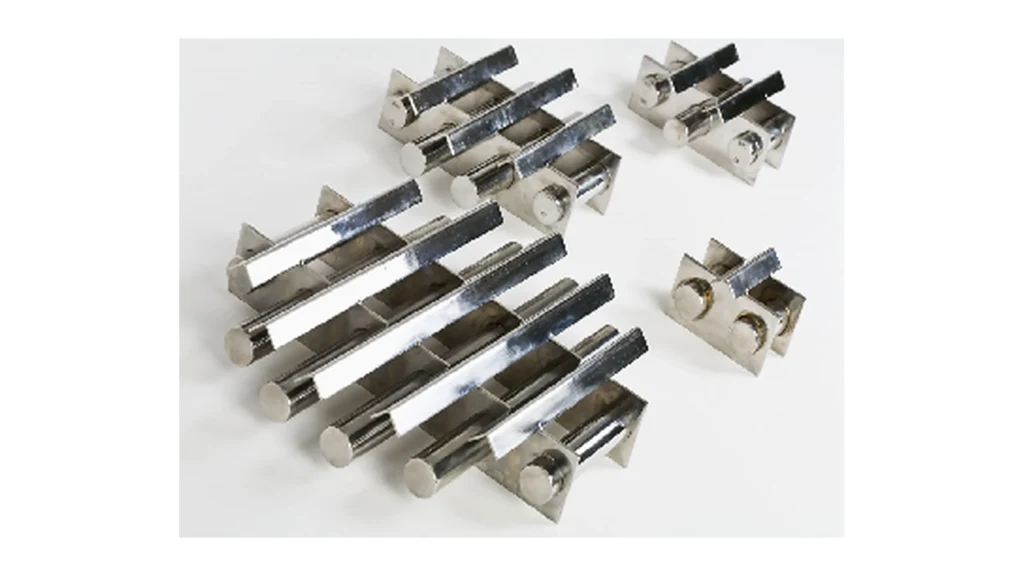
There is no single fixed magnetic filter grid service life. In a clean, moderate-temperature process, a well-built grate may remain usable for many years. In an abrasive powder line, tube wear or weld damage can end its service life much earlier—even while the internal magnets still retain acceptable strength.
Key point: the useful life of a magnetic grid is usually set by the stainless tube, welds, seals, cleaning damage and hygiene condition—not by the calendar age of the NdFeB magnets alone.
What Ages Inside a Magnetic Grid?
The internal NdFeB stack can retain useful magnetization for a long time if it stays below its thermal and demagnetization limits and remains dry. Normal reversible temperature loss returns after cooling. Irreversible loss occurs when temperature and opposing field move the magnet beyond a safe operating point.
The external tube experiences direct contact with product and cleaning tools. Abrasive granules can thin the working surface, while impacts can dent the tube toward the magnet stack. A cracked weld or failed end seal allows moisture or chemicals inside, where corrosion can damage the magnets rapidly.
Main Service-Life Drivers
| Factor | Typical effect | What to monitor |
|---|---|---|
| Abrasive product | Thins the stainless tube | Wear track and remaining wall thickness |
| Impact from tramp metal | Dents or cracks tubes and welds | Flat spots, leakage and deformation |
| High process temperature | Reduces flux and may cause irreversible loss | Peak internal temperature and gauss trend |
| Caustic or acidic cleaning | Attacks seals, welds or tube alloy | Compatibility, pitting and discoloration |
| Aggressive scraping | Scratches hygienic surfaces | Surface finish and cleanability |
| Overloaded product flow | Causes bridging and mechanical force | Grid deflection and support condition |
Planning Ranges Versus Actual Life
For budgeting, some users plan around five to ten years in benign dry service. This is not a guaranteed range. Highly abrasive minerals, ceramics, glass-filled resin or metal-bearing regrind can wear a tube in months or a few years. A sanitary food application may instead retire a grid because a weld or surface can no longer be cleaned reliably.
| Service condition | Likely limiting component | Inspection emphasis |
|---|---|---|
| Dry food powder | Hygienic surface and cleaning wear | Welds, finish, retained product and gauss map |
| Plastic pellets/regrind | Tube abrasion and impact | Wear tracks, dents and tube thickness |
| Hot process material | Magnet coercivity and seals | Temperature history and field trend |
| Corrosive liquid | Tube alloy, welds and sealing | Pitting, leaks and pressure integrity |
| Heavy tramp contamination | Mechanical damage and cleaning frequency | Dents, overload and capture layer |
How to Inspect a Magnetic Grid
- Clean and isolate the grid using the plant’s safe procedure.
- Inspect every tube, weld, end plug and mounting point under good lighting.
- Check dents, cracks, corrosion, sharp damage and abnormal wear.
- Measure critical wall thickness where abrasion is expected.
- Map surface gauss at defined pole positions using the same calibrated probe and temperature.
- Compare results with the original acceptance record and written rejection limits.
One isolated peak reading is not enough. The test should cover the usable magnetic length and look for a weak pole, temperature-related decline or internal displacement. Our guide to magnetic filter rod surface gauss explains how probe position affects results.
When Should the Grid Be Replaced?
| Reject condition | Reason |
|---|---|
| Tube wear below the approved minimum thickness | Risk of breach and product contamination |
| Cracked weld, leakage or failed end seal | Loss of hygiene or internal corrosion protection |
| Deep dent touching the internal stack | Possible magnet damage and reduced cleanability |
| Field below the validated acceptance limit | Reduced capture performance |
| Surface cannot be cleaned or verified | Process and hygiene risk |
| Frame or mounting deformation | Unsafe fit and altered product flow |
Extending Useful Service Life
Select the tube alloy, wall thickness and surface finish for the real product. A replaceable wear sleeve may protect a high-intensity core, although the added gap lowers surface field. Upstream screening can remove large impact hazards. Cleaning tools should remove captured metal without gouging the tube.
Guande designs magnetic rods, grids and housings as custom magnetic assemblies. We can define field-mapping points, tube and weld inspection, temperature grade and acceptance criteria. See also our guides to magnetic filter grid operation and grid applications by product flow.
Send the product, temperature, abrasiveness, cleaning chemistry, tube size and required field for a serviceable grid design and inspection proposal.