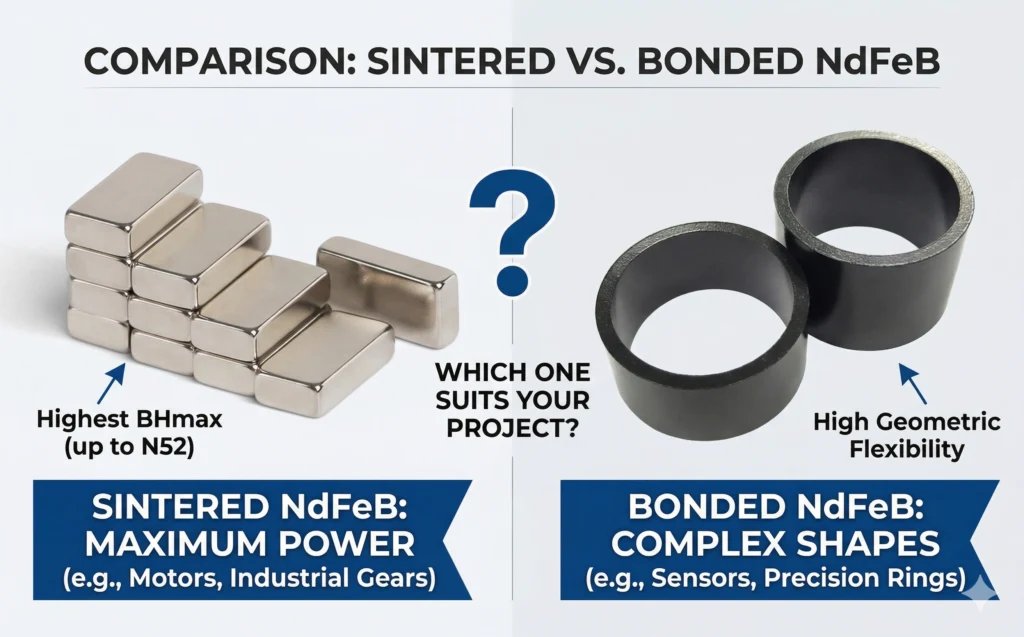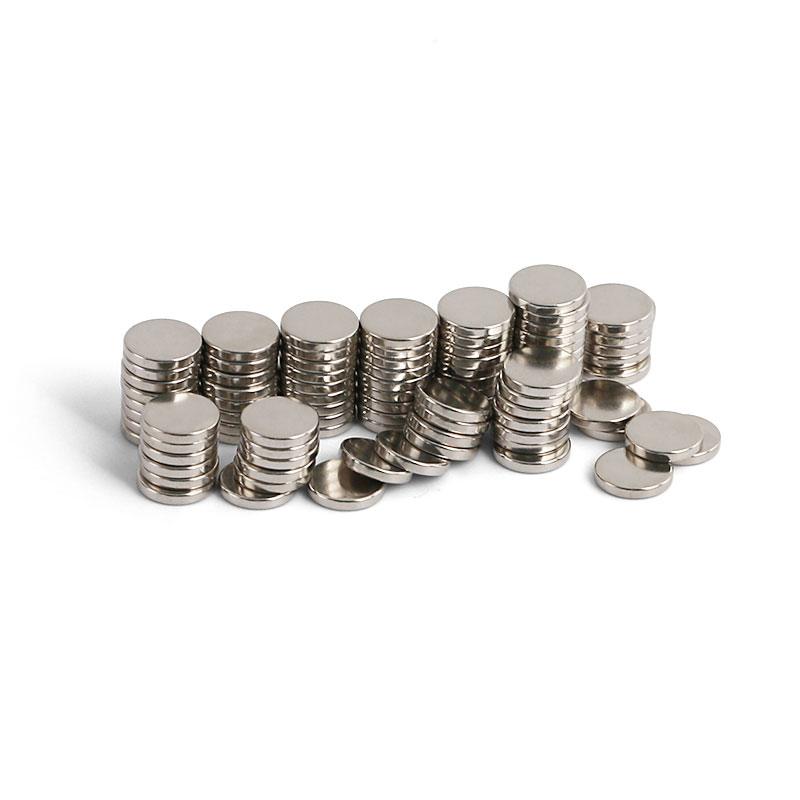
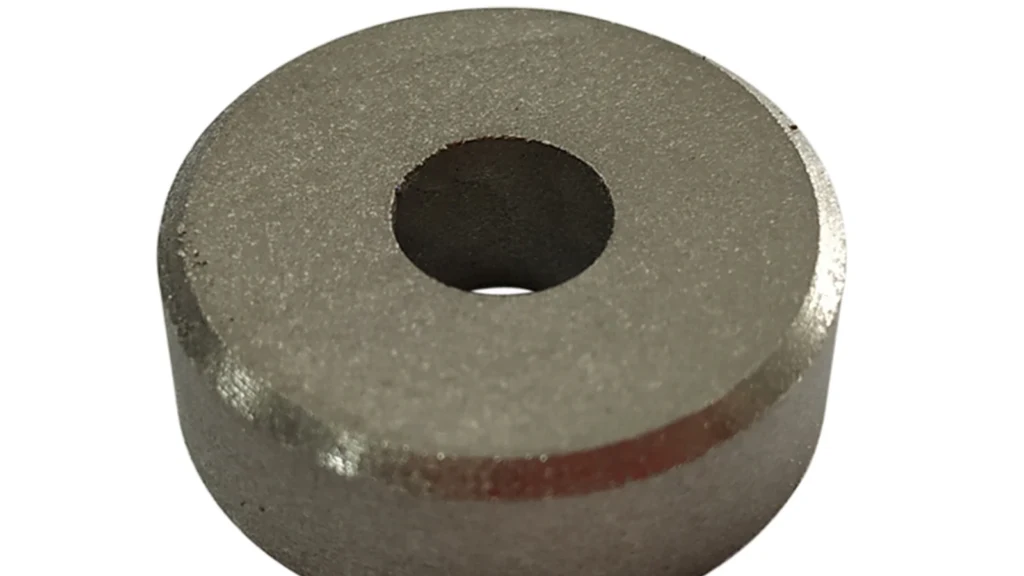
NdFeB, SmCo and AlNiCo are all permanent-magnet materials, but they solve different engineering problems. NdFeB provides the highest magnetic energy in the smallest volume. SmCo retains useful coercivity and flux at elevated temperature and usually needs less corrosion protection. AlNiCo offers excellent temperature stability and very high service-temperature capability, but its low coercivity makes circuit geometry and handling especially important.
Selection rule: choose the material from the operating point, peak temperature, opposing field, available volume, environment and total system cost—not from surface gauss or grade name alone.
Typical Magnetic and Physical Parameters
The following ranges are representative of common commercial sintered or cast grades. They are not guaranteed values for every shape. Thin magnets, unfavorable length-to-diameter ratios, machining allowance and the surrounding steel circuit can shift the usable operating point.
| Parameter | Sintered NdFeB | Sintered SmCo | Cast AlNiCo |
|---|---|---|---|
| Typical remanence, Br | 1.10–1.48 T | 0.85–1.18 T | 0.70–1.35 T |
| Typical (BH)max | 33–55 MGOe | 16–35 MGOe | 1.3–13 MGOe |
| Typical intrinsic coercivity, Hcj | 12–33+ kOe | 15–30+ kOe | Usually below 2 kOe |
| Reversible Br coefficient | About −0.09 to −0.12%/°C | About −0.03 to −0.045%/°C | About −0.02%/°C |
| Practical maximum use temperature | About 80–230°C, grade and circuit dependent | About 250–350°C; special grades can go higher | About 450–550°C with a suitable circuit |
| Corrosion behavior | Usually requires a coating | Generally better than NdFeB | Generally good |
| Density | About 7.4–7.6 g/cm³ | About 8.2–8.5 g/cm³ | About 7.0–7.4 g/cm³ |
Published values are useful for screening, but the hot demagnetization curve is the decisive document for a motor, actuator or sensor exposed to temperature and reverse field. The maximum neodymium magnet operating temperature is not a universal threshold: the same grade can behave differently in an open circuit and inside a well-designed steel return path.
NdFeB: Highest Force and Torque Density
NdFeB is normally selected when the product must be compact, light and magnetically strong. Common examples include servo motors, BLDC rotors, linear motors, magnetic couplings, speakers, compact sensors and holding assemblies. The broad range of neodymium magnet grades allows designers to trade energy product against intrinsic coercivity. A high-energy N52-type grade may not be the best motor material if the rotor experiences high temperature or a severe armature reaction field; an H, SH, UH or EH grade may provide more useful margin.
The main limitations are corrosion sensitivity, comparatively large negative temperature coefficient and brittleness. Nickel-copper-nickel, epoxy, zinc and other coatings protect the surface, but the coating cannot correct an unsuitable load line. Visit our sintered NdFeB magnet capabilities for grade, shape, coating and magnetization options.
SmCo: Stable Output in Hot and Corrosive Conditions
SmCo usually sacrifices some room-temperature energy density compared with high-grade NdFeB, but it offers stronger temperature stability and excellent high-temperature coercivity. It is widely considered for aerospace actuators, high-speed motors, downhole instruments, vacuum equipment, precision sensors and magnetic couplings operating above the comfortable range of NdFeB.
SmCo is also brittle and should not carry structural impact. Its raw-material and processing cost is normally higher, so it is most valuable where a smaller hot-performance drift, high-temperature survival or reduced coating dependence avoids a larger system penalty. SmCo 1:5 and 2:17 families have different property balances; selection should use the supplier’s complete B-H curves.
AlNiCo: Temperature Stability with Low Coercivity
AlNiCo can deliver high remanence and exceptionally stable flux over temperature. It remains relevant in measuring instruments, high-temperature sensors, guitar pickups, magnetos and specialized holding or laboratory systems. Its weakness is low coercivity: a short open-circuit AlNiCo magnet can be partially demagnetized by an opposing field or careless handling.
AlNiCo is therefore often made long in the magnetization direction and used with pole pieces or a closed magnetic circuit. It is commonly magnetized after final assembly so the operating point is established inside the intended circuit. A design that simply replaces an NdFeB block with an equal-size AlNiCo block is unlikely to work.
Application-Based Comparison
| Application condition | Usually preferred | Reason | Design caution |
|---|---|---|---|
| Compact motor below roughly 120°C | NdFeB | Highest torque density | Confirm hot Hcj and coating |
| Motor or coupling at 180–300°C | SmCo | Better coercivity and flux stability when hot | Manage brittleness and cost |
| Precision sensor with wide temperature swing | SmCo or AlNiCo | Lower reversible flux change | Check opposing field and geometry |
| Very high-temperature instrument | AlNiCo or special SmCo | High service-temperature capability | AlNiCo requires a favorable closed circuit |
| High-volume compact consumer device | NdFeB | Maximum output per unit volume | Corrosion, handling and temperature |
| Vacuum or aggressive environment | SmCo | Good stability and corrosion behavior | Verify outgassing and assembly materials |
How to Specify the Material Efficiently
Provide the magnet envelope, magnetization direction, working air gap, surrounding steel, continuous and peak temperature, opposing field, corrosion environment, required flux or torque, and acceptable irreversible loss. These inputs allow a realistic permanent magnet material comparison. If only room-temperature pull force is supplied, the design may miss the actual failure mode.
Guande supports custom neodymium magnets, material and load-line review, precision grinding, coating, magnetization and magnetic inspection. For motors and mechanisms that need steel, hubs, adhesives or retainers, our custom magnetic assembly service links material choice to the complete circuit. For motor geometries, see our custom arc magnets and rotor magnet assemblies.
For an initial review, send the drawing, temperature profile, target performance and available magnetic-circuit space through our engineering quote form. We will recommend a practical grade and validation method rather than defaulting to the strongest catalog material.